
Deep Learning in the Courtroom: A Survey of the Legal AI Frontier
A Review on the Application of Deep Learning in Legal Domain
This paper provides a comprehensive review of Deep Learning (DL) applications within the legal domain, covering research published between 2015 and 2019. It categorizes legal AI tasks into three functional pillars: Legal Data Search, Legal Text Analytics, and Legal Intelligent Interfaces, highlighting the shift from traditional ML to SOTA architectures like CNNs, LSTMs, and Bi-GRUs.
TL;DR
The legal industry is undergoing a digital transformation where "Artificial Intelligence" is moving beyond a buzzword into a functional tool. This review synthesizes how Deep Learning (DL) architectures—specifically CNNs for classification and LSTMs for analytics—are replacing antiquated manual workflows, achieving SOTA results in tasks ranging from Supreme Court case categorization to automated judgment prediction.
Background & Motivation: The "Legalese" Bottleneck
Law is a domain built on text, precedent, and precise language. For decades, legal professionals have been buried under an "information explosion" where physical archives turned into massive, unmanageable digital databases. Traditional search tools relied on exact keyword matching, which failed to capture the semantic intent behind legal concepts. The motivation for this research is to evaluate how DL can act as a force multiplier, reducing "fatigue duty" for lawyers while increasing the accuracy of predictive justice.
Methodology: The Three Pillars of Legal AI
The authors categorize the application of DL into three distinct functional areas:
1. Legal Data Search
The focus here is on Information Retrieval (IR) and Classification.
- Insight: Traditional systems miss synonyms. By using Word2Vec and Node2vec, researchers created "vector space representations" where terms like "landlord" and "lessor" exist in proximity, regardless of the exact string used.
- Architecture: CNNs are the gold standard for classification, outperforming Support Vector Machines (SVM) by effectively capturing local patterns in legal text.
2. Legal Text Analytics
This involves deeper NLP tasks such as summarization, translation, and extraction.
- The Power of RNNs: Since legal documents are sequential and hierarchical, LSTMs and Bi-LSTMs are the preferred choice. They allow the model to "remember" context from the beginning of a contract to its end, crucial for identifying deontic modalities (obligations vs. permissions).
3. Legal Intelligent Interfaces
The "front-end" of legal tech, involving Chatbots (Legalbots) and Prediction Systems.
- Judgment Prediction: One of the most provocative uses of DL is predicting whether a defendant is "guilty" or "not guilty" based on factual inputs using Bi-directional GRUs with Attention.
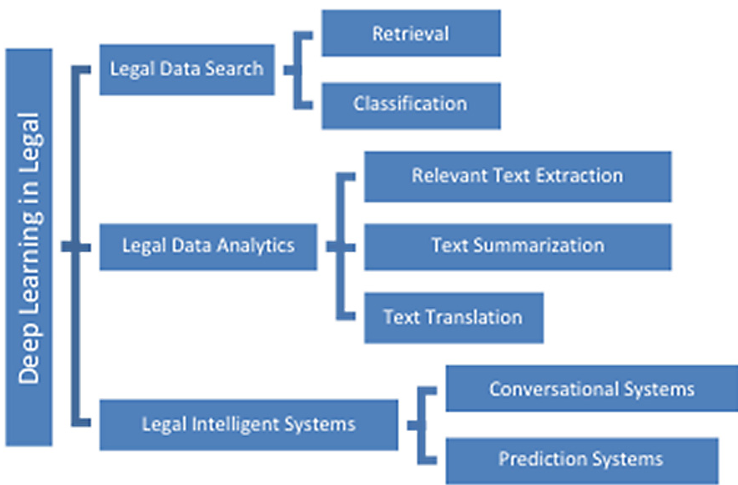 Figure 1: The hierarchical classification of legal tasks addressed by Deep Learning.
Key Experimental Results
The review highlights several "wins" for Deep Learning:
- Supreme Court Classification: A CNN model utilizing Word2Vec achieved 72.4% accuracy, a significant jump over traditional non-neural baselines.
- Multi-Task Efficiency: In German legal context (Elnaggar et al.), a single multi-task model handled summarization and translation better than specialized single-task models, proving that "transfer learning" is viable in data-scarce legal sectors.
- Judgment Prediction: In Thai courts, the Bi-GRU model with Attention outperformed Naïve Bayes and SVM, proving that word order and "attention" to specific legal provisions are critical for judicial accuracy.
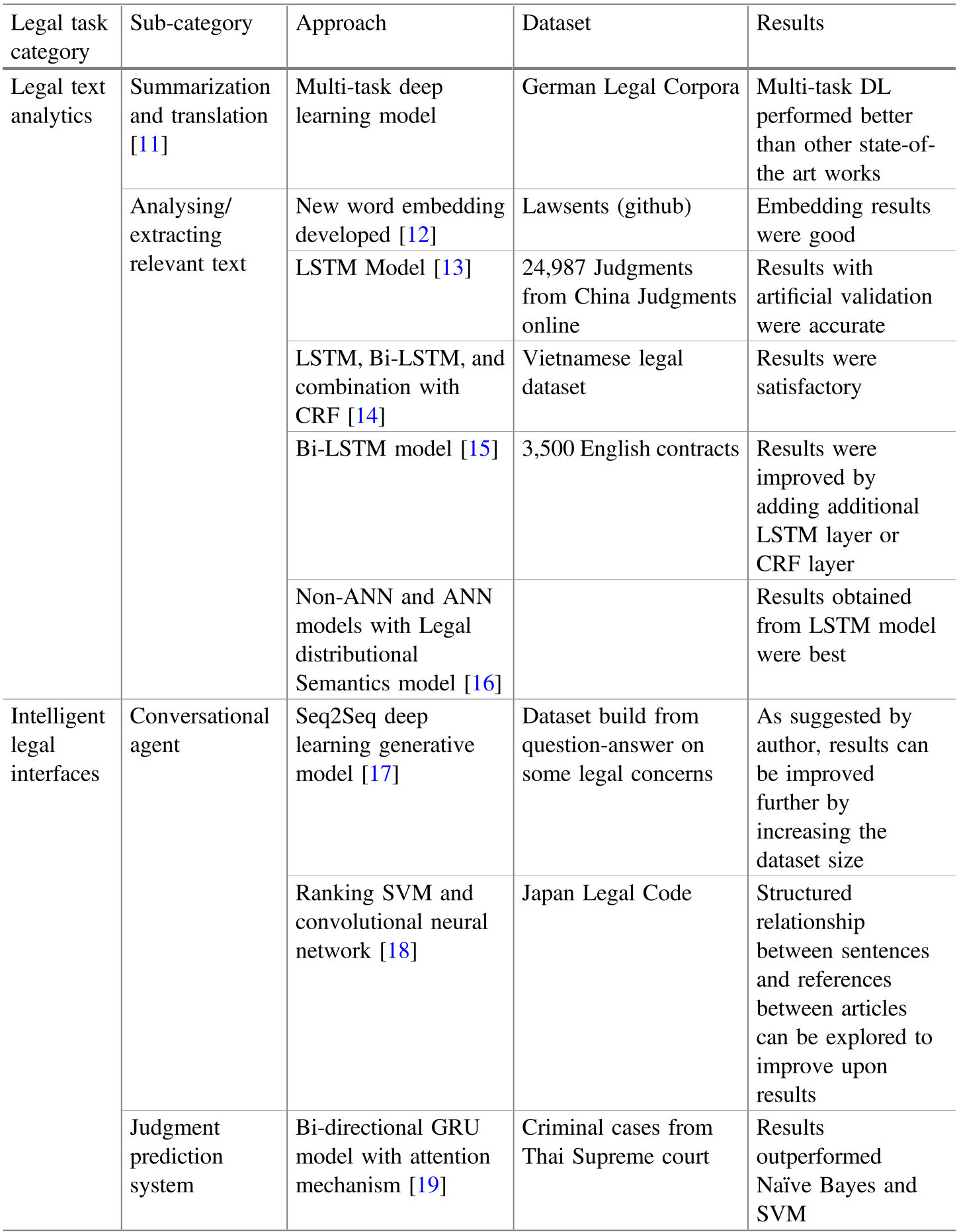 Table 1: Comparison of DL architectures across various global legal jurisdictions.
Critical Insight & Future Outlook
While the results are promising, a major hurdle identified is the uniqueness of datasets. Unlike the CV or general NLP fields (like ImageNet or GLUE), legal data is often siloed by jurisdiction and language (e.g., German, Chinese, Thai). This makes "Universal Legal AI" difficult to achieve.
The Takeaway: We are moving toward a hybrid era where AI handles the "laborious search" and "initial contract review," allowing human lawyers to focus on strategy and high-level negotiation. The future will likely see a shift toward context-based summarization and temporal prediction (predicting how long a case will take to resolve).
Conclusion
This study confirms that Deep Learning is no longer experimental in the legal field—it is successful. As architectures evolve from RNNs to Transformers (the logical next step after this review period), the gap between human and machine comprehension of "The Law" continues to close.