
Keep It Simple: Why Deep Learning Might Be Overkill for Code Smell Detection
Keep it simple: Is deep learning good for linguistic smell detection?
This paper investigates the efficacy of Deep Learning (specifically CNNs) versus traditional Machine Learning (RF, SVM, J48) for Linguistic Smell/Antipattern detection in source code. Using a manually validated oracle of 1,753 instances, the study achieves SOTA results using a Bayesian-optimized SMO classifier, which significantly outperforms CNNs.
TL;DR
In the era of "Deep Learning for everything," this study serves as a crucial reality check. The authors evaluate whether Convolutional Neural Networks (CNNs) are actually better than traditional Machine Learning (ML) for detecting Linguistic Antipatterns (LAs)—consistency issues between code names and their implementation. The result? A properly tuned traditional model (SMO) didn't just match the CNN; it crushed it in precision, speed, and resource efficiency.
Context: The Allure of Complexity
In software engineering (SE), deep learning has shown massive success in complex tasks like semantic clone detection. However, these models come at a cost: they are "black boxes," hungry for data, and computationally expensive. The authors invoke Occam’s Razor: if two models perform similarly, we should prefer the simpler one.
The core question: Is linguistic smell detection a "complex" task requiring deep layers, or a "simple" one where feature engineering and tuning win the day?
The Contenders: CNN vs. The Old Guard
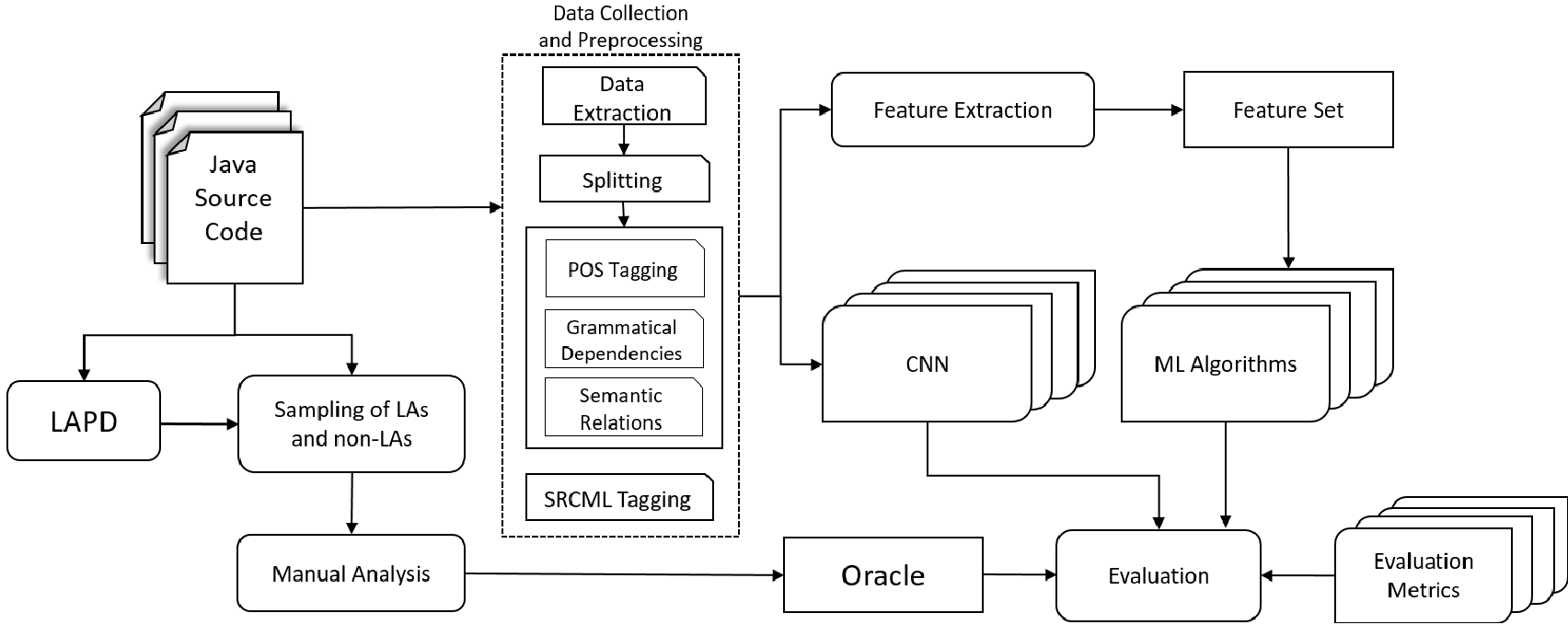
The researchers built a high-quality Oracle of 1,753 instances across 13 open-source projects (like Apache Lucene and Spark).
1. The CNN Approach
They used a 1D-CNN architecture typically used for sentence classification.
- Input: Source code tokens converted into word embeddings (Word2Vec).
- Mechanism: Multiple filter sizes (2 to 5) to capture local linguistic patterns.
- Cost: Required high-performance GPU clusters and weeks of tuning.
2. The Traditional ML Approach
They tested Random Forest, J48, SVM, and Naive Bayes.
- Input: Rich linguistic features (Part-of-Speech tags, Grammatical Dependencies, Semantic Relations from WordNet).
- Optimization: Used Auto-Weka (Bayesian Optimization) to automatically find the best hyperparameters.
Results: A "TKO" for Traditional ML
The experiment results were polarized. While the CNN performed "adequately," it couldn't keep up with the optimized traditional models.
- Accuracy & Precision: The tuned SMO (Sequential Minimal Optimization) reached a Precision of 91.78%, while the best CNN hovered around 75.58%.
- Efficiency: Traditional models trained in seconds on a standard laptop. The CNN required 90GB of RAM and specialized GPUs.
- Interpretability: Traditional models like J48 provide clear rules (e.g., "If method starts with 'is' but returns a 'String', it's a smell"), whereas the CNN's decision-making remains opaque.
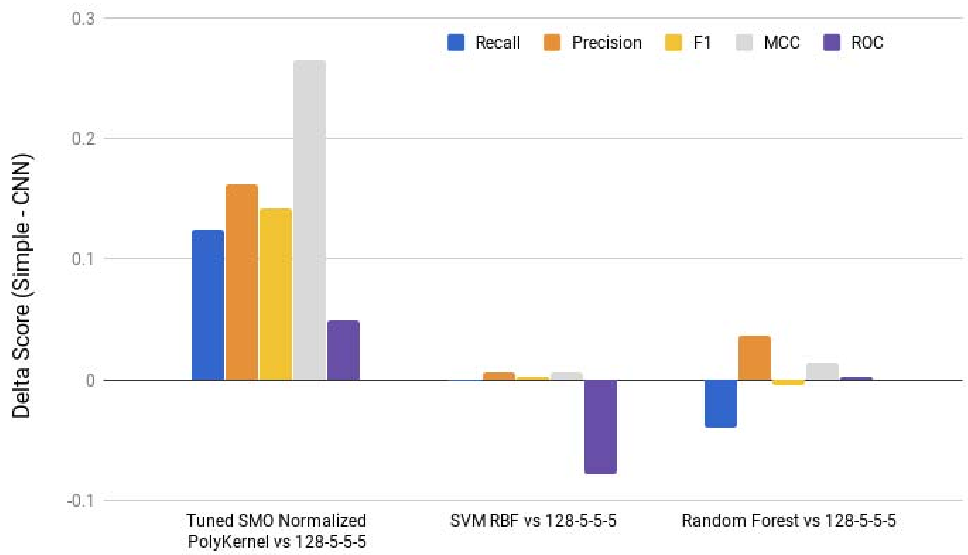 Negative bars would favor CNN; positive bars show the massive lead of traditional ML.
Why Did Deep Learning "Fail"?
The authors suggest several reasons for this performance gap:
- Data Scarcity: 1,700 instances is a "large" manual oracle but a "tiny" dataset for a deep neural network to learn complex abstractions.
- Domain Specificity: Linguistic smells are often defined by specific grammatical rules. Traditional features (like POS tags) capture these rules directly, whereas a CNN has to "guess" them from raw vectors.
- Tuning Matters: Most failures attributed to traditional ML in other papers are actually failures of tuning. When using Bayesian optimization, the "old" algorithms reveal their true SOTA potential.
Critical Analysis & Conclusion
Takeaway
This paper is a call to arms for Experimental Rigor. It proves that for many classification tasks in Software Engineering, the complexity of Deep Learning doesn't translate to better results—only to higher carbon footprints.
Limitations
The study used a relatively small dataset compared to massive NLP corpuses. It's possible that with 100,000 labeled instances, the CNN might eventually surpass the SMO. However, in the real world, manual validation is expensive, making the "small-data effectiveness" of traditional ML its greatest strength.
Future Outlook
For practitioners, the message is clear: Tune your SVMs and Random Forests before buying a GPU. For researchers, the focus should shift toward better feature engineering and automated hyperparameter optimization rather than just stacking more layers.