
SPEAK: High-Performance Link Prediction via Social Patterns and Deep Learning
Deep Learning Based Link Prediction with Social Pattern and External Attribute Knowledge in Bibliographic Networks
This paper introduces SPEAK (Social Pattern and External Attribute Knowledge), a novel feature-based framework for link prediction in bibliographic networks. By integrating microsociology-inspired social patterns and semantic similarities (affiliation and topic) into a Deep Neural Network (DNN), the method achieves SOTA performance on the AMiner dataset, particularly for long-distance nodes.
Executive Summary
Link prediction—the task of forecasting future collaborations between entities—is a cornerstone of network science. While classic methods rely heavily on the "geometry" of the graph (topology), they often fail when candidates are several hops apart. This paper introduces SPEAK (Social Pattern and External Attribute Knowledge), a framework that leverages microsociology and semantic similarity. By feeding these insights into a Deep Neural Network (DNN), the authors drastically improve prediction accuracy for distant author pairs in the AMiner bibliographic network.
Motivation: The "Distance Decay" Problem
Most existing link prediction algorithms suffer from a fundamental limitation: structural sparsity. If two authors do not share immediate common neighbors, topological metrics like the Jaccard Coefficient or Adamic/Adar become zero or near-zero, losing their predictive power. Furthermore, traditional shallow models (e.g., Random Forests) struggle to model the latent, non-linear relationships between an author's research interests and their social standing. The authors hypothesize that by looking at who the intermediaries are (Social Patterns) and what the authors do (External Attributes), we can bridge this gap.
Methodology: The SPEAK Framework
The core innovation lies in the feature engineering of SPEAK, which moves beyond simple graph counting.
1. Social Patterns: The Power of the "Ordinary"
The authors categorize authors into "Elite" (top 50% PageRank) and "Ordinary." By analyzing triadic relationships (X-Z-Y), they discovered a counter-intuitive insight: in academic networks, Ordinary users are more effective bridges than Elite users. Links are more likely to form if the "middleman" (Z) is an ordinary author rather than a superstar.
2. External Attributes: Moving Beyond Binary Similarity
Instead of checking if two authors belong to the exact same department (Binary Similarity), the authors use Cosine Similarity on affiliation strings. This allows the model to recognize that "IBM Watson" and "IBM Austin" are semantically related, even if they aren't identical strings. Similar logic is applied to research topics.
3. The DNN Architecture
The extracted features are processed by a multi-layer Feed-Forward Neural Network. The DNN excels at finding "hidden" correlations between the SPEAK features and topological data.
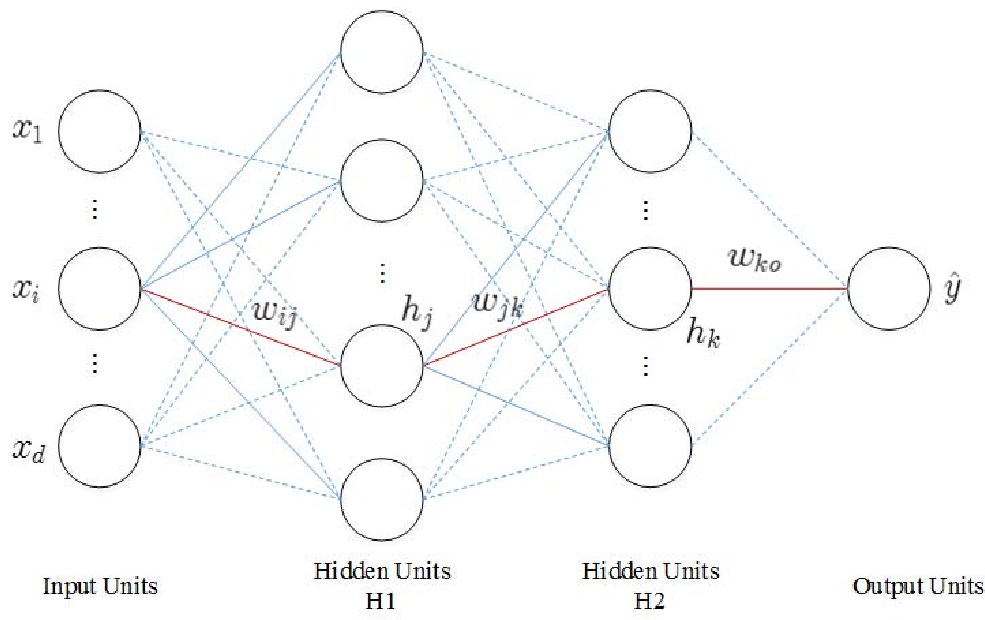 Figure 1: The DNN framework used to fuse topological and SPEAK features.
Experimental Validation
Using the AMiner dataset (2.1M papers), the researchers compared their DNN+SPEAK model against heavyweights like Node2vec and HPLP.
Key Results:
- Consistent Superiority: The proposed DNN consistently achieved the highest AUC.
- The Long-Distance Champion: At a geodesic distance of 4 (where topology is most sparse), the model maintained an AUC of 0.865, while structural-heavy methods saw a sharp decline.
- Model Sensitivity: The study found that model depth must be balanced; an overly complex DNN (too many layers/units) leads to overfitting, particularly in sparse social data.
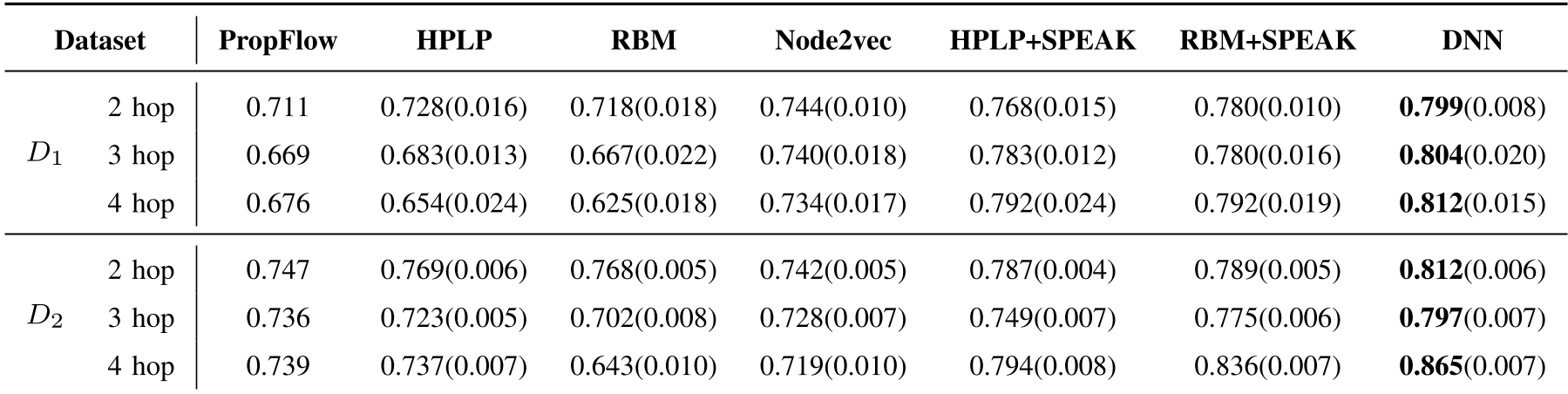 Table 1: AUC performance comparison across different geodesic distances (n=2, 3, 4).
Critical Insight & Conclusion
The success of SPEAK highlights a shift in network analysis: Context matters as much as Connection. While a graph shows us the "bones" of a network, external attributes provide the "flesh."
The discovery that ordinary users are vital for network evolution challenges the "rich-get-richer" (Preferential Attachment) obsession in social theory, suggesting that for academic collaboration, the "middle class" of researchers provides the most significant connective tissue. For future research, integrating these features into Graph Convolutional Networks (GCNs) could further automate feature extraction and improve scalability.