
LSTM-Powered Sentiment Analysis: Decoding the "Word of Mouth" for Smart Bracelets
A Study of Deep Learning to Sentiment Analysis on Word of Mouth of Smart Bracelet
This paper presents a sentiment analysis framework for Chinese online reviews of smart bracelets using Long Short-Term Memory (LSTM) Recurrent Neural Networks. By integrating custom domain-specific dictionaries (iTSBSD) with deep learning, the study achieves a state-of-the-art accuracy of 89.92% on Taobao consumer data.
TL;DR
Researchers from Tamkang University have developed a specialized sentiment analysis system that beats traditional machine learning by nearly 20% in accuracy. By leveraging LSTM (Long Short-Term Memory) networks and a custom-built Chinese sentiment dictionary (iTSBSD), the team successfully categorized consumer reviews from Taobao for smart bracelets with an impressive 89.92% accuracy.
Background: The Power of Reputation
In the hyper-competitive wearable market, positive electronic Word of Mouth (eWOM) is the ultimate sales driver. For brands like Xiaomi, Garmin, and Huawei, understanding why a user praises a "Mi Band 2" or complains about a "Huawei B3" is critical. However, manual sentiment tracking is slow, and standard algorithms often trip over the complexities of Chinese e-commerce slang.
The Problem with Traditional ML
Most prior works utilized Naïve Bayes or SVM (Support Vector Machines). While robust, these methods suffer from two major flaws:
- Feature Engineering: They require manual selection of "opinion words," which is tedious and often misses context.
- Short-Term Memory: Traditional RNNs and shallow models struggle with "gradient vanishing"—they simply "forget" the beginning of a long review by the time they reach the end.
Methodology: The iTSBSD + LSTM Approach
The authors' innovation lies in a hybrid pipeline that combines linguistic expertise with deep learning power.
1. The iTSBSD Dictionary
The researchers constructed the iTSBSD (intelligent Taobao Smart Bracelet Sentiment Dictionary). They identified 107 positive words (e.g., "物美" - good quality) and 24 negative words (e.g., "掉色" - color fading) specific to the hardware domain.
2. LSTM Architecture
To solve the memory problem, the study uses an LSTM network. Unlike standard RNNs, LSTM uses "gates" (Input, Forget, and Output) to decide what information to keep or discard over long sequences.
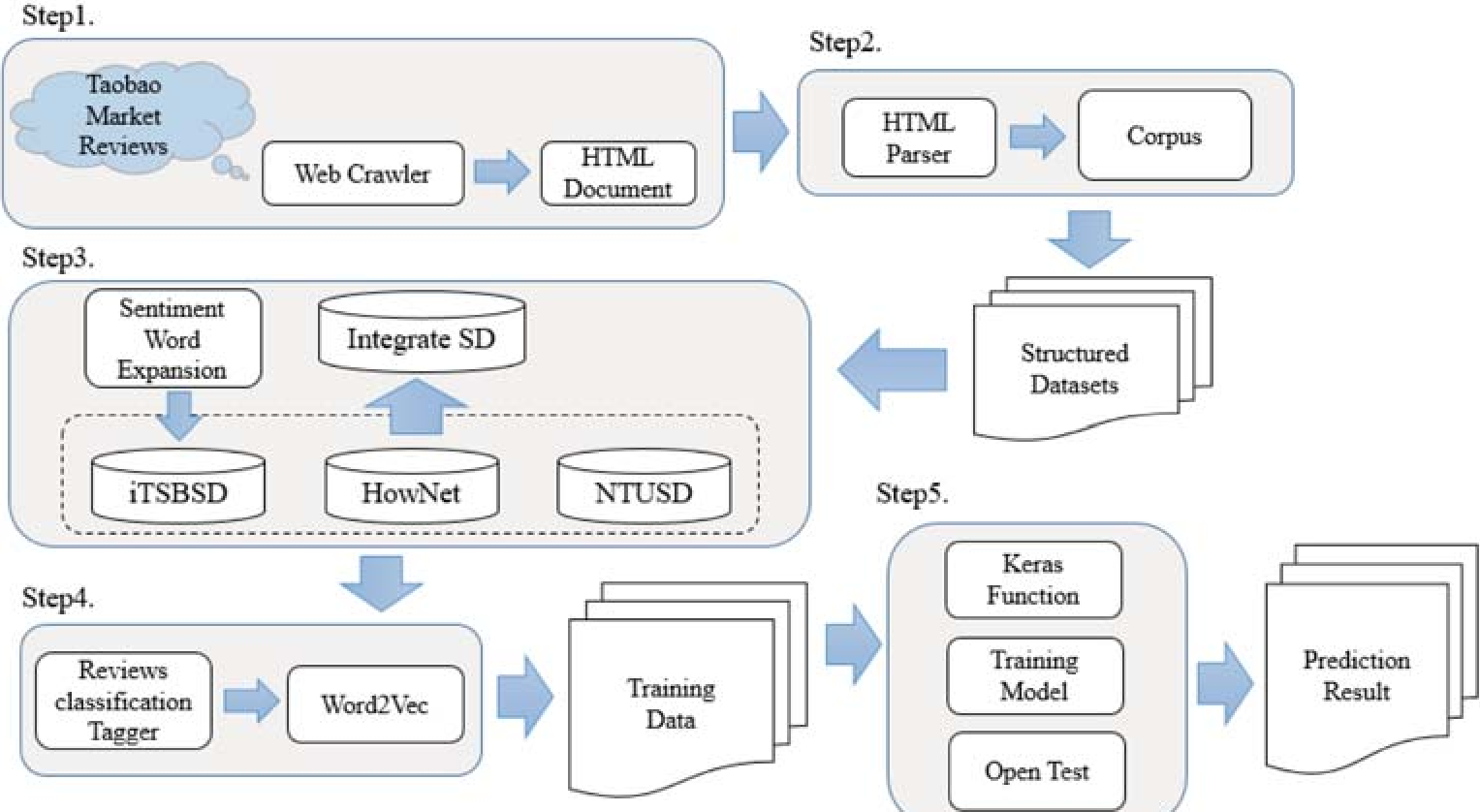 Figure 1: The proposed system architecture for processing Taobao reviews through Deep Learning.
3. Word Embedding
Using Word2vec, words were converted into 100-dimensional vectors, ensuring that semantically similar words (like "Praise" and "Appreciation") were mapped closely together in the feature space.
Experimental Results: A Clear Winner
The experiment utilized 36,004 reviews from Taobao, downsampled to a balanced set of 1,930 high-quality reviews. The results were categorical:
| Model | Accuracy |
|---|---|
| LSTM (Sigmoid) | 89.92% |
| Naïve Bayes | 70.67% |
| SVM (Support Vector Machine) | 66.01% |
The LSTM didn't just win; it dominated the competition with a ~20% lead over the best lexicon-based Naïve Bayes approach.
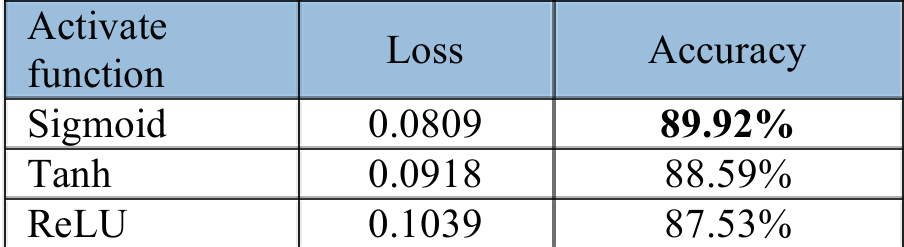 Figure 2: Performance of LSTM across different activation functions.
Critical Insights & Future Outlook
Why did it work? The success of the LSTM model stems from its ability to handle semantic sequence. In a review like "The battery is good, but the strap is quite hard to wear," a simple dictionary might see one positive and one negative word and get confused. The LSTM understands the structure and the "but" contrast, leading to a more nuanced classification.
Limitations & Next Steps:
- Emoticons: Taobao users love emojis. Future models could treat emoticons as sentiment tokens to increase depth.
- Model Evolution: While LSTM was state-of-the-art in 2017, today's Transformers (like BERT) would likely push this accuracy even higher by using self-attention.
Conclusion
This study proves that deep learning is no longer just for image recognition—it is a vital tool for market intelligence. By replacing manual labeling with automated LSTM processing, enterprises can monitor brand health in real-time with human-like precision.