
Deciphering Sleep: Deep Belief Networks Meet Crowdsourcing for Spindle Detection
Sleep spindle detection using deep learning: A validation study based on crowdsourcing
This paper introduces a sleep spindle detection system leveraging Deep Belief Networks (DBN) and a crowdsourcing-based labeling approach. By utilizing Power Spectrum Density (PSD) as input, the DBN achieves a superior F1-score of 92.78%, outperforming traditional classifiers like SVM and KNN in identifying these transient EEG oscillations.
TL;DR
Detecting sleep spindles—those brief, mysterious bursts of brain activity during NREM sleep—is crucial for diagnosing neurological disorders. This paper moves beyond traditional, rigid thresholds by combining Deep Belief Networks (DBN) with a crowdsourced dataset from 100 non-experts. The result? A detection system that rivals human experts with an F1-score of 92.78%.
The Motivation: The "Gold Standard" Dilemma
For decades, the "Gold Standard" for sleep spindle detection has been visual scoring by experts. However, this method faces two major hurdles:
- Subjectivity: Even top-tier experts often disagree on what constitutes a "true" spindle.
- Scalability: Manual scoring is agonizingly slow and labor-intensive.
Existing automation typically uses simple frequency thresholds. But spindles aren't just frequency spikes; they have a specific "waxing and waning" morphology that simple math often misses. The authors hypothesized that Deep Learning could capture these nuances if provided with enough (even if noisy) data.
Methodology: Crowds and Depth
The researchers used a two-pronged strategy:
1. Crowdsourcing as a Labeling Engine
Instead of relying on a few experts, they recruited 100 non-experts. Each participant was trained to identify spindles and then scored segments of EEG data. By applying a Majority Rule (Threshold for Non-Expert Group Consensus - ), they created three distinct datasets:
- Dataset 1: Spindle vs. Obvious Non-spindle.
- Dataset 2: Spindle vs. "Alike-spindle" (the tricky ones that look like spindles but aren't).
- Dataset 3: A balanced mixture.
2. Deep Belief Networks (DBN)
The core architecture is a DBN—a stack of Restricted Boltzmann Machines (RBMs). They compared two versions:
- P-PSD: Input consisting of 4 pre-extracted features from the Power Spectrum Density.
- Raw PSD: Feeding the entire 5-20Hz spectrum directly into the DBN.
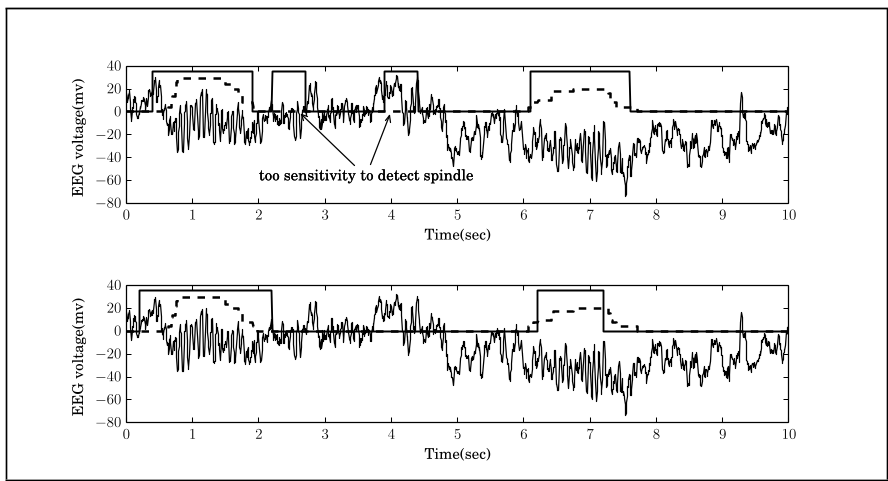 Fig 1. DBN application to raw EEG activity. The upper panel shows a DBN trained on Dataset 1, while the lower panel shows the more selective DBN trained on Dataset 2.
Experiments and Results
The findings confirmed that "deeper is better." The DBN outperformed Support Vector Machines (SVM), K-Nearest Neighbors (KNN), and Decision Trees (DT) across the board.
| Model | Feature | Best F1-Score |
|---|---|---|
| DT / KNN | P-PSD | ~83% |
| DBN | P-PSD | 85.7% |
| DBN | Raw PSD | 92.78% |
Key Insight: The DBN trained on Raw PSD performed significantly better (>10% improvement) than the one trained on manually extracted features. This proves that manual feature extraction actually loses information that the deep learning model can otherwise exploit.
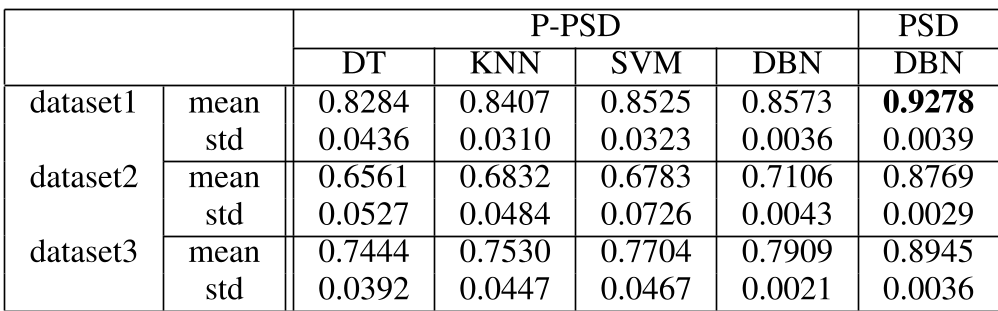 Table: Comparison of F1-scores across different classifiers and datasets.
Critical Analysis & Conclusion
The most impressive feat was the DBN's ability to handle "Dataset 2"—the "alike-spindles." Most automated systems fail here, confusing alpha waves with spindles. By seeing thousands of these "confusing" examples via crowdsourcing, the DBN learned to reject them, achieving a performance level comparable to an expert consensus.
Limitations & Future Work
- Threshold Selection: While the model is powerful, the choice of the consensus threshold () significantly impacts training.
- Sample Size: The study used 30 young subjects. To be clinically viable, the DBN needs to be tested on older populations and patients with sleep disorders where spindle morphology changes.
The Takeaway: This work validates that we don't necessarily need "perfect" expert data to build "perfect" AI; a large enough crowd and a deep enough network can bridge the gap.