
Rethinking Architecture: Why Smaller Models Win the "Small Data" Race
A close look at deep learning with small data
This paper investigates the performance of Deep Learning architectures in the "small data" regime, where training samples are extremely limited. It proposes that low-complexity Convolutional Neural Networks (CNNs) can outperform high-complexity models like ResNet-20 and specialized architectures like CNTK when operating with only a few samples per class.
TL;DR
In the world of Deep Learning, the "bigger is better" mantra is a dogma sustained by the abundance of data. This paper, "A Close Look at Deep Learning with Small Data", challenges this by demonstrating that in low-sample regimes (e.g., 10-80 samples per class), low-complexity CNNs significantly outperform high-capacity models like ResNet-20. By optimizing model width and leveraging standard regularization, the authors achieve SOTA results on small-data benchmarks without the need for massive pre-training.
The "Small Data" Dilemma
While we celebrate models trained on millions of images, real-world applications—such as specialized medical diagnosis or interactive robotics—often start with a "cold start" problem.
The authors identify a critical gap: high-capacity models possess a high inductive bias for large datasets but suffer from catastrophic overfitting when the number of trainable parameters vastly exceeds the number of data points. They argue that we need to understand the "starting period" of an application—before a large dataset is accumulated—to choose the most effective model architecture.
Methodology: Complexity vs. Generalization
The researchers compared four main architectures across sub-sampled versions of CIFAR-10, Fashion-MNIST (FMNIST), and SVHN:
- CNN-lc (Low Complexity): 8 base filters.
- CNN-mc (Medium Complexity): 16 base filters.
- CNN-hc (High Complexity): 32 base filters (~400k parameters).
- ResNet-20: The most complex baseline in terms of FLOPs (~1.6M FLOPs).
Architecture & Complexity Comparison
The authors meticulously balanced the parameters and FLOPs as shown in the table below:

Key Insights from Experimental Results
1. Small Nets > Big Nets (Initially)
One of the most striking findings is that standard CNNs consistently outperform ResNet-20 when the samples per class () are low. For sCIFAR-10, the gap is roughly 10% in favor of simpler CNNs until reaches 320.
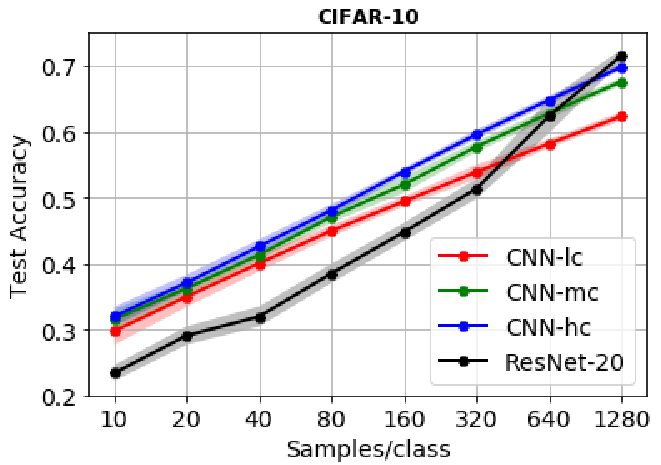 Fig 1: Simpler CNNs with dropout (0.7) maintain a lead over ResNet-20 in low-data regimes.
2. The Power of Data Augmentation
The study highlights that standard data augmentation (padding, cropping, flipping) is a massive equalizer. For ResNet-20, augmentation provides a performance boost of up to 20% on SVHN. Interestingly, data augmentation allows larger models to "catch up" to smaller models much earlier (e.g., at instead of ).
3. Dropout is Still King
Contrary to some beliefs that dropout might hinder learning when data is scarce, the authors found that a high dropping rate (0.7) improved generalization by up to 5-10%, especially for the CNN-mc and CNN-hc variants on noisy datasets like SVHN.
Comparison with State-of-the-Art
The paper compares its findings with the Convolutional Neural Tangent Kernel (CNTK), which was previously considered the gold standard for small-data tasks. The results show that the CNN-hc (with standard Cross-Entropy loss) outperforms CNTK by 3-5% across various CIFAR-10 sub-samples.
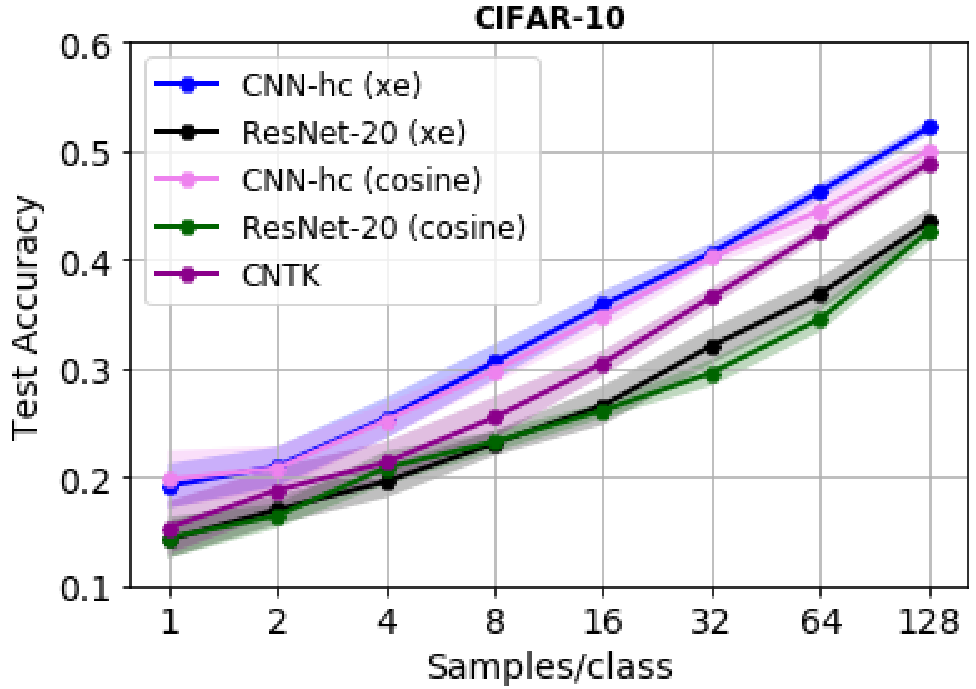 Fig 4: CNN-hc consistently beats the CNTK baseline without needing specialized kernel methods.
Critical Analysis & Takeaways
- The Sweet Spot: The "High Complexity CNN" (CNN-hc) represents a "Goldilocks" zone—it has enough capacity to handle the feature depth of images but not so much that it loses itself in the training noise.
- Loss Functions: Interestingly, the authors found that the Cosine Loss (often touted for small data) didn't consistently beat standard Cross-Entropy in these specific settings, suggesting that loss function choice is highly sensitive to model architecture.
- Future Impact: This work serves as a reminder that "State of the Art" is context-dependent. For startups and researchers working in niche, data-poor domains, the move should be toward architectural efficiency and aggressive regularization rather than scaling up.
Conclusion
Brigato and Iocchi provide a rigorous empirical foundation for "Small Data" Deep Learning. Their work proves that by carefully selecting model complexity and maximizing the utility of every sample through dropout and augmentation, we can achieve high performance even when the data "gold mine" is just a small pocket.