
Decoding Social Media: BiLSTM and Specialized Preprocessing for Sentiment Analysis
Deep learning for automated sentiment analysis of social media
This paper presents a deep learning framework specifically designed for automated sentiment analysis of social media text, such as Facebook and YouTube comments. It introduces a specialized preprocessing pipeline for informal language and evaluates the performance of LSTM, BiLSTM, and GRU models on a custom-crawled movie review dataset.
TL;DR
Social media is a goldmine for word-of-mouth (WOM) marketing, but its chaotic nature—slang, typos, and emojis—breaks traditional NLP. This paper proposes a deep learning framework that cleans social "noise" through specialized slang mapping and repeated-letter shrinking, proving that BiLSTM is superior at capturing the sentiment of informal micro-messages with over 87% accuracy.
Background & Motivation: The "Short-Text" Crisis
Most traditional sentiment analysis tools were built for the "New York Times" style of writing: formal, long, and grammatically correct. However, modern consumer insights are buried in YouTube comments and Facebook fan pages.
The authors identify three primary "pain points" in social media data:
- Extreme Sparsity: With an average length of just 28 characters, traditional Bag-of-Words (BOW) models create empty, useless feature matrices.
- Informal Emphasis: Words like "OMGGGGG" or "LOOOL" confuse standard tokenizers.
- Semantic Slang: Terms like "gr8" (great) or "AFAIK" require a translation layer before a model can perform semantic reasoning.
Methodology: The Prep-Work is the Secret Sauce
The core contribution of this work isn't just the neural network—it's the preprocessing pipeline designed to normalize "internet speak" into a format deep learning models can digest.
1. The Preprocessing Pipeline
The authors developed a four-step normalization process:
- Shrinking: Reducing "OMGGGGG" to a standard token by stripping repeated letters.
- Slang Mapping: Using a dictionary to expand acronyms (e.g., "gr8" "great").
- Emoticon Identification: Extracting symbols like
:)or:Dwhich carry high sentiment weight. - Voting-based Labeling: Using a combination of NLTK, TextBlob, and Google Cloud Natural Language API to create high-quality "silver" labels for training.
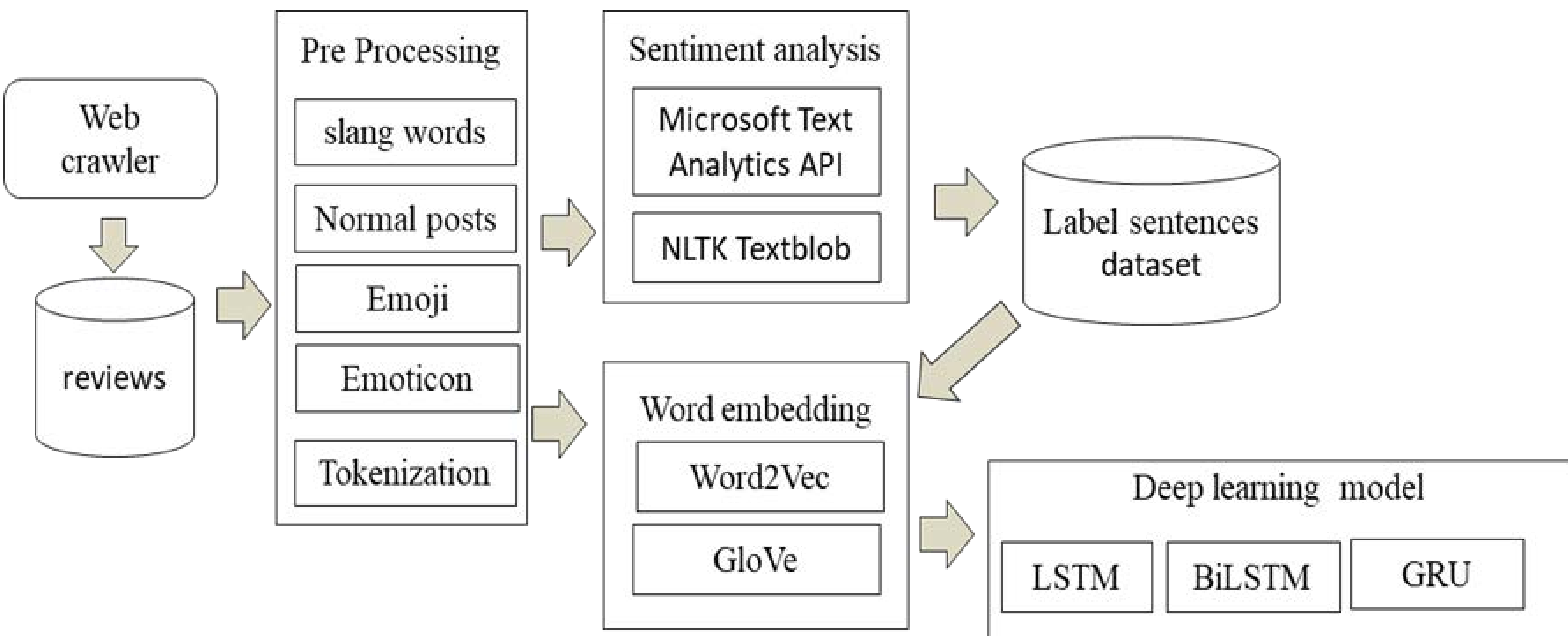 Figure 1: The proposed sentiment analysis framework from crawling to classification.
2. Deep Learning Architectures
The researchers compared three sequential models to see which could best handle the dependencies in short text:
- LSTM (Long Short-Term Memory): Designed to solve the vanishing gradient problem in RNNs.
- BiLSTM (Bidirectional LSTM): Processes the text from both left-to-right and right-to-left, capturing context from both "future" and "past" words.
- GRU (Gated Recurrent Unit): A more computationally efficient version of LSTM with fewer gates.
Experimental Results: BiLSTM Reigns Supreme
Using a dataset of 6,000 labeled sentences from YouTube trailer comments, the study conducted a head-to-head comparison.
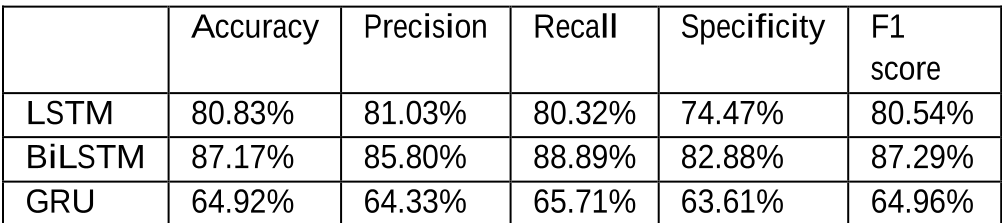 Table 1: Performance comparison across different architectures.
Key Insights from results:
- BiLSTM’s Dominance: Achieving 87.17% accuracy, the BiLSTM proved that in short messages, knowing what comes after a word is just as important as knowing what came before it.
- The GRU Failure: Surprisingly, the GRU performed poorly (64.92% accuracy). This suggests that for highly noisy social media data, the simplified gating mechanism of the GRU may not be robust enough to filter out the irrelevant "noise" of informal text compared to the more complex LSTM.
Critical Analysis & Conclusion
This paper serves as a vital reminder that in the world of Deep Learning, data quality and preprocessing often outweigh architectural complexity. By translating social media slang into "Standard English," the authors allowed standard word embeddings (GloVe/Word2Vec) to function at their peak efficiency.
Takeaway for Practitioners: If you are building a sentiment engine for customer feedback, don't just throw a Transformer at the raw text. Invest in a slang-aware preprocessing layer and consider Bi-directional architectures to bridge the gap between human "internet speak" and machine understanding.
Future Work: The authors intend to expand this to a full-scale "crawled intelligence" framework, perhaps incorporating Transformer-based models (like BERT) which have since set new benchmarks in this specific research area.