
Deciphering Bitcoin Volatility: Deep Learning Benchmarks across Social and Financial Dimensions
Deep Learning Approach to Determine the Impact of Socio Economic Factors on Bitcoin Price Prediction
This paper presents a comparative study of Bitcoin price prediction using CNN, LSTM, and GRU deep learning models. It evaluates the impact of historical Bitcoin data, international Gold prices, and Twitter sentiment analysis, achieving the lowest prediction error with a 4-layer LSTM model.
TL;DR
Is Bitcoin truly "Digital Gold," or is it a social phenomenon driven by digital chatter? This research evaluates three heavyweights of deep learning—CNN, LSTM, and GRU—to predict Bitcoin prices. The verdict: LSTM reigns supreme for time-series forecasting, social sentiment is a potent predictor, and surprisingly, Gold prices have almost no predictive value for Bitcoin's short-term movements.
Context & Positioning
In the landscape of quantitative finance, Bitcoin remains the "final boss" of volatility. This paper moves beyond simple regression by positioning Bitcoin in a triangular coordinate system: Historical Trends, Traditional Commodities (Gold), and Social Sentiment (Twitter). It attempts to validate whether Bitcoin follows traditional economic dependencies or thrives in a vacuum of social hype.
Problem & Motivation
Most retail investors treat Bitcoin as a safe-haven asset, similar to Gold. However, the technical challenge lies in identifying which "signals" actually penetrate the market noise. Prior works often focused on a single model or a single data source. The authors identified a gap: the lack of a head-to-head architectural comparison (CNN vs. RNN variants) specifically tested against the "Gold correlation" hypothesis.
Methodology: The Core
The study utilizes three distinct architectures to process temporal data:
- 1D-CNN: Leverages convolutional filters to extract local patterns in price movements.
- LSTM (Long Short-Term Memory): Designed to solve the vanishing gradient problem, allowing the model to "remember" long-term price dependencies through its gate mechanisms (Input, Forget, Output).
- GRU (Gated Recurrent Unit): A streamlined version of LSTM that uses update and reset gates, often faster to train but potentially less expressive for complex sequences.
Architectural Framework
The researchers integrated a sentiment pipeline using the VADER algorithm, which assigns scores to tweets based on keywords, follower counts, and engagement metrics to quantify "Social Influence."
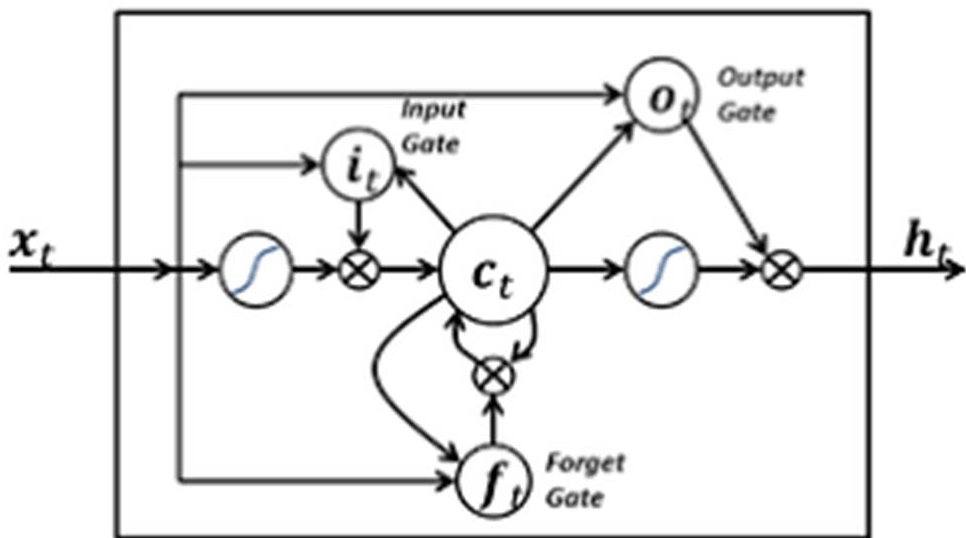 Above: The internal wiring of the LSTM model used to capture long-term temporal dependencies.
Experiments & Results
1. The Superiority of LSTM
When training on internal Bitcoin parameters (Open, High, Low, Close), the 4-layer LSTM achieved an RMSE of 47.91, significantly lower than CNN or GRU. This suggests that Bitcoin prices are heavily influenced by long-term historical windows that LSTMs are uniquely equipped to handle.
2. The Gold Myth
Perhaps the most striking finding is the failure of Gold prices to predict Bitcoin. The RMSE skyrocketed to over 151.67 when using Gold as a primary feature.
- Insight: The lack of correlation suggests that the "Digital Gold" narrative may be more of a marketing term than a statistical reality in high-frequency trading.
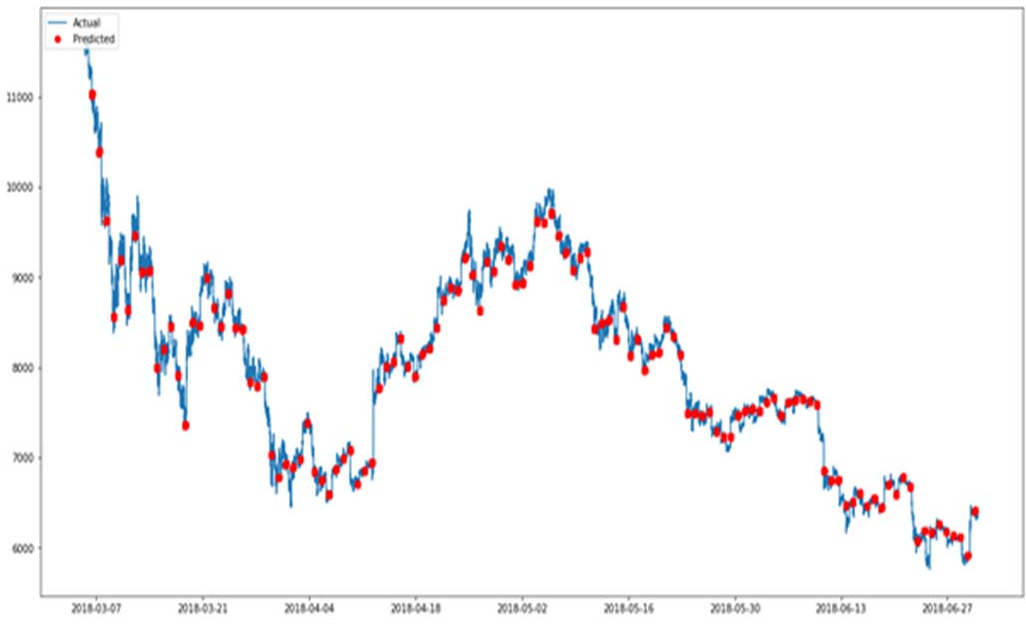 Above: LSTM predictions (red) closely tracking actual Bitcoin prices (blue) using internal parameters.
3. Sentiment Dynamics
The study confirmed a "Social Feedback Loop." High sentiment scores from influential Twitter accounts (measured by followers and likes) preceded price hikes, while negative sentiment correlated with immediate drops.
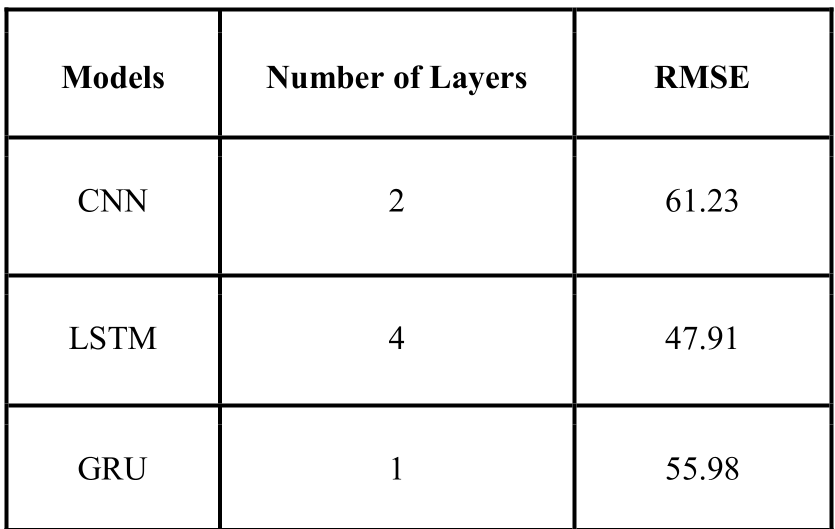 Table 1: Comparison of RMSE across models. Note how LSTM consistently provides the most stable error rates.
Critical Analysis & Conclusion
Takeaway
For developers and data scientists building crypto-bots, the message is clear: Architecture matters. The LSTM’s ability to maintain a "cell state" is vital for the crypto market's recursive nature. Furthermore, ignoring social API data in favor of traditional commodity indexes is a recipe for high error rates.
Limitations & Future Work
- Data Granularity: The study mapped 5-minute data to daily intervals, potentially losing "micro-burst" volatility info.
- Influencer Weighting: While the study looks at follower counts, it doesn't account for "bot" activity or wash-trading signals.
- Future Direction: The authors suggest integrating live data streams to move from back-testing to real-time predictive signaling.
In summary, this research anchors the "Social Sentiment" theory in rigorous deep learning benchmarks, proving that in the world of Bitcoin, the crowd's voice is louder than the price of gold.