
DLMF: Overcoming the Initialization and Community Challenges in Social Recommendations
On Deep Learning for Trust-Aware Recommendations in Social Networks
This paper introduces DLMF (Deep Learning based Matrix Factorization), a trust-aware recommendation framework that integrates deep autoencoders for latent feature initialization and a social trust ensemble model. It achieves significantly lower RMSE and higher coverage compared to state-of-the-art methods like SocialMF and STE on Epinions and Flixster datasets.
TL;DR
Deep Learning based Matrix Factorization (DLMF) is a hybrid recommendation framework that solves the two biggest headaches of collaborative filtering: poor initialization and neglected community structures. By using a deep autoencoder for pre-training and a "TrustCliques" algorithm for social regularization, it achieves a 2-4% precision boost over traditional SOTA methods, especially for "cold-start" users who have barely rated any items.
Background: Why Social Trust is Not Enough
Standard Recommender Systems (RS) often rely on Matrix Factorization (MF). While effective, MF is notoriously sensitive to how you start the "guessing" process (initialization). Start with bad random numbers, and the model converges to a mediocre local minimum. Furthermore, most systems treat all "trusted friends" equally, ignoring the Community Effect—the reality that you might trust different friends for Sci-Fi movies than for historical biographies.
The DLMF Architecture: Pre-training + Social Ensemble
The authors break the recommendation task into two distinct phases.
1. Pre-training with Deep Autoencoders
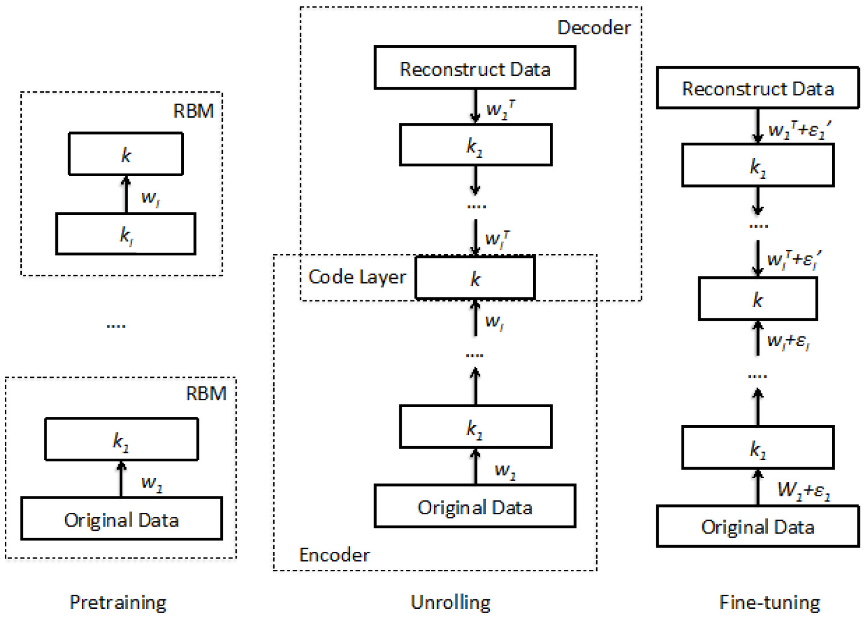
Instead of random Gaussian noise, DLMF uses a Deep Autoencoder to compress sparse user/item rating history into a dense latent space. This provides a "warm start" for the Matrix Factorization.
- Mechanism: It utilizes Continuous Restricted Boltzmann Machines (CRBM) to handle continuous rating data.
- Insight: This captures the non-linear similarities between users before the fine-tuning even begins.
2. Social Trust Ensemble & TrustCliques
The second phase refines the ratings by considering:
- User/Item Biases: Accounting for "generous" vs. "critical" raters.
- Trust Deviation: Instead of just mimicking a friend's rating, the model looks at the difference between your taste and your friend’s taste.
- Community Regularization: The authors developed TrustCliques, an algorithm that finds overlapping communities in the social graph. Users within the same clique are regularized to have more similar latent features.
Experimental Battleground: Epinions & Flixster
The model was tested on two massive datasets. Epinions is particularly challenging due to its extreme sparsity (many items, few ratings).
Key Findings:
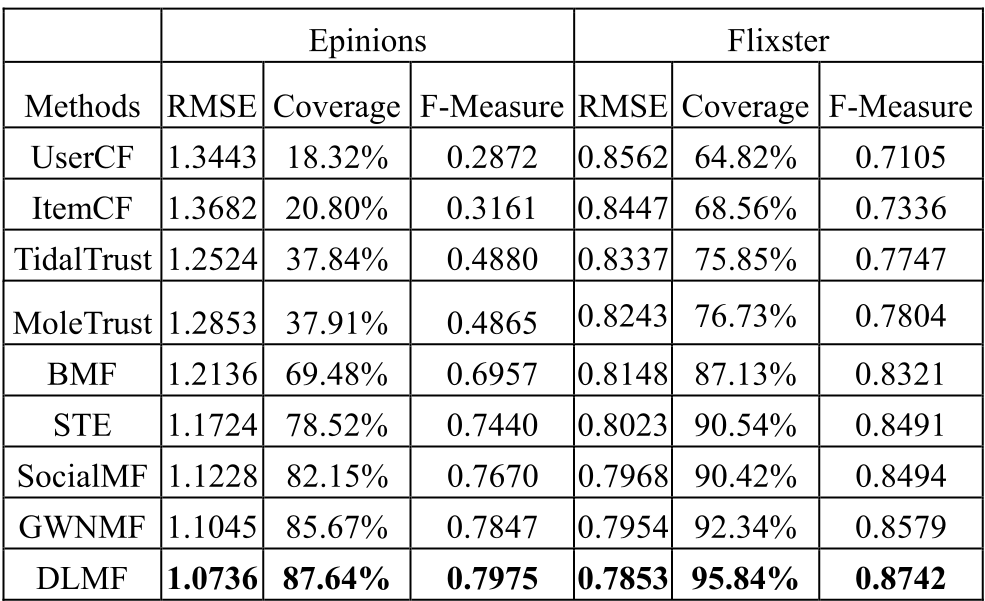
- Superior Accuracy: DLMF achieved the lowest RMSE across both datasets compared to benchmarks like SocialMF and STE.
- The Cold-Start Cure: For users with fewer than 5 ratings, DLMF’s ability to "borrow" features from the community and trust network resulted in a significant performance lead.
Ablation Study: Does the "Phase 1" Pre-training Matter?
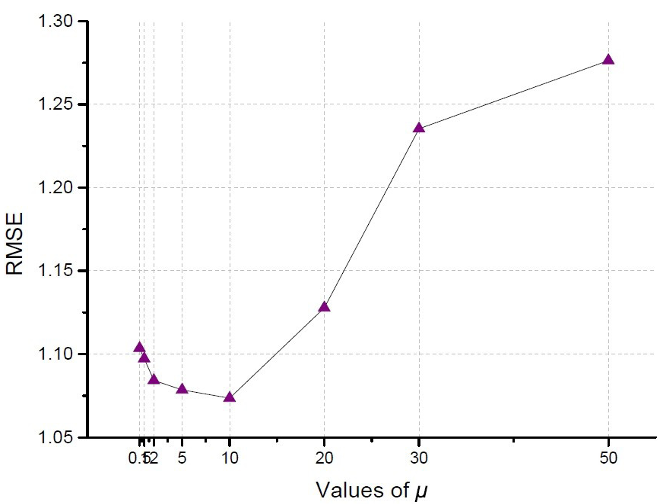
The results were clear: using a Deep Autoencoder for initialization resulted in lower error rates than K-means, Ncut, or random initialization. While it adds about 20% to the offline training time, the precision gain makes it worthwhile for production environments.
Deep Insights
The true innovation of DLMF is the realization that social trust is multi-dimensional. By combining the "global" representation learning of autoencoders with the "local" structural constraints of TrustCliques, the model successfully captures both individual preferences and group dynamics.
Conclusion & Future Work
DLMF proves that deep learning isn't just for end-to-end prediction; it is an incredible tool for feature initialization in established mathematical frameworks like MF. Moving forward, the authors point toward time-sensitivity—acknowledging that your trust in a friend and your interest in a product both evolve over time.
Takeaway for Practitioners: If your recommendation model is struggling with new users, don't just add more data—rethink your initialization and look for the hidden "cliques" in your user social graph.