
Deep Learning for SIoT: Beyond Simple Malicious Node Detection
Deep Learning for Trust-Related Attacks Detection in Social Internet of Things
This paper introduces a Deep Learning-based trust evaluation model for the Social Internet of Things (SIoT). By employing a Multi-Layer Perceptron (MLP) architecture, the authors successfully classify node interactions into five categories: benign or one of four specific trust-related attacks (BMA, BSA, SPA, DA), achieving state-of-the-art detection accuracy.
TL;DR
The integration of social paradigms into the Internet of Things (SIoT) introduces complex trust vulnerabilities. While prior works could identify if a node was malicious, they couldn't identify how. This paper presents a Deep Learning framework using Multi-Layer Perceptrons (MLP) to detect and categorize specifically four types of trust attacks (BMA, BSA, SPA, and DA) with over 95% precision, significantly outperforming traditional weighted-mean and simple machine learning baselines.
Problem & Motivation: The "What" is not enough
In the Social Internet of Things, objects aren't just tools; they are "social" entities established through autonomous relationships. This opens the door to sophisticated trust-related attacks:
- Bad-Mouthing (BMA): Ruining a good node's reputation.
- Ballot-Stuffing (BSA): Artificially boosting a malicious node's ego.
- Self-Promoting (SPA): A node lying about its own quality.
- Discriminatory Attack (DA): Attacking strangers based on a lack of social ties.
Existing SOTA methods treated this as a binary classification or a ranking problem. However, the authors argue that attack identification is crucial because the severity of a "Bad-Mouthing" attack might be negligible in a smart home but catastrophic in a collaborative industrial SIoT.
Methodology: The Deep Aggregation Architecture
The proposed system moves away from linear aggregation (weighted mean) and simple logic. It operates in two distinct phases:
1. Composition Phase (The Features)
The model extracts 11 input dimensions based on node pairs (), including global reputation, honesty (rating consistency), and social similarity. These are derived from the authors' previous research but expanded to capture the nuances of specific attack vectors.
2. Aggregation Phase (The Neural Engine)
The heart of the paper is the Multi-Layer Perceptron (MLP). Unlike CNNs (for images) or RNNs (for sequences), MLP is the optimal choice here due to the numerical nature of the trust factor weights.
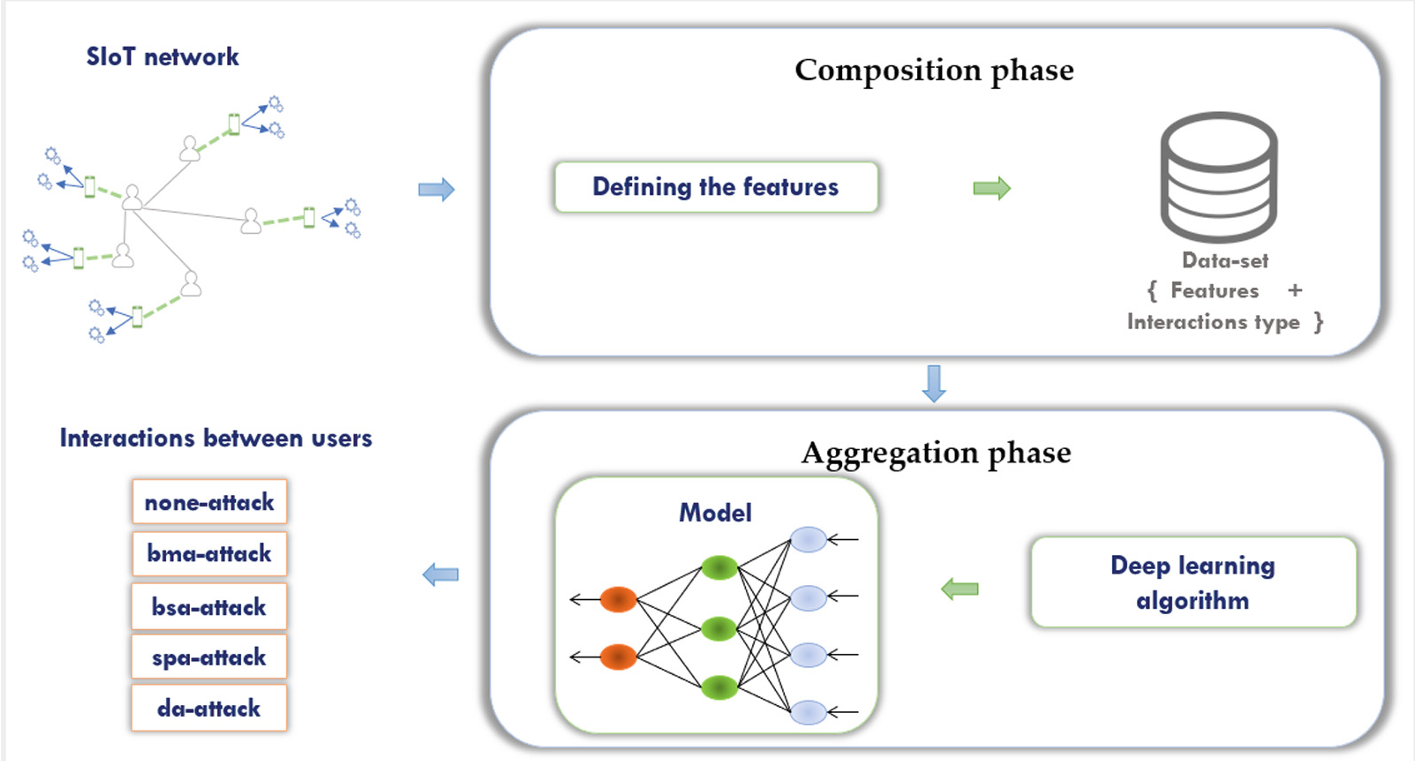 Figure 1: The proposed trust evaluation architecture, from SIoT network inputs to attack classification.
Technical Specs of the MLP:
- Input Layer: 11 neurons (trust features).
- Hidden Layers: 10 layers with 80 neurons each, utilizing ReLU activation to prevent vanishing gradients.
- Output Layer: 5 neurons with Sigmoid activation (representing the 5 classes: 4 attacks + 1 benign).
- Optimizer: Adam, minimizing Categorical Cross-Entropy.
Experiments & Results
Using the Sigcomm dataset (75 users, 32,000 interactions), the authors simulated the four attack types to create a supervised learning environment.
SOTA Comparison
The model was compared against a standard Perceptron-based machine learning approach. The results were clear:
- Precision: Improved by 2.78%.
- Recall: Improved by 1.60%.
- Overall Accuracy: Reached 95.63%.
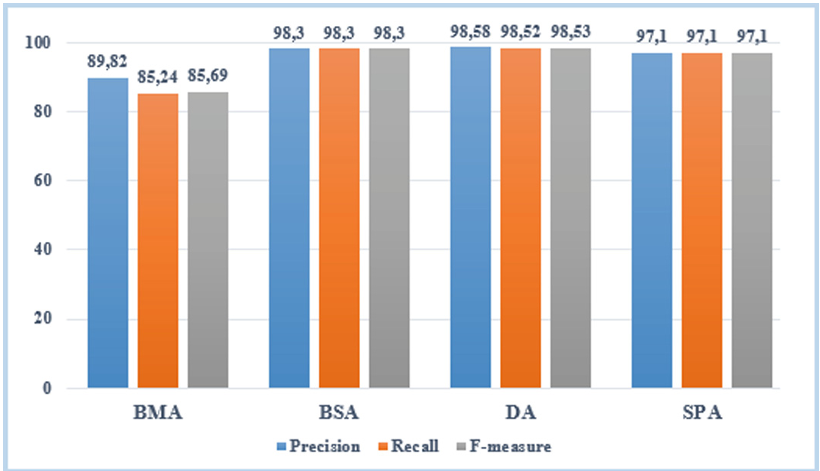 Figure 2: Performance breakdown by attack type. Note that BSA and DA attacks show exceptionally high detection resilience.
The data suggests that the "depth" of the network allows it to find non-linear correlations between features—like the discrepancy between a node's "Honesty" and its "Rating Frequency"—which are hallmarks of sophisticated attacks like Ballot-Stuffing.
Deep Insights & Conclusion
The significance of this work lies in its granularity. In a real-world SIoT deployment, simply blocking a node might be too aggressive; understanding that a node is performing a "Discriminatory Attack" might instead trigger a re-evaluation of social proximity weights rather than a total network ban.
Limitations & Future Path:
- Device-Level Trust: The current model focuses on the "User" level. The authors admit that a specialized "Device" level trust model is needed to account for hardware compromises.
- Dataset Realism: The results rely on simulated attacks on real social data. Real-world malicious data remains the "holy grail" for this field.
- Dynamic Evolution: Future work should look at "Opportunistic Service Attacks" (OSA), where nodes behave well initially to gain trust before striking—a temporal pattern that might require LSTMs or Transformers rather than MLPs.
In conclusion, this paper successfully bridges the gap between trust management and deep learning, providing a robust specialized tool for securing the next generation of social-aware autonomous devices.