DNN vs. GBDT: Decoding Stroke Risk in Large-Scale Medical Claims Data
Abstract-Electronic medical claims (EMCs) can be used to accurately predict the occurrence of a variety of diseases, which can contribute to precise medical interventions. While there is a growing interest in the application of machine learning (ML) techniques to address clinical problems, the use of deep-learning in healthcare have just gained attention recently. Deep learning, such as deep neural network (DNN), has achieved impressive results in the areas of speech recognition, computer vision, and natural language processing in recent years. However, deep learning is often difficult to comprehend due to the complexities in its framework. Furthermore, this method has not yet been demonstrated to achieve a better performance comparing to other conventional ML algorithms in disease prediction tasks using EMCs. In this study, we utilize a large population-based EMC database of around 800,000 patients to compare DNN with three other ML approaches for predicting 5-year stroke occurrence. The result shows that DNN and gradient boosting decision tree (GBDT) can result in similarly high prediction accuracies that are better compared to logistic regression (LR) and support vector machine (SVM) approaches. Meanwhile, DNN achieves optimal results by using lesser amounts of patient data when comparing to GBDT method
This study evaluates Deep Neural Networks (DNN) against traditional machine learning models (GBDT, LR, SVM) for 5-year stroke prediction using a large-scale National Health Insurance Research Database (NHIRD) from Taiwan. The researchers demonstrate that DNN and Gradient Boosting Decision Trees (GBDT) achieve SOTA-level performance, with the DNN exhibiting superior data efficiency.
TL;DR
Predicting stroke occurrence from Electronic Medical Claims (EMCs) is a high-stakes task that requires navigating massive, noisy databases. In this study, researchers leveraged Taiwan's NHIRD (840,000+ patients) to prove that Deep Neural Networks (DNN) and Gradient Boosting Decision Trees (GBDT) significantly outperform traditional clinical benchmarks like Logistic Regression. Notably, DNNs demonstrated a superior "learning curve," achieving peak accuracy with much less data than competing algorithms.
Background: The Complexity of Claims Data
Electronic Medical Claims (EMCs) are more than just billing records; they are longitudinal snapshots of a patient's health journey. However, they present two major challenges:
- High Dimensionality: Thousands of ICD codes and medication ATC categories.
- Temporal Latency: A diagnosis three years ago may have a complex, non-linear relationship with a stroke today.
While linear models like Logistic Regression (LR) are favored for their interpretability, they often fail to capture the "hidden" interactions between diverse clinical variables. This paper asks: Does the complexity of Deep Learning actually translate to better clinical outcomes in this domain?
Methodology: Engineering the Patient Timeline
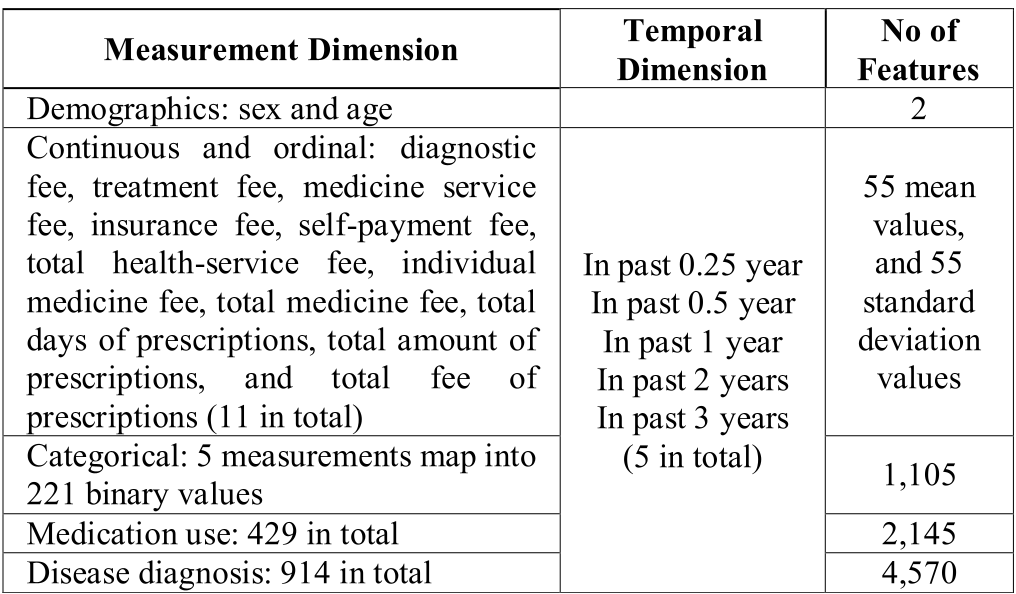
The authors didn't just dump data into a model. They engineered a feature matrix cross-referencing Measurement Dimensions (Demographics, Costs, Medication, Diagnoses) against Temporal Dimensions (0.25, 0.5, 1, 2, and 3-year windows).
The Model Architecture
- Preprocessing: GBDT-based feature selection reduced the initial 7,932 features down to the 2,007 most discriminative variables.
- DNN Structure: A 3-layer fully connected network using Tanh activations and Stochastic Gradient Descent (SGD).
- Evaluation Metric: Unweighted Average Recall (UAR) was used to ensure the model wasn't simply biased toward the majority "no-stroke" class.
Experimental Results: Accuracy and Efficiency
The results confirmed that non-linear models (DNN and GBDT) are essential for this task. Both achieved an AUC of approximately 0.91-0.92, leaving LR and SVM behind.
The "Data Efficiency" Breakthrough
The most striking finding came from the subsampling experiments. The researchers varied the amount of training data to see how quickly each model "learned."
- DNN Plateau: Reached maximum performance at 320,000 patients.
- GBDT Plateau: Required 560,000 patients to reach the same level.
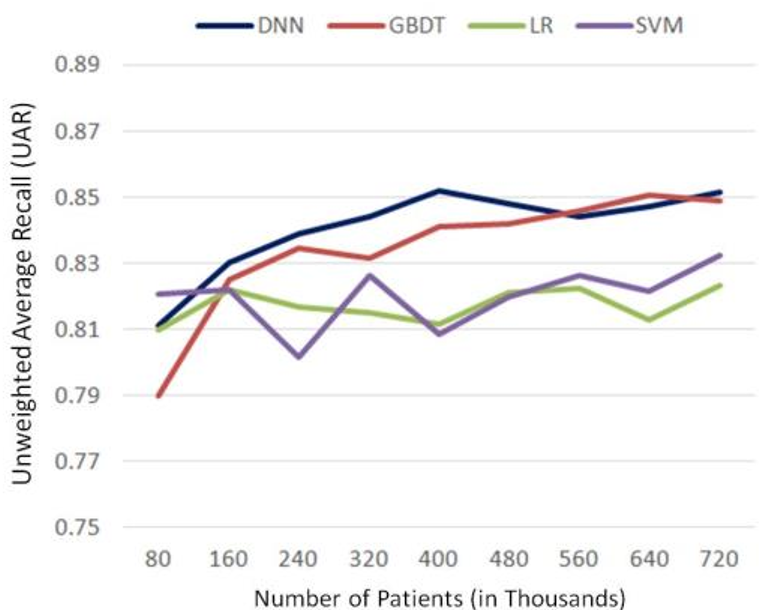
This suggests that DNNs are better at extracting high-level abstractions from complex medical schemas even when the available cohort size is relatively limited.
Critical Analysis: Why Does This Matter?
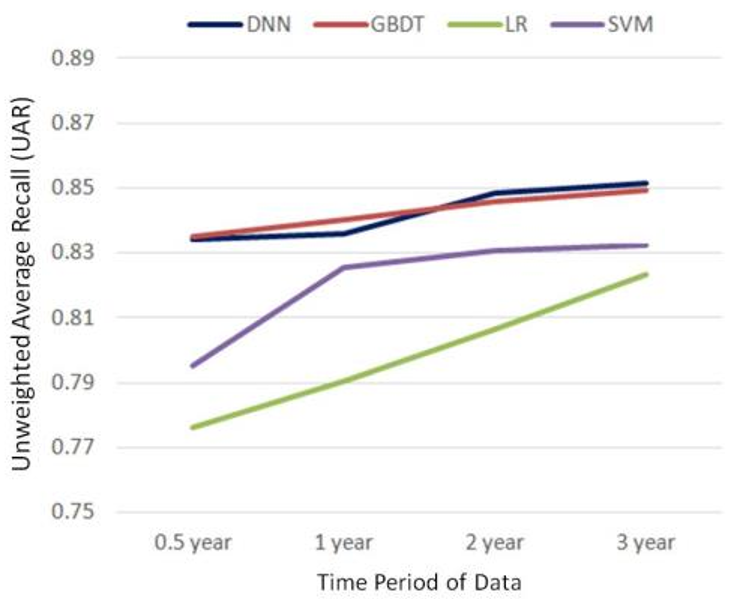
The study proves that while GBDT is a "Swiss Army knife" for tabular data, DNNs possess an inherent advantage in modeling the latent manifold of medical claims. The fact that longer historical data (up to 3 years) improved all models highlights the "long-memory" nature of cardiovascular risk.
Limitations: The study relies on a fully connected architecture. While effective, it does not explicitly model the sequential nature of medical events like a Recurrent Neural Network (RNN) or a Transformer would. Additionally, the "black box" nature of the 3-layer DNN remains a barrier to clinical adoption where "Why was this patient flagged?" is as important as "Will they have a stroke?"
Conclusion
This work sets a strong baseline for ML-based decision support in healthcare. By demonstrating that DNNs can achieve SOTA performance with smaller datasets than GBDT, the authors pave the way for more efficient, automated stroke screening tools that can be integrated directly into insurance and hospital billing workflows.