
Modeling the Co-Evolution: Deep Learning for Dynamic User Preferences and Item Attributes
Deep Modeling of the Evolution of User Preferences and Item Aributes in Dynamic Social Networks
This paper introduces a comprehensive neural framework to jointly model the evolution of user preferences and item attributes within dynamic social networks. By combining Multi-Layer Perceptrons (MLP) for non-linear social influence integration and Long Short-Term Memory (LSTM) networks for item dynamics, it achieves state-of-the-art performance in rating prediction.
TL;DR
User interests and item trends are moving targets. This paper presents a neural framework that tracks these shifts in real-time by treating social influence and item characteristics as dynamic latent variables. By utilizing MLPs to capture non-linear social dynamics and LSTMs for item evolution, the model achieves a significant ~5% leap in prediction accuracy over previous SOTA benchmarks.
Background: The Moving Targets of Recommendation
In recommendation systems, the "static" assumption is the enemy of accuracy. A user’s taste in fashion changes with age; a restaurant's popularity shifts with the seasons. Historically, Matrix Factorization (MF) provided a snapshot of these interactions. However, even modern deep learning approaches often miss a critical nuance: social influence. Existing models either ignore social links or assume that a user's personal preference is the exact same signal they broadcast to their friends. This paper argues that who you are and how you influence others are two different, though related, things.
Problem & Motivation: The Gap in Social Dynamics
Existing research suffers from three main limitations:
- Dynamic Blindness: Failing to model the simultaneous drift of both users and items.
- Linear Simplification: Using simple linear combinations to merge social influence with personal preference, which fails to capture complex human behavior.
- Identity Flaw: Assuming a user’s latent preference vector () is identical to their influence vector (), neglecting the "transformation" that occurs when one user recommends an item to another.
Methodology: Decoupling and Deep Integration
The proposed framework is bifurcated into two specialized deep learning modules.
1. User Preference Model (Socially-Aware MLP)
To address the "Identity Flaw," the authors introduce a Transformation Matrix (). This matrix operates on the user's historical latent state to generate a distinct "influence" vector. Instead of a simple addition, these factors are fed into a Multi-Layer Perceptron (MLP). This allows the model to learn high-order, non-linear interactions between a user's past habits and the pressure/advice from their social circle.
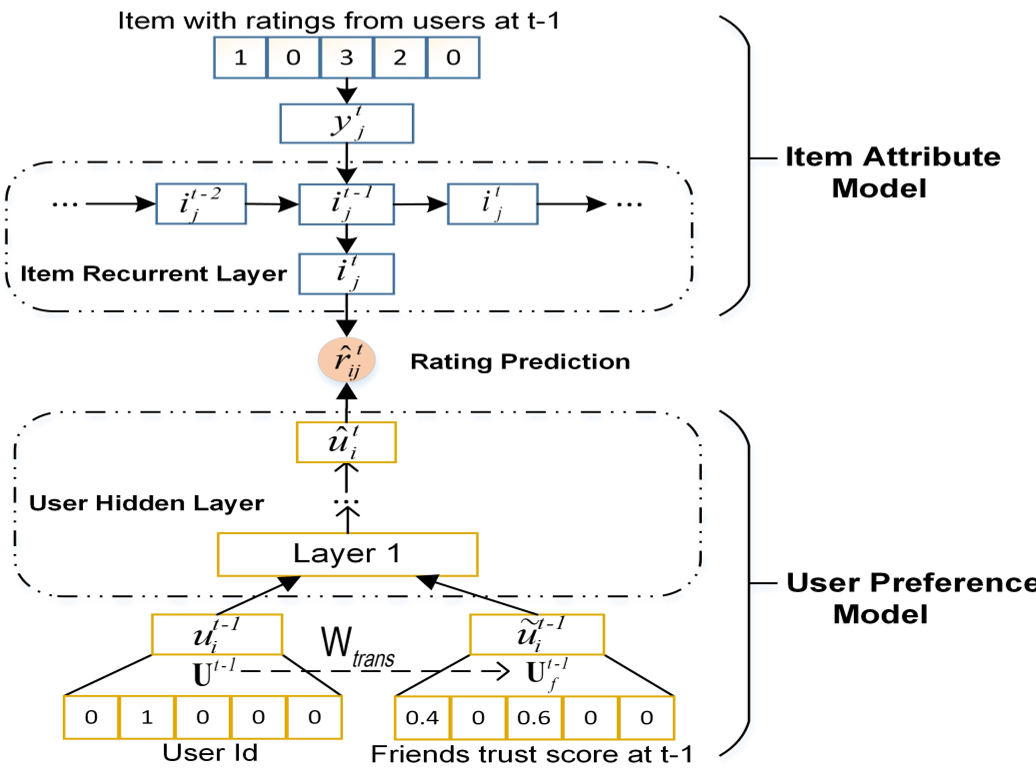 Figure 1: The dual-path architecture showing the social influence integration (bottom) and item evolution (top).
2. Item Attribute Model (LSTM Path)
Items are not static entities. To capture their "inherent dynamics," the authors employ an LSTM (Long Short-Term Memory) network. The input to this LSTM is an embedding derived from the ratings the item received in the previous time step, allowing the model to "feel the pulse" of the item's current popularity and market position.
3. Final Rating Prediction
The model acknowledges that while some things change, others stay the same. The final rating is a hybrid of:
- Dynamic components: Outputs from the MLP and LSTM.
- Stationary components: Fixed embeddings for traits like gender or item genre.
Experiments & Results: Setting New Benchmarks
The model was tested against two major datasets: Epinions (a trust-based consumer site) and Gowalla (a location-based social network).
- Accuracy: The model achieved an average RMSE improvement of 4.5% to 5.1% over the previous best-performing models.
- Social Impact: The experiments confirmed that as the social trust weight () is tuned, the model reaches an optimal balance, proving that social context is a vital "denoiser" for preference modeling.
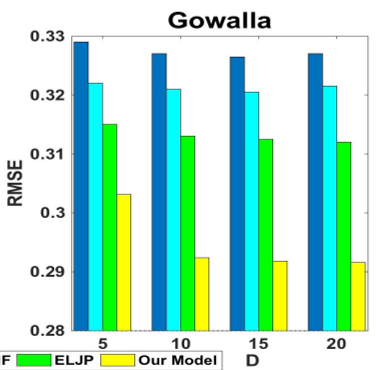 Figure 2: Performance comparison showing our model (lowest RMSE) across various latent dimensions.
Deep Insight & Conclusion
The core strength of this work lies in its Inductive Bias: the realization that social influence is a transformed version of preference, not a mirror image. By moving away from linear combinations toward deep, non-linear integration (MLP) and sequential memory (LSTM), the framework captures the "drift" of the digital world more effectively than traditional CF methods.
Future Outlook: While powerful, the model relies on one-hot encodings for users, which may struggle with extreme scale (billions of users). A future evolution could involve Graph Convolutional Networks (GCNs) to more efficiently propagate these social signals without the need for massive trust score vectors.