
DeepRec: Bridging the Gap in POI Recommendation with Deep Neural Networks
A Deep Point-of-Interest Recommendation System in Location-Based Social Networks
This paper introduces "DeepRec," a two-stage Point-of-Interest (POI) recommendation system for Location-Based Social Networks (LBSNs). It utilizes a Deep Neural Network (DNN) to capture non-linear relationships between users and geographical locations, achieving state-of-the-art performance on Gowalla and Brightkite datasets.
TL;DR
Point-of-Interest (POI) recommendation is no longer just about whether a user likes a place; it is about the complex interplay between geographical proximity, social influence, and temporal habits. This paper proposes DeepRec, a two-stage system that first filters candidates via social-geographical proximity and then ranks them using a Deep Neural Network (DNN). By moving away from hand-crafted features to deep abstractions, the authors achieve superior Precision and Recall on major LBSN datasets.
Problem & Motivation: The Limits of Heuristics
Traditional methods in Location-Based Social Networks (LBSNs) rely heavily on Collaborative Filtering (CF) or specific distributions (like Power-law for geography). However, these methods suffer from several flaws:
- Manual Feature Engineering: They require experts to decide which factors (social vs. spatial) matter most.
- Linearity Bias: Traditional CF cannot easily capture the non-linear, "high-order" relationships between a user's evening habits and their friend's weekend travel patterns.
- Data Complexity: The latent relationship between a user’s check-in time and a POI’s popularity is too complex for simple matrix factorization.
Methodology: The Two-Stage Architecture
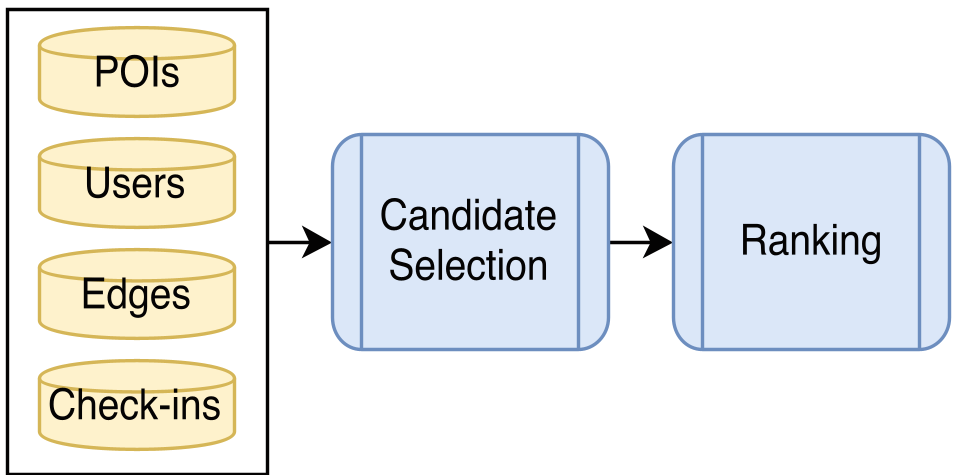
The authors break the recommendation problem into a manageable pipeline: Candidate Selection and Neural Ranking.
1. Candidate Selection
To avoid the computational cost of ranking every POI in the world, DeepRec first identifies a relevant subset based on:
- Geographical Proximity: Using DBSCAN to find a user's "home location" and filtering POIs within a Geohash neighborhood.
- Social Circle: POIs visited by friends or nearby neighbors.
 (Note: Fig 1. The Two-Stage System Architecture)
2. Deep Ranking via Feature Embedding
The core innovation lies in the feature matrix. The system constructs individual profiles for both Users and POIs:
- Temporal Preferences: 24-hour time slots and day-of-week statistics.
- Mobility Patterns: Average check-in distances and time intervals.
- Social Context: Aggregate friend check-in counts.
The DNN then processes these concatenated embeddings to output a predicted rating. The use of the Huber Loss function is a critical choice here, as it provides a robust middle ground between Mean Squared Error (MSE) and Mean Absolute Error (MAE), preventing outliers (users with excessive check-ins) from dominating the gradients.
 (Note: Fig 2. Embedding User and POI Profiles into the Feature Matrix)
Experiments & Results
The model was validated using the Gowalla and Brightkite datasets.
SOTA Comparison
DeepRec was compared against four baselines:
- POPULAR: Simple popularity ranking.
- SVD: Standard matrix factorization.
- US: Social-enhanced CF.
- USG: The previous state-of-the-art that models User, Social, and Geographical factors.
Key Findings:
- Precision and Recall: DeepRec outperformed all baselines. Interestingly, the performance gap was most significant for the Top-5 and Top-10 recommendations, which are the most critical for real-world user interfaces.
- DNN Superiority: While USG also considers geographical and social factors, DeepRec's DNN architecture proved much better at finding the "latent" connections that USG's probabilistic models missed.
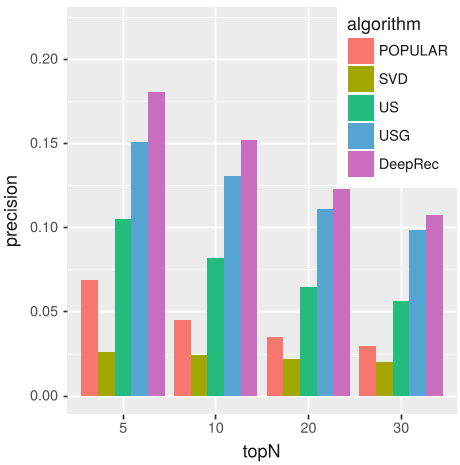 (Note: Performance comparison showing DeepRec's lead in Recall and Precision across different Top-N values)
Critical Insight & Conclusion
The significance of this work lies in its hybrid nature. By combining a heuristic-based social-geographic filter (Stage 1) with a deep-learning ranker (Stage 2), it manages to solve the "needle in a haystack" problem of POI recommendation.
Future Directions: While highly effective, the current model relies on statistical profiles (averages and counts). Future iterations could benefit from Recurrent Neural Networks (RNNs) or Transformers to capture the sequential nature of check-ins (e.g., a user visits a gym after work, not just "at some point during the day").
In summary, DeepRec proves that even in the highly constrained world of physical geography, "deep" abstractions are the key to personalizing the user experience.