
DSCF: Deep Social Collaborative Filtering via Item-Aware Sequences and Opinion Embedding
Deep social collaborative filtering
Deep Social Collaborative Filtering (DSCF) is a deep learning framework designed for social recommendation tasks that utilizes Bi-LSTM and attention mechanisms to aggregate signals from social networks. It achieves state-of-the-art results on Ciao and Epinions datasets, outperforming traditional Matrix Factorization and existing Graph Neural Network baselines in rating prediction.
TL;DR
Social recommendation algorithms typically assume "homophily"—that friends share similar tastes. However, Deep Social Collaborative Filtering (DSCF) takes this further by arguing that not all friends are relevant to every purchase and the specific rating a friend gave matters. By combining random walks, Bi-LSTM, and attention mechanisms, DSCF captures distant social influence and fine-grained opinions to set new SOTA benchmarks in rating prediction.
Problem & Motivation: Beyond the Direct Circle
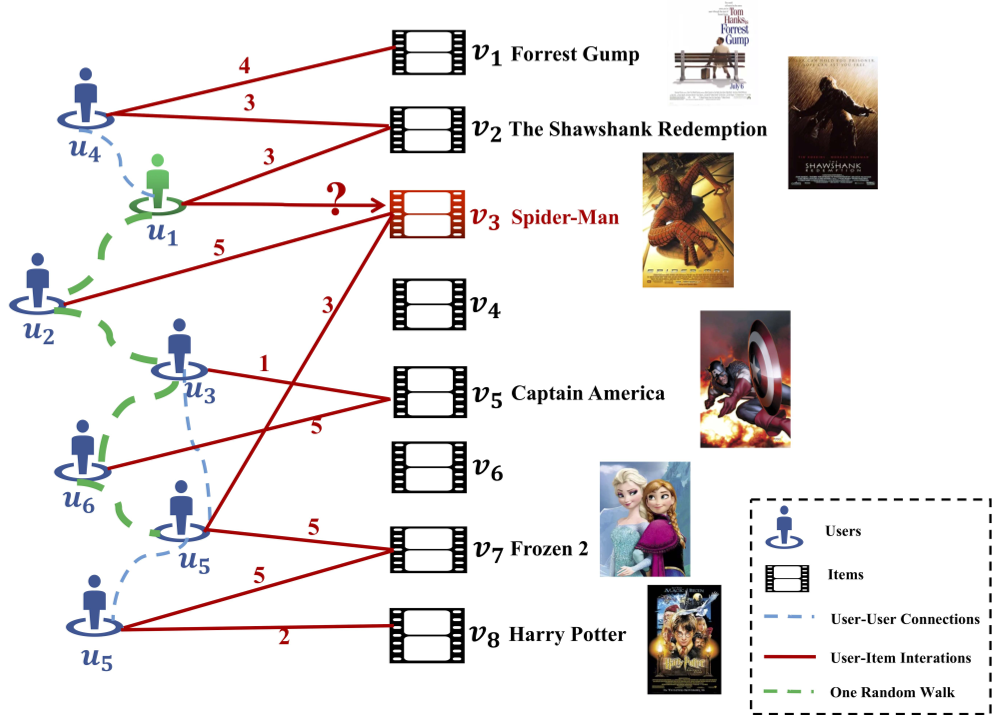
In the digital world, your preferences are influenced not just by your best friends, but also by the "weak ties" or distant connections in your network. Most prior works (like GraphRec or SoRec) face three bottlenecks:
- Locality Bias: They only look at direct neighbors, missing the "influence diffusion" from distant nodes.
- Context Insensitivity: They assume a friend's influence is constant, but a friend's preference for Nike shoes shouldn't influence your interest in an iPhone.
- Opinion Neglect: They treat an interaction as a binary edge, ignoring whether the neighbor actually liked the item (the rating value).
Methodology: The Core Architecture
DSCF addresses these challenges through a four-layered approach:
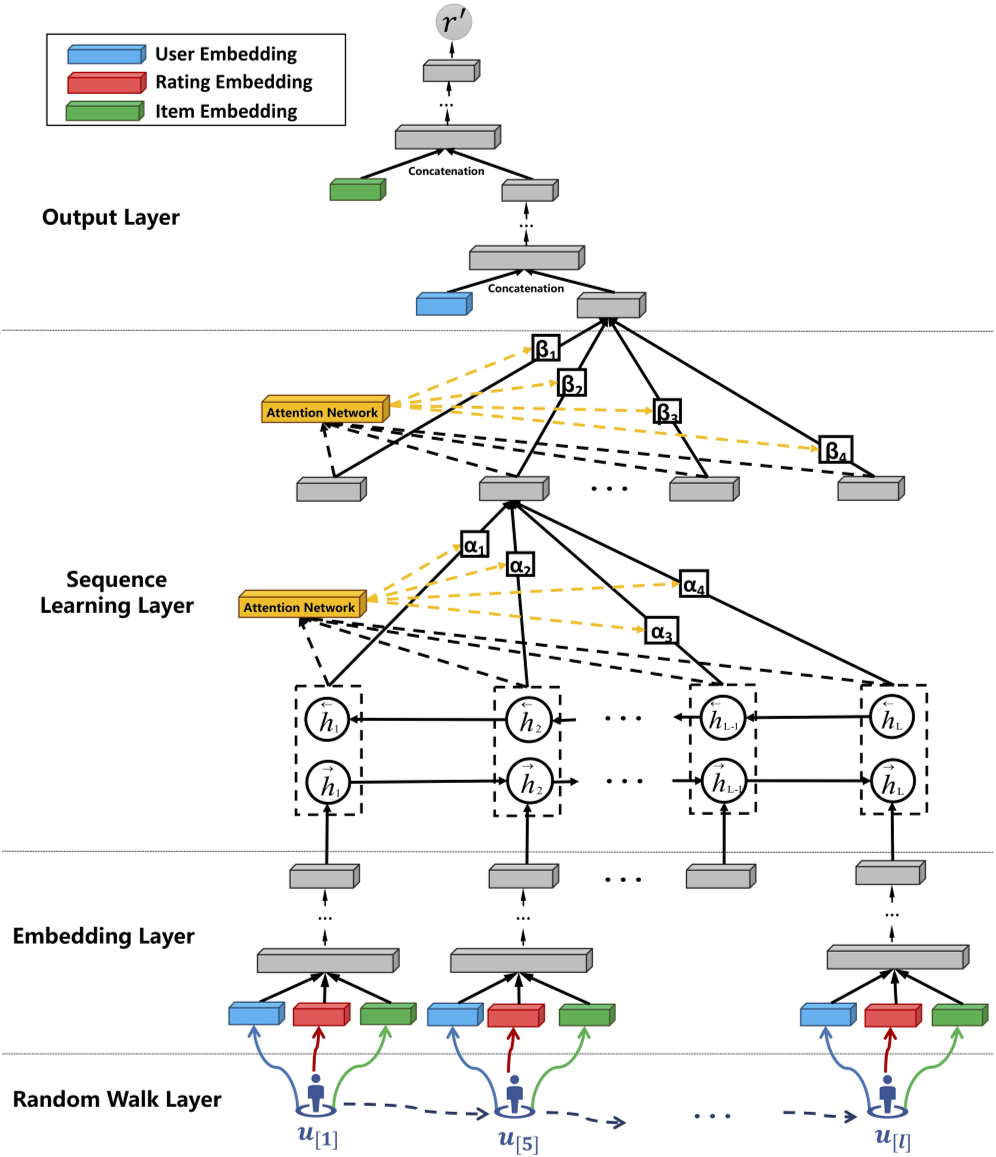
1. Item-Aware Social Sequences
Instead of a static graph, the authors use Random Walks to explore the neighborhood. To ensure relevance, for every neighbor in the sequence, the model selects the item they previously interacted with that is most similar to the target item .
2. The Embedding & Sequence Learning Layer
Unlike traditional models that just embed the user and item, DSCF embeds the Opinion (the rating score) as well.
- Input: Fusion of (User embedding, Rating embedding, and Item embedding).
- Processing: A Bi-LSTM captures the bi-directional influence between users in the sequence.
- Dual Attention:
- Neighbor-level attention identifies which specific neighbor in a sequence is most influential.
- Sequence-level attention weights multiple random walk sequences to form a single representative vector .
Experiments & Results
The model was validated on the Ciao and Epinions datasets. The results consistently showed that DSCF outperforms both traditional MF-based social models (like SocialMF) and modern deep models (like GCMC+SN).
| Metric (Ciao 80%) | PMF | NeuMF | DeepSoR | GCMC+SN | DSCF (Ours) |
|---|---|---|---|---|---|
| RMSE | 1.1238 | 1.0617 | 1.0316 | 0.9931 | 0.9867 |
| MAE | 0.9021 | 0.8062 | 0.7739 | 0.7526 | 0.7270 |
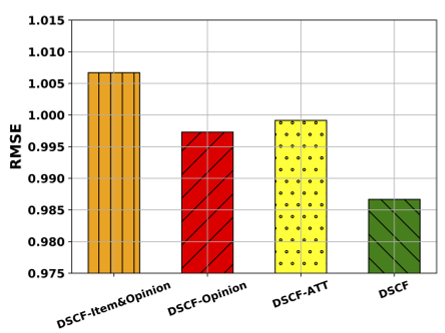
Ablation Study Insights
- Removing Opinions: Performance dropped significantly, proving that knowing how much a friend liked an item is critical.
- Removing Distant Neighbors: Shortening the sequence length hurt accuracy, confirming that "weak ties" provide non-redundant information.
Critical Analysis & Conclusion
Takeaway: DSCF marks a shift from "Global Social Influence" to "Contextual Social Influence." By filtering social signals through the lens of the target item and the specific sentiment (opinion), it provides a far more surgical approach to recommendation.
Limitations:
- The model relies on Cosine Similarity of pre-trained embeddings to find "relevant items," which might be a bottleneck if those embeddings are noisy.
- Computational cost: Multiple random walks and Bi-LSTM passes per user-item pair could be heavy for real-time industrial deployment without optimization.
Future Work: The authors suggest incorporating multi-modal data (product images or text reviews) into the similarity function to further refine the item-aware selection process.