
Deep Social Learning: Harmonizing Auction Theory and Subcultures in Cultural Algorithms
Deep Social Learning in Dynamic Environments Using Subcultures and Auctions With Cultural Algorithms
This paper introduces a Subcultured Distribution Mechanism (SDM) for Cultural Algorithms (CA) to optimize problem-solving in dynamic, complex environments. By integrating Auction Theory (First Price, English, Multi-round) with a subculture-based selection process, the system achieves state-of-the-art performance across landscapes ranging from linear to chaotic complexity.
TL;DR
Optimization in chaotic environments requires more than just raw compute—it requires a social structure that knows how to share information. This paper proposes a Subcultured Distribution Mechanism (SDM) that treats knowledge distribution like a market. By allowing different subnetworks to "auction" off influence, the system learns to adapt its internal communication strategy, significantly improving resilience in non-linear environments.
Background: Stability is Not Enough
In the study of complex systems, "Sustainability" is defined by two pillars:
- Robustness: The ability to bend but not break under small perturbations.
- Resilience: The speed at which a system recovers its performance after a catastrophic knockdown.
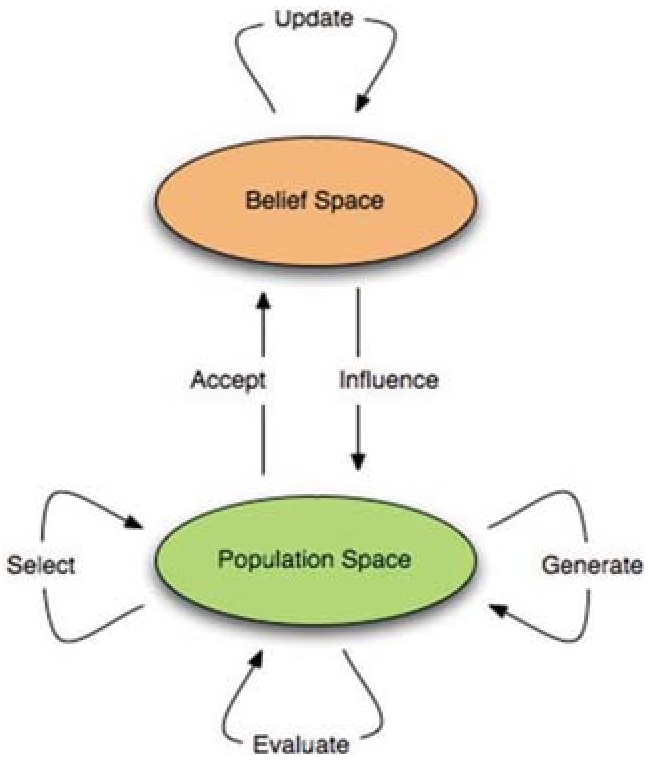
Cultural Algorithms (CA) model this through a dual-inheritance system: a Population Space (agents) and a Belief Space (knowledge sources). The bottleneck has always been conflict resolution: when different types of knowledge (Normative, Situational, etc.) give conflicting advice to an agent, which one should the agent follow?
The Pain Point: The Fidelity-Complexity Trade-off
Previous methods relied on "Weighted Majority Wins" (the wisdom of the crowds). While effective in low-noise, linear environments, it fails when the landscape becomes chaotic. The author's key insight is that as environmental entropy (measured by Langton's ) increases, the system needs higher-fidelity distribution mechanisms—like Auctions—to resolve these conflicts.
Methodology: Deep Social Learning via Subcultures
The paper introduces the Subcultured Distribution Mechanism (SDM). Instead of using one flat rule for the whole population, the SDM partitions the population into subcultures.
1. The Auction Spectrum
The authors test several auction types to see how they handle information:
- First Price (FP): Low complexity, one bid round. Good for simple signals.
- First Price Multi-round (FPM): Higher complexity via tie-breaking.
- English Auction: Highly complex, interactive bidding. Best for extracting signal from high-entropy (chaotic) environments.
2. The SDM Controller
The SDM uses a multi-layer roulette wheel system. It tracks which mechanism (Auction vs. Majority) performs best for which Knowledge Source in which sub-topology.
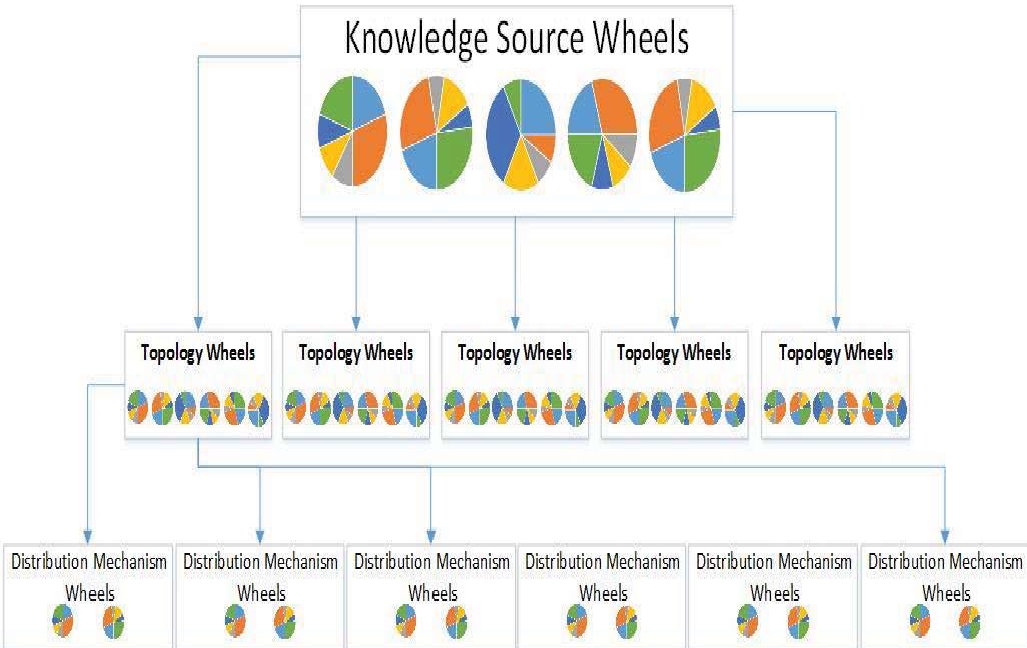
If a specific auction type improves fitness in generation , its probability of being selected increases. This prevents any single mechanism from "stagnating" or dominating the cultural evolution prematurely.
Experimental Battleground: Cones World
The authors used Cones World, a dynamic landscape generator where "resources" (cones) shift positions based on different levels of entropy (). 1.0 < < 3.0 represents linear change, while is pure chaos.
Key Findings:
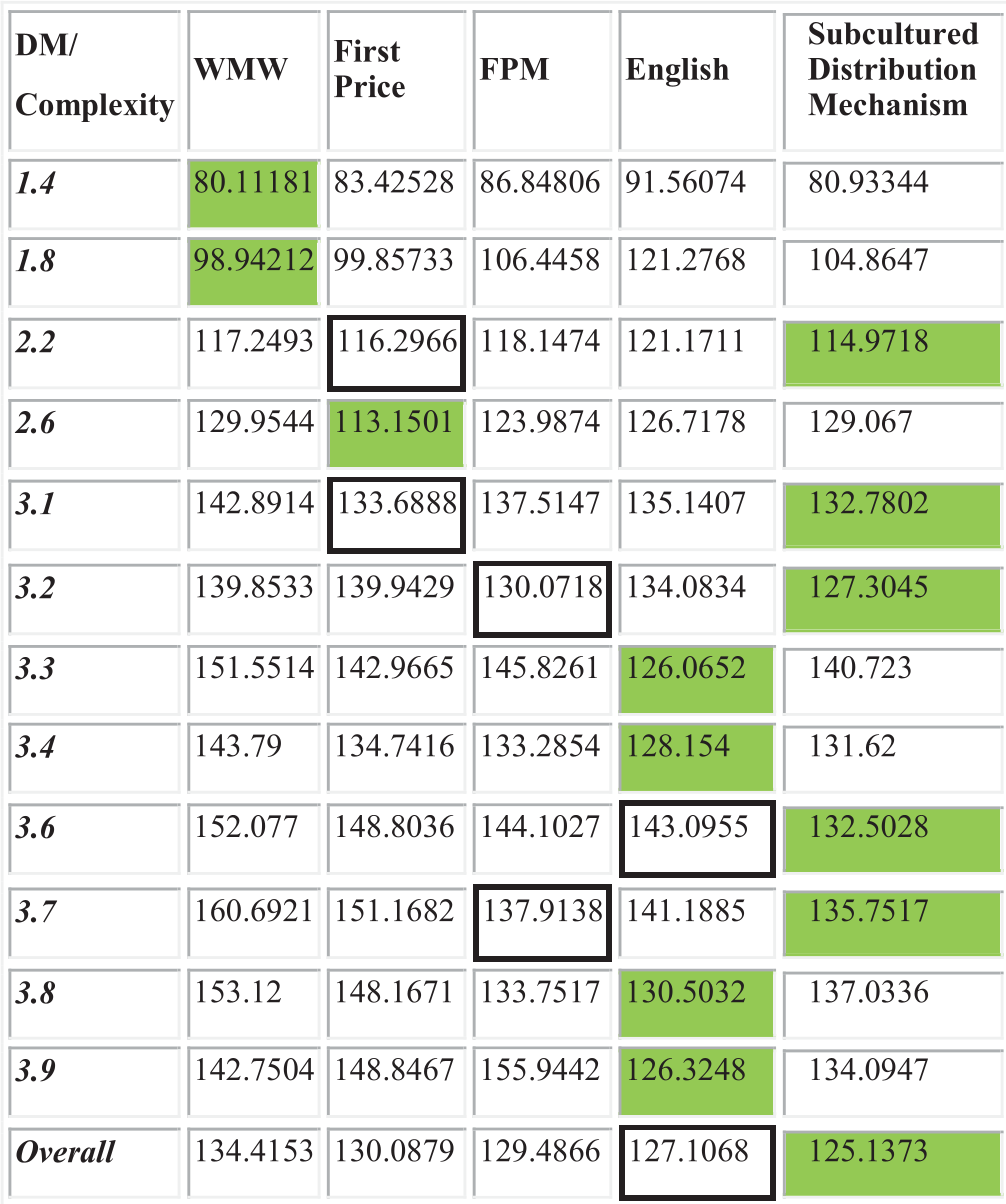
- Linear Dominance: In simple transitions (), Weighted Majority is king because it has low overhead.
- The "Niche" Effect: As the world becomes non-linear, the English Auction begins to shine.
- The SDM Advantage: In "transitional" zones (where the environment shifts from linear to non-linear), the Subcultured Mechanism consistently outperformed every individual strategy. It effectively learned to combine the strengths of "predecessor" and "successor" mechanisms.
Critical Insight & Conclusion
The true value of this work lies in the concept of "Informational Biomes." Just as biological ecosystems support different species in different niches, the SDM allows a computational system to maintain a "portfolio" of social behaviors.
Takeaway: To solve modern AI problems in volatile domains (like financial markets or real-world robotics), we must move beyond static architectures. We need "Deep Social Learning"—algorithms that don't just learn data, but learn how to organize their own social fabric to process that data more effectively.
Limitations & Future Work
While SDM shows clear potential, the authors note that the overhead of maintaining these subcultures must be balanced. Future iterations involve "Human-in-the-loop" interfaces, where humans can inject new cultural norms directly into the Engine's performance metrics to guide the subculture evolution.