
Beyond Content: Leveraging User Behavioral Graphs for Superior Rumor Detection
Deep Structure Learning for Rumor Detection on Twitter
This paper introduces a hybrid deep learning model for Twitter rumor detection that combines Graph Convolutional Networks (GCN) with Recursive Neural Networks (RvNN). By modeling user behavior as a co-occurrence graph and rumor propagation as a tree structure, it achieves state-of-the-art performance on Twitter15 and Twitter16 datasets.
TL;DR
In the era of information overload, rumors spread faster than truth. This paper presents a novel hybrid model that doesn't just look at what is being said, but who is interacting with whom. By combining Graph Convolutional Networks (GCN) to model user clusters and Recursive Neural Networks (RvNN) to model the "shape" of a rumor’s spread, the researchers have set a new benchmark for accuracy on Twitter datasets.
The Missing Link: User Behavior Networks
Traditional rumor detection has largely been a game of feature engineering—counting hashtags, measuring sentiment, or checking user follower counts. While deep learning transitioned this to Recurrent Neural Networks (RNNs) to capture temporal flow, a critical dimension remained neglected: the social graph.
The authors observed that rumors are often pushed by "loyal promoters"—groups of users who exhibit specific co-occurrence patterns. These users don't just exist in isolation; they form a "Deep Structure" of behavior. Traditional models see a list of users; this model sees a web of interactions.
Methodology: The Hybrid Architecture
The proposed model is a sophisticated pipeline that processes two distinct types of structural data:
1. User Encoder (The GCN Module)
Instead of treating users as static entities, the authors construct a User Co-occurrence Graph. If two users participate in the same claim discussion, an edge is drawn between them.
- The Logic: GCNs allow the model to update a user's representation based on their neighborhood. If a user is surrounded by known rumor-spreaders in the graph, their embedding will reflect that "guilt by association" or behavioral similarity.
2. Propagation Tree Encoder (The RvNN Module)
Information on Twitter spreads like a tree (root tweet → replies → retweets). The model uses two flavors of Recursive Neural Networks:
- Bottom-Up (BU): Aggregates information from leaf nodes (replies) up to the source to see the collective response.
- Top-Down (TD): Follows the flow from the source downward to capture how the narrative evolves.
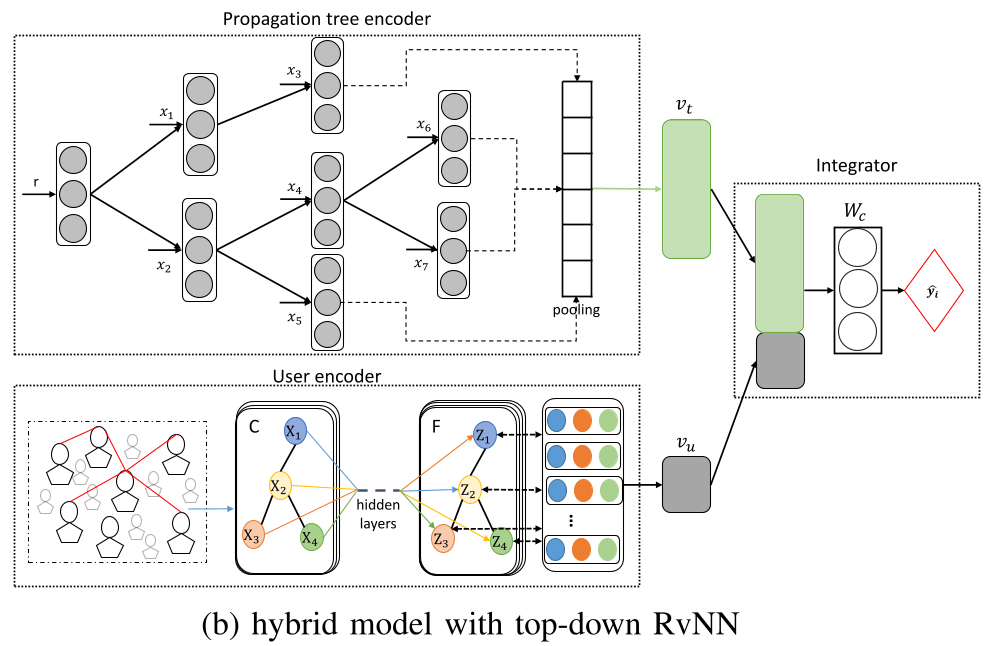 Fig 1: The architecture showing the parallel processing of the User Graph (Left) and the Propagation Tree (Right).
Experimental Results: Setting the SOTA
The model was tested against iconic baselines including SVM-based kernels and purely text-based RNNs.
| Dataset | Best Baseline (TD-RvNN) | Our Model (TD-Hybrid) |
|---|---|---|
| Twitter15 Accuracy | 72.3% | 75.2% |
| Twitter16 Accuracy | 73.7% | 77.3% |
The results clearly show that adding the GCN-based user encoder provides a consistent performance boost (approx. 3-4% absolute Gain).
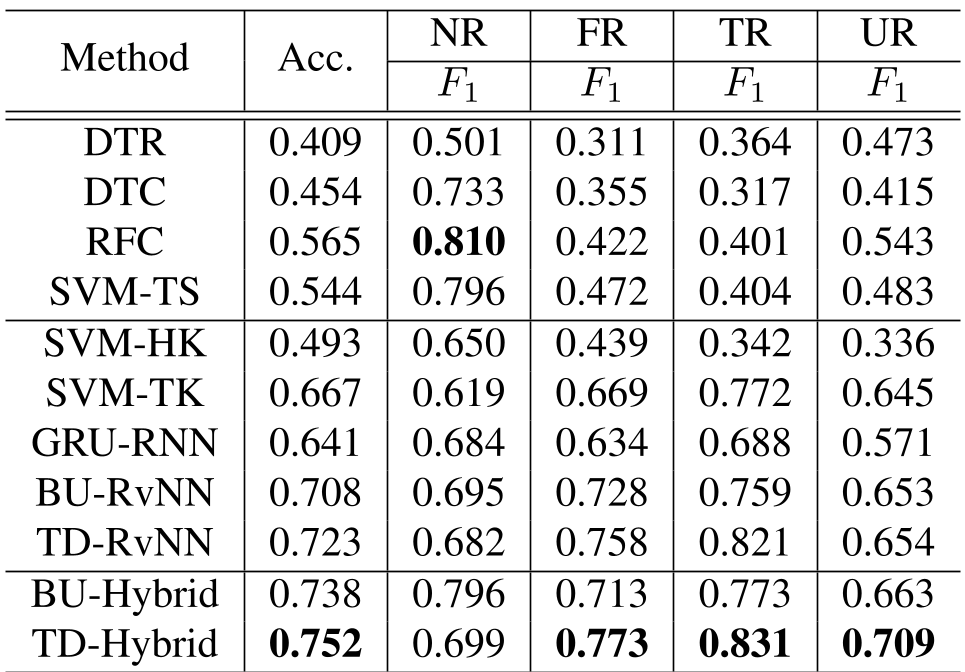 Fig 2: Comparative performance across various rumor types (True, False, Unverified, Non-Rumor).
Critical Insight: Why does it work?
The genius of this approach lies in its Inductive Bias. By using a GCN, the model acknowledges that rumors are social phenomena, not just linguistic ones.
- Content vs. Context: While the RvNN captures the semantics of the argument (e.g., people expressing doubt), the GCN captures the trustworthiness of the source community.
- Ablation Success: The authors' ablation study showed that using GCN out-performed simpler alternatives like SVD (Singular Value Decomposition) or raw feature concatenation, proving that the topology of user behavior is a rich signal for truth-telling.
Limitations & Future Outlook
While powerful, the model currently uses the poster of the root tweet only for the final integration. The authors note that for the Top-Down model, this might be a bottleneck. Future iterations could involve weighting edges based on the stance (agreement/disagreement) of the users, or treating the entire dataset as one massive, heterogeneous graph.
Summary
This paper proves that in the fight against misinformation, we must look beyond the text. By encoding the "deep structure" of how users cluster around stories, we can distinguish the organic spread of truth from the coordinated injection of rumors.