
DUMER: Rethinking Event Recommendation via Deep User Perspective Modeling
Deep User Modeling for Content-based Event Recommendation in Event-based Social Networks
This paper proposes DUMER, a deep learning framework for event recommendation in Event-based Social Networks (EBSNs). It shifts the modeling focus from event similarity to user preference by integrating a Convolutional Neural Network (CNN) with Probabilistic Matrix Factorization (PMF) to capture contextual semantics of events a user has attended.
Executive Summary
TL;DR: DUMER (Deep User Modeling for Event Recommendation) addresses the extreme cold-start problem in Event-based Social Networks (EBSNs) by using CNNs to extract rich semantic features from a user's past attendance history. Unlike previous models that focus on what an event is, DUMER focuses on who the user is through the lens of their historical choices, achieving a massive reduction in RMSE (down to ~0.29) compared to traditional MF methods.
Academic Positioning: This work bridges the gap between deep content representation and collaborative filtering. It specifically adapts the concept of "Document-context-aware recommendation" to the unique constraints of EBSNs, where item lifecycles are short and user feedback is delayed.
Problem & Motivation: The Cold-Start Crisis in EBSNs
Recommending events on platforms like Meetup or Eventbrite is fundamentally harder than recommending movies on Netflix for two reasons:
- Short Life Cycle: An event must be recommended before it happens, but it often has zero historical attendance or ratings at the time of publication.
- Semantic Sparsity: Traditional Bag-of-Words (BoW) models like LDA treat event descriptions as a "soup of words," missing the vital context provided by word order (e.g., "Paris travel" vs. "Travel from Paris").
Previous SOTA models like ConvMF focused on items. However, in EBSNs, events are transient while users are permanent. The authors' key insight: Model the user's permanent interest profile by aggregating the descriptions of everything they've ever attended.
Methodology: From Words to User Latent Factors
DUMER’s architecture consists of three sophisticated stages:
1. Word Embedding & User Document Construction
Instead of one-hot vectors, DUMER uses GloVe embeddings. It concatenates the descriptions of all events a user has attended into a single "User Document" .
2. The CNN Feature Extractor
The model passes through a specialized CNN:
- Convolutional Layer: Uses multiple filter sizes (3, 4, and 5 words) to capture local n-gram patterns.
- 1-Max Pooling: Selects the most prominent features from the entire user history.
- Fully Connected Layer: Maps these features to a latent vector that represents the user's "deep" preferences.
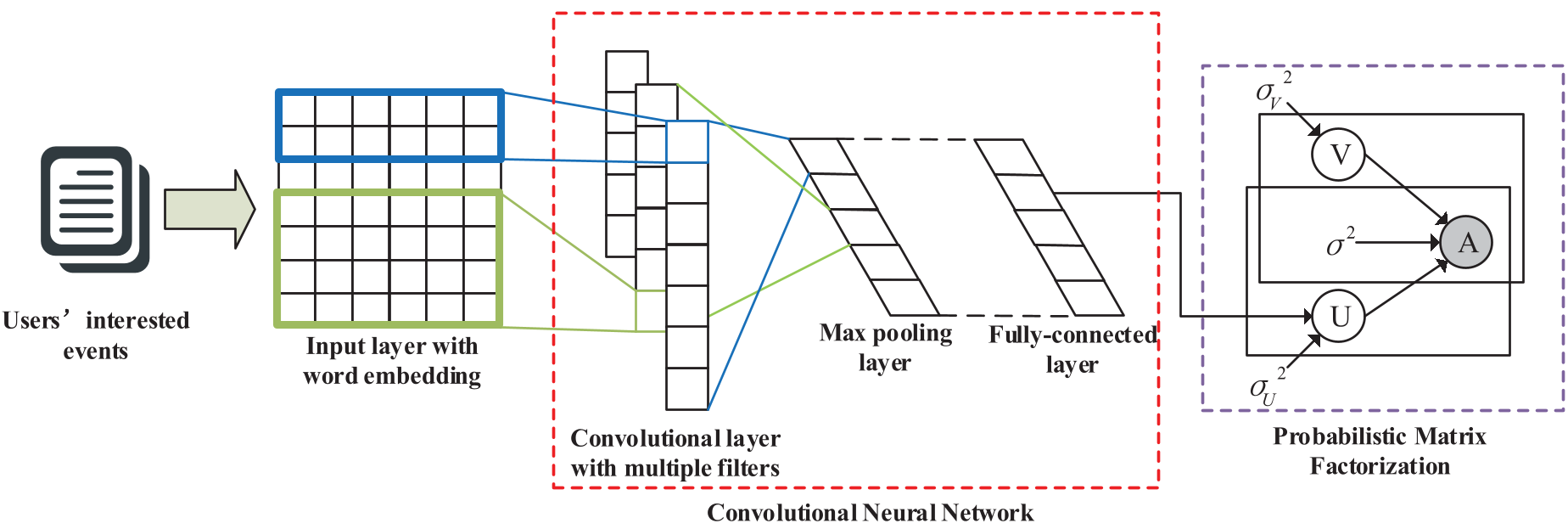
3. Integrated Probabilistic Matrix Factorization (PMF)
The deep feature is not just an auxiliary input; it is integrated directly into the PMF objective function. The user latent factor is modeled as: where is Gaussian noise. This allows the model to "correct" the CNN's predictions using the actual attendance matrix .
Experiments & Results
The authors compared DUMER against prestigious baselines including Collaborative Deep Learning (CDL) and Collaborative Topic Regression (CTR).
The Power of the "User Perspective"
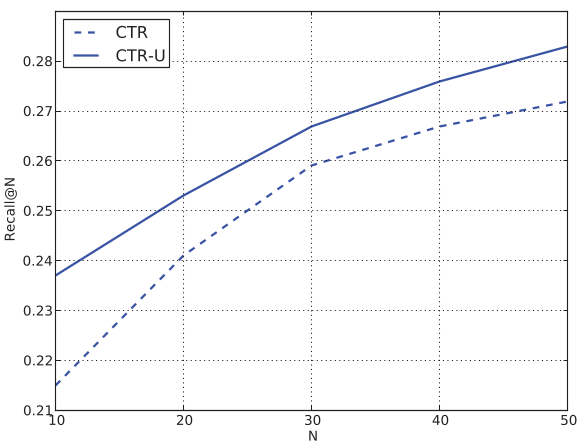
A critical experiment compared standard models (Item-oriented) with their "User-oriented" versions (e.g., CTR vs. CTR-U). In every case, shifting the focus to the user documents yielded superior Recall.
Quantitative Performance
- RMSE Performance: DUMER achieved an RMSE of 0.2902, significantly lower than CTR (0.4012) and PMF (0.9776).
- Robustness: DUMER remains stable even when the training data is reduced from 80% to 40%, indicating high efficiency in learning from sparse histories.
Critical Analysis & Conclusion
Takeaway: DUMER successfully proves that for ephemeral items, the secret to recommendation lies in the deep semantic modeling of the user's history. By replacing BoW with CNNs and GloVe, it captures "interests" rather than just "keywords."
Limitations:
- Computational Expense: Concatenating all historical event descriptions into one "User Document" can lead to very large input matrices for highly active users.
- Temporal Decay: The model treats an event attended 5 years ago with the same weight as one attended yesterday.
Future Work: The logical next step for DUMER is the integration of Geographic context and Social Influence, as EBSNs are inherently tied to physical locations and organizer reputation.
Senior Editor's Note: DUMER represents a significant shift toward "User-Centric Deep Modeling" in social computing, offering a blueprint for handling platforms where items vanish as quickly as they appear.