
DeepDirect: Rethinking Social Ties through Edge-Based Network Embedding
DeepDirect: Learning Directions of Social Ties with Edge-Based Network Embedding (Extended Abstract)
This paper defines the Tie Direction Learning (TDL) problem and proposes DeepDirect, an edge-based network embedding framework. DeepDirect converts directed, undirected, and bidirectional social ties into low-dimensional vectors to predict tie orientation, achieving state-of-the-art accuracy in direction discovery and quantification tasks.
TL;DR
Social networks are fundamentally defined by how people interact, yet the direction of these interactions is often treated as an afterthought. DeepDirect shifts the paradigm from embedding nodes (users) to embedding edges (ties) directly. By combining topological preservation with supervised labels and social consistency patterns, it solves the Tie Direction Learning (TDL) problem, enabling us to discover the "proposer" in undirected relationships and quantify dominance in bidirectional ones.
Problem & Motivation: The "Node-First" Fallacy
In the world of Graph Representation Learning, we usually focus on nodes. To understand a connection between User A and User B, we typically concatenate their individual embeddings.
The authors of DeepDirect argue this is inherently flawed for directionality. Specifically:
- Information Loss: Node-based embeddings prioritize node similarities, not the unique structural signature of the tie.
- Line Graph Complexity: Converting a graph to a "Line Graph" (where edges become nodes) explodes the computational cost to a degree that is unmanageable for large social networks.
- Undirected Ambiguity: In many "mixed" networks (like Facebook merged with Twitter data), it is hard to tell who initiated a tie, which is crucial for understanding social influence and information flow.
Methodology: The DeepDirect Architecture
The core innovation lies in the E-Step (Embedding) and D-Step (Directionality) workflow. Instead of just looking at who is connected to whom, DeepDirect looks at Connected Ties—ordered pairs of edges where the destination of one is the source of the next.
1. Topology Preservation
DeepDirect uses a skip-gram inspired objective. For any tie , it maximizes the probability of observing its "connected ties" . This ensures that ties sharing structural roles are mapped closely in the latent space.
2. Tri-Loss Optimization
The model doesn't just learn blindly. It optimizes a total loss composed of:
- : Structural connectivity.
- : Supervised signals from known directed ties.
- : Heuristics derived from Social Status Theory (e.g., ties usually flow from lower-degree nodes to higher-degree "influencers").
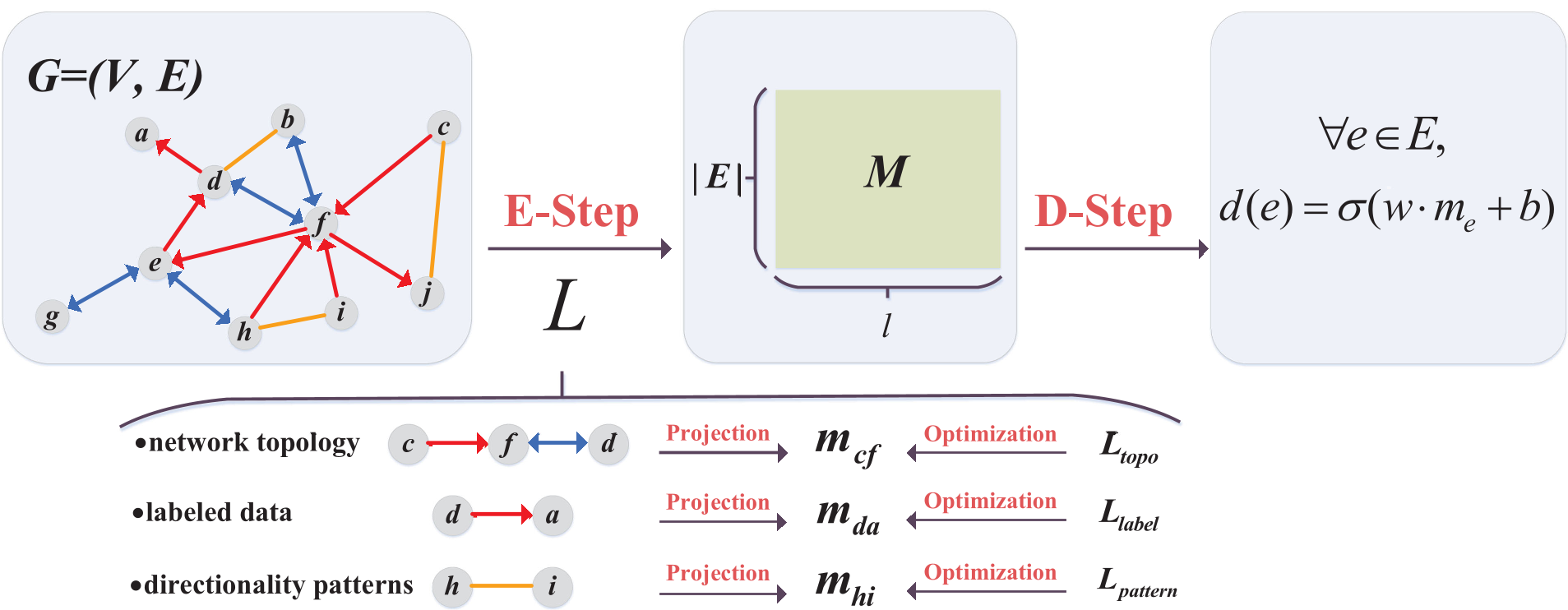 Figure: The Overview of the DeepDirect model consisting of E-Step (Edge Embedding) and D-Step (Logistic Regression).
Experiments: Superior Discrimination
The researchers tested DeepDirect against industry standards like LINE and Node2vec.
Visual Evidence
The power of edge-based embedding becomes clear when visualized via t-SNE. While node-based methods like LINE result in a "jumbled mess" of directions, DeepDirect's embeddings clearly cluster ties into distinct directional groups.
 Figure: t-SNE visualization on the Slashdot dataset. (a) DeepDirect shows clear separation between source-target orientations compared to (b) LINE.
Quantifying Bidirectional Ties
One of the most profound applications is Direction Quantification. In a friendship where both follow each other, who holds more "weight"? By replacing binary adjacency values (0 or 1) with the learned Directionality Function values, the authors improved Link Prediction AUC across the board.
Deep Insight & Conclusion
DeepDirect proves that edges carry their own "identity" that is more than the sum of their endpoints.
Takeaway for Practitioners: If your task involves understanding relationship dynamics—such as identifying influencers, detecting fraud in transaction networks, or modeling information cascades—stop relying on node concatenations. Direct edge embedding, specifically when initialized with social consistency patterns, provides a far more discriminative feature set.
Limitations: While DeepDirect handles topology brilliantly, it currently ignores content information (e.g., the text of a tweet). Future iterations combining topological edge embedding with NLP features could represent the "ultimate" social tie model.