
DeepSBD: Unmasking Sophisticated Socialbots through Multi-Modal Deep Attention
DeepSBD: A Deep Neural Network Model With Attention Mechanism for SocialBot Detection
DeepSBD is an attention-aware deep neural network model for socialbot detection on Online Social Networks (OSNs) like Twitter. It jointly utilizes Bidirectional Long Short Term Memory (BiLSTM) and Convolutional Neural Networks (CNN) to process profile, temporal, activity, and content information, achieving SOTA results across five benchmark datasets.
TL;DR
The battle against socialbots—automated agents that mimic human behavior to spread misinformation—has moved beyond simple rule-based filters. DeepSBD is a new deep learning framework that integrates profile metadata, temporal posting patterns, activity sequences, and tweet content into a unified, attention-aware model. By combining BiLSTM and CNN architectures, it achieves near-perfect detection rates on benchmark datasets, outperforming existing feature-engineered and graph-based tools.
The Evolution of the Digital "Devil"
Socialbots have evolved far beyond the primitive spam bots of the 2000s. Today, they participate in political astroturfing, manipulate financial markets, and sway public opinion by mimicking human "cadence"—they retweet specific topics, engage in periodic bursts of activity, and even maintain complex social profiles.
The primary limitation of current detection systems lies in their granularity. Feature-engineering methods (like BotOrNot) are easily "gamed" by botmasters who know which metrics are being watched. Graph-based methods can be bypassed if a bot successfully infiltrates a human community. DeepSBD addresses this by arguing that while a bot can fake one behavior, it is nearly impossible to fake the interconnected harmony of all behaviors.
Methodology: The Four Pillars of Identity
DeepSBD processes the digital footprint of an OSN user through four distinct technical lenses:
- Profile Representation: Uses 12 core attributes (follower/friend rates, account age, etc.) processed via a stacked BiLSTM.
- Temporal Dynamics: Analyzes both Diurnal patterns (time-of-day activity) and Periodic intervals (the "gap" between tweets) to catch scheduling algorithms.
- Activity Sequences: Encodes actions (Tweet, Retweet, Reply, Quote) as a sequence of integers, capturing the structural "rhythm" of interaction.
- Content Analysis: Transforms tweets into a 3D matrix (Tweets × Words × Embedding Dim) processed by a deep CNN to find semantic regularities that humans rarely repeat.
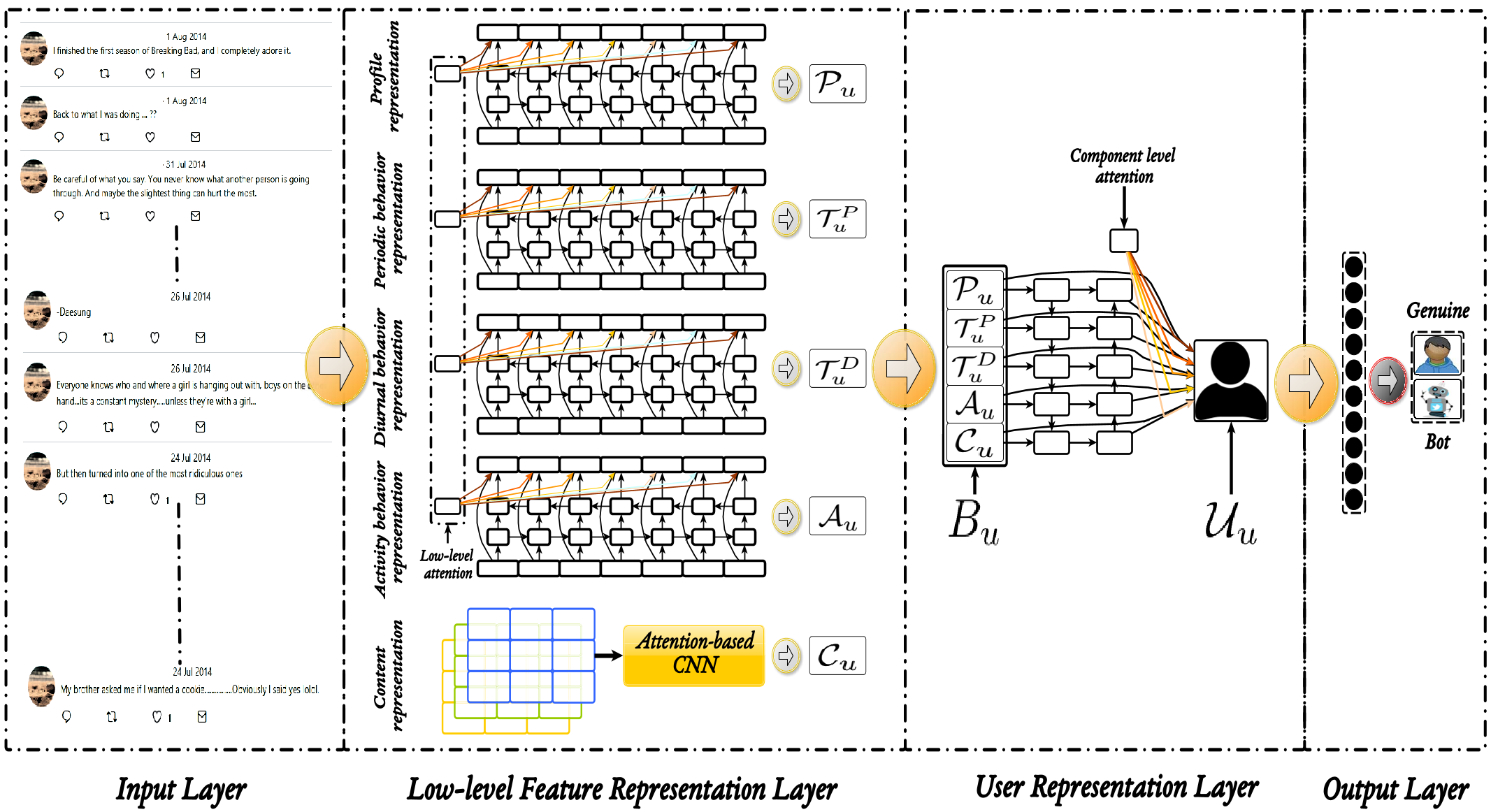 Figure 1: The hierarchical architecture of DeepSBD, showcasing the fusion of BiLSTM and CNN streams.
The Power of Hierarchical Attention
The "secret sauce" of DeepSBD is its two-level attention mechanism. At the low level, the model learns which specific features (e.g., a sudden change in status rate) are most suspicious. At the high level, it learns which behavioral pillar is most reliable for a given user. If a bot has a very human-like profile but posts with machine-like periodicity, the attention mechanism will "weigh" the temporal pillar more heavily to make the final classification.
Experimental Results & Insights
The researchers tested DeepSBD against five real-world datasets, including a custom dataset (SD4) created through a "honeypot" injection experiment.
| Metric | SD1 (Spambots) | SD2 (Social Spambots) | SD5 (Mixed) |
|---|---|---|---|
| Precision | 100.00% | 99.45% | 98.85% |
| F1-Score | 99.81% | 99.42% | 97.94% |
Visual Evidence: Bot vs. Human
The study provides striking visual proof of why temporal modeling works. As seen in the figure below, socialbots (left) show rigid, "clustered" activation windows, whereas benign users (right) exhibit the chaotic, unpredictable randomness of real life.
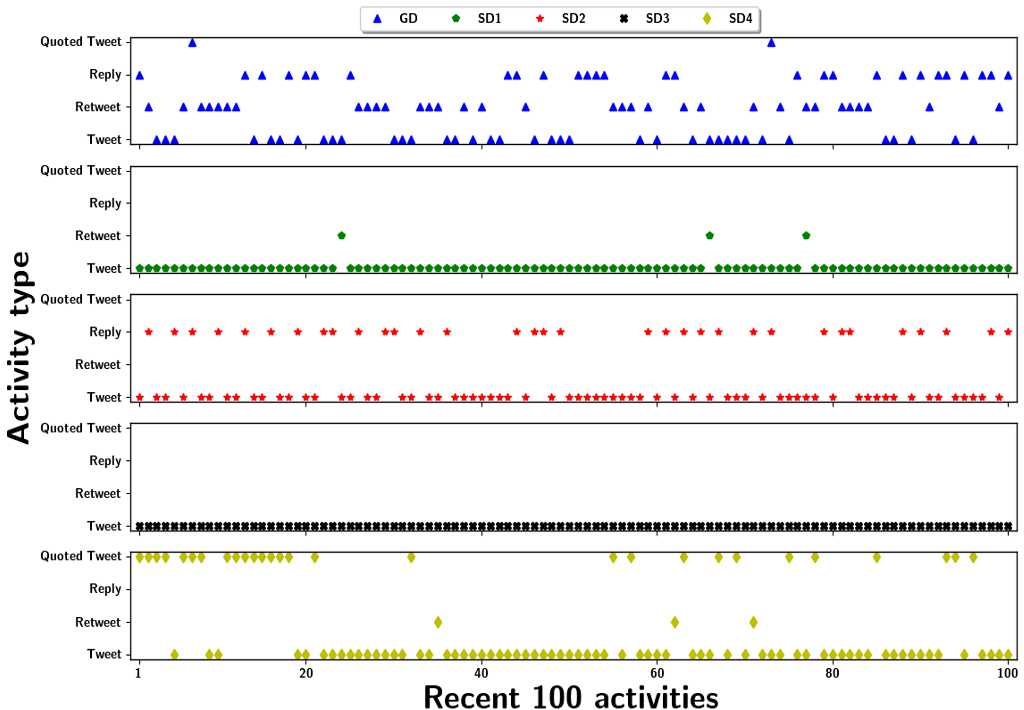 Figure 2: Bot (Left) vs. Human (Right) temporal activity. The vertical spikes represent surgical precision in automated posting.
Ablation Study: What Matters Most?
The authors performed an ablation study by removing individual components to see which "pillar" was most critical. They found that Profile and Content are the most powerful discriminators. Interestingly, the Diurnal (time-of-day) behavior was the least effective, likely because modern bots are now programmed to follow global time zones to appear more human.
Critical Analysis & Conclusion
DeepSBD marks a transition from "feature-watching" to "identity-modeling."
- Value-Add: It eliminates manual feature extraction, making the system more robust against future "zero-day" bot behaviors.
- Limitations: While high in accuracy, the training time is significantly higher than simpler models (e.g., DNNBD) because of the intensive CNN processing of tweet content.
- Future Impact: As LLMs make tweet content look more "human," the multi-modal approach of DeepSBD—relying on the interaction between metadata and content—will become the industry standard for OSN integrity.
Final Takeaway: In the era of automated disinformation, don't just look at what a user says; look at how and when they say it. The synergy of multi-modal attention is the best defense we have.