
DeepSeek-V4: Breaking the Efficiency Barrier of Million-Token Context Intelligence
DeepSeek-V4: Towards Highly Efficient Million-Token Context Intelligence
DeepSeek-V4 is a next-generation Mixture-of-Experts (MoE) model series, featuring DeepSeek-V4-Pro (1.6T total, 49B activated) and DeepSeek-V4-Flash (284B total, 13B activated). It introduces a hybrid attention architecture (CSA and HCA) and the Muon optimizer to achieve SOTA performance and native support for million-token context windows.
Executive Summary
TL;DR: DeepSeek-V4 represents a major architectural leap, moving beyond the standard MoE paradigm to solve the "Attention Bottleneck" of long-context AI. By introducing Hybrid Attention (CSA + HCA) and Manifold-Constrained Hyper-Connections (mHC), it supports a one-million-token context with a fraction of the computational cost of its predecessors.
Strategic Positioning: This isn't just a "larger" model; it is an efficiency-first SOTA work that redefines the Pareto frontier for open-source models, matching or exceeding frontier closed models like GPT-5.2 in reasoning and coding while slashing inference overhead by up to 90%.
Problem & Motivation: The Quadratic Wall
As the industry shifts toward "Test-Time Scaling" (where models think longer to solve harder problems), the quadratic complexity of vanilla attention has become a hard limit. Processing a million tokens is mathematically expensive and memory-prohibitive due to the KV cache explosion.
The DeepSeek team identified that to enable true "Long-Horizon" intelligence—such as multi-round agentic workflows or massive document analysis—we need to decouple the hidden state dimension from the attention complexity.
Methodology: The Core Innovations
1. Hybrid Attention (CSA & HCA)
The most radical change is the hybrid attention mechanism. It splits the attention layers into two types:
- Compressed Sparse Attention (CSA): Compresses every tokens into one entry and then uses a "Lightning Indexer" to perform sparse selection (Attention Top-K).
- Heavily Compressed Attention (HCA): Applies a much higher compression rate () but maintains dense attention to capture global context.
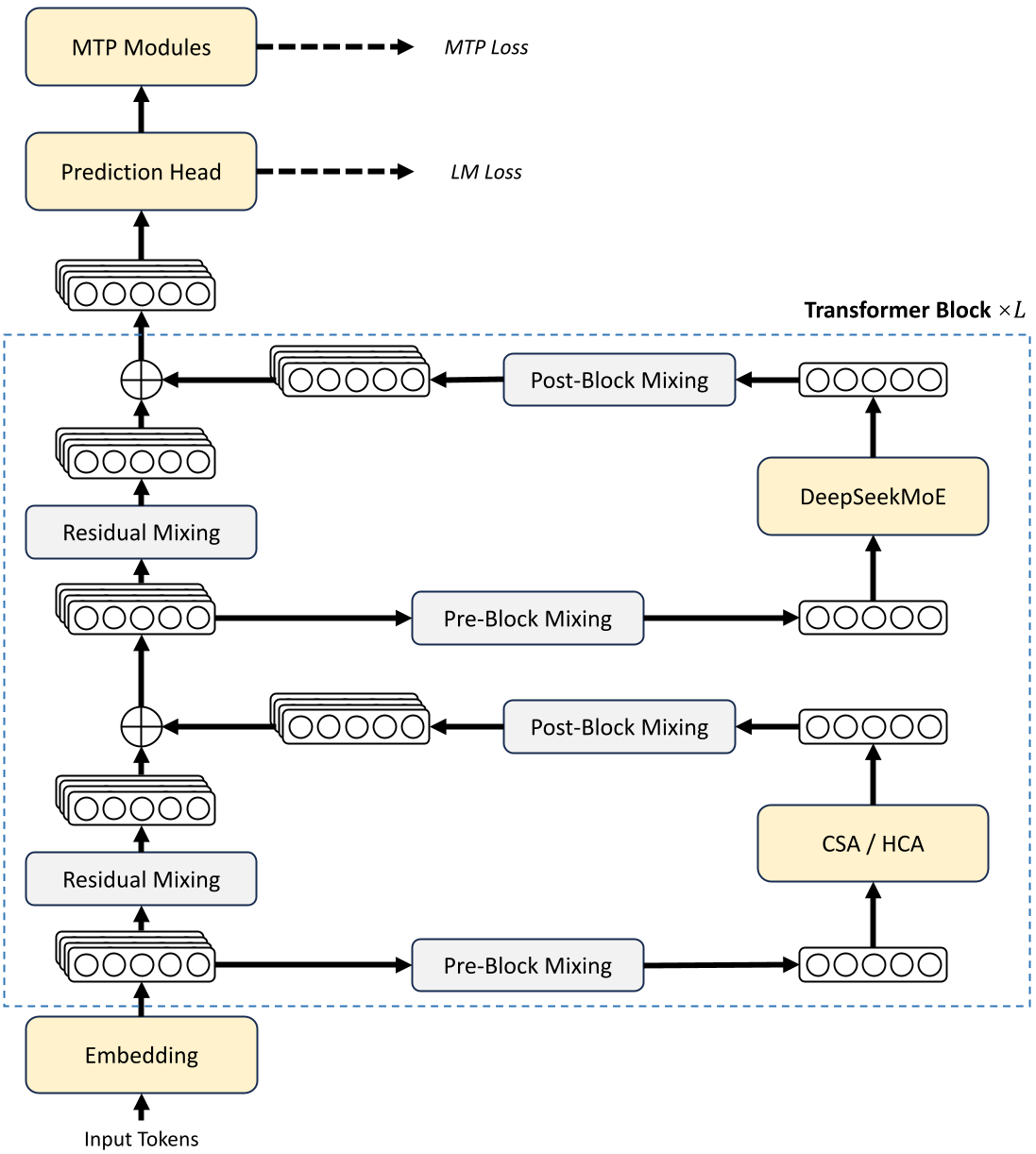
2. Manifold-Constrained Hyper-Connections (mHC)
Traditional residual connections can become unstable in very deep networks. mHC upgrades these by constraining the residual mapping onto the manifold of "doubly stochastic matrices" via the Sinkhorn-Knopp algorithm. This ensures signal stability without sacrificing the model's expressive "width."
3. The Muon Optimizer
Moving away from standard AdamW for most layers, DeepSeek-V4 uses Muon. By utilizing Newton-Schulz iterations for orthogonalization, Muon provides faster convergence and superior stability for the 1.6-trillion-parameter scale.
Experiments & Results: Efficiency Redefined
The efficiency gains of V4 are staggering. When compared to the already optimized DeepSeek-V3.2, V4-Pro reduces the accumulated KV cache size by 90% and inference FLOPs by 73% in the 1M-token setting.
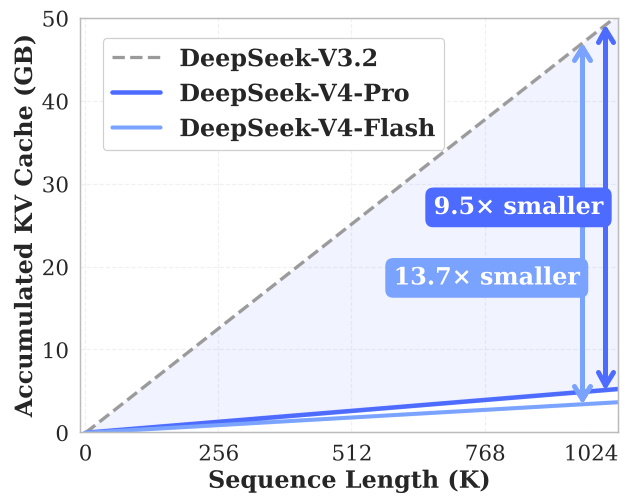
Key Benchmarks:
- Coding: DeepSeek-V4-Pro-Max reached an Elo rating of 3206 on Codeforces, ranking 23rd among human candidates globally.
- Reasoning: On HLE and GPQA, it matches or narrows the gap with frontier closed models like Gemini-3.1-Pro.
- Long Context: It maintains stable retrieval performance up to 1M tokens, outperforming Gemini-3.1-Pro on in-context retrieval (MRCR) tasks.

Deep Insight: Why Does It Work?
The success of DeepSeek-V4 stems from Inductive Bias Engineering. By forcing the attention mechanism to be both sparse and compressed, the model learns to prioritize "anchor" information across the sequence. The use of Anticipatory Routing (using historical parameters for MoE routing) and SwiGLU Clamping addresses the long-standing "loss spike" issues of MoE training at a trillion-parameter scale.
Critical Analysis & Conclusion
Takeaway: DeepSeek-V4 proves that we don't need to sacrifice efficiency for context length. The "Flash" version (284B) is particularly impressive, providing near-SOTA reasoning with significantly lower activated parameters.
Limitations: The architecture is increasingly complex. The hybrid nature of CSA/HCA/SWA requires highly specialized "Mega-Kernels" (like their open-sourced DeepGEMM/TileLang) to be performant on current hardware.
Future Outlook: DeepSeek is moving toward "Model Sparsity" in every dimension—MoE for weights, CSA for attention, and potentially sparse embeddings next. This is the blueprint for real-time, long-horizon AI agents.