
Genie: Turning the Social Graph into a Shield Against Data Scrapers
Defending against large-scale crawls in online social networks
Deeply integrated with credit network theory, Genie is a defense system designed to thwart large-scale automated profile crawling in Online Social Networks (OSNs). By leveraging social graph distances and credit-based rate limiting, it ensures that legitimate browsing remains unaffected while making exhaustive data collection computationally and socially expensive for attackers.
TL;DR
In the cat-and-mouse game of data privacy, crawlers often have the upper hand by using thousands of fake (Sybil) or compromised accounts to bypass simple rate limits. Genie flips the script. By treating social connections as "credit lines," Genie forces crawlers to pay more for viewing distant profiles. The result? A system that slows down massive crawls from days to years, with almost zero impact on real users.
Background: The Limits of Traditional Defense
Whether it’s a search engine or a malicious aggregator, crawlers want one thing: your data. Historically, platforms like Facebook or Renren used Account-based or IP-based rate limiting. However, these are "stateless" at a social level. If a crawler buys 10,000 compromised accounts on the black market, a per-account limit of 100 views/day still allows for 1,000,000 profiles to be harvested daily.
Genie's core insight is that Honest users have "Social Liquidity." They view friends or friends-of-friends. Crawlers, conversely, are "Socially Isolated"—they view everyone regardless of distance, and they rarely receive organic views in return.
Methodology: The Credit Network Economy
Genie transforms the social graph into a Credit Network. Each friendship link acts as a two-way credit pipe.
1. The Cost of Distance
Genie doesn't just limit how many views you get; it limits where you can look.
- Viewing a friend? Low or zero cost.
- Viewing a "friend of a friend"? Moderate cost.
- Viewing a total stranger 6 hops away? Expensive. The system uses a cost function where is the shortest path distance.
2. Credit Rebalancing
To prevent honest but active users from "going bankrupt," Genie implements a rebalancing rate (). Additionally, when someone views your profile, you gain credit. Since crawlers are rarely viewed by real people, their accounts quickly run out of "money" and can no longer access the network.
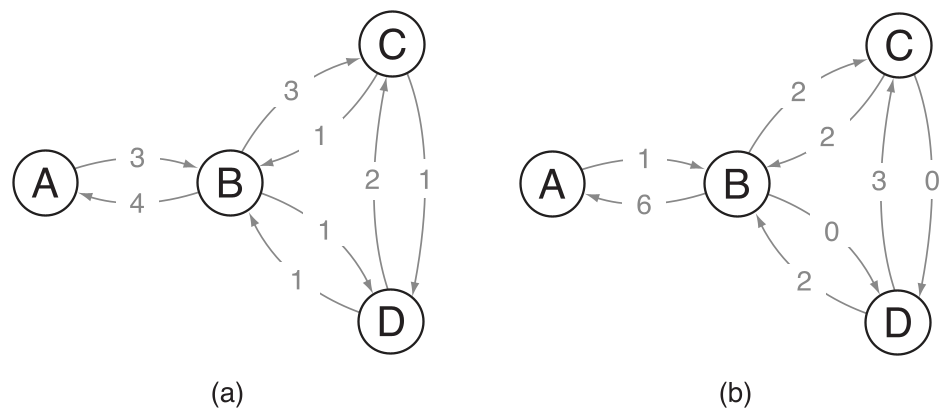 Figure: Credits are debited from the viewer and credited to the viewee along the social path, maintaining local liquidity for honest clusters.
Experiments: Performance at Scale
One of the historical hurdles for credit networks was computation. Calculating max-flow for every profile view in a network of millions (like Flickr) is usually too slow. Genie solves this by integrating with Canal, a landmark-routing framework that provides 94%+ accuracy while processing views in less than 1ms.
Key Findings:
- Crawler Frustration: A crawler with 1,000 compromised accounts on YouTube would take years to finish a crawl that previously took days.
- Minimal Collateral Damage: Over 99% of users are completely unaffected.
- The "Low-Degree" Recourse: The small fraction of honest users who are flagged are typically those with very few friends (low liquidity). The study showed that adding just 1-4 more friends solved the problem for 97% of these users.
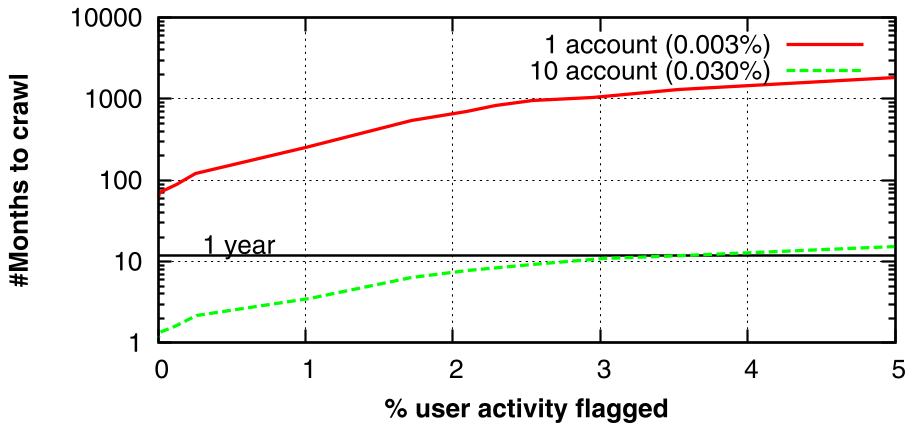 Figure: The trade-off between crawling time (defense strength) and percentage of honest views flagged.
Critical Insight: Inductive Bias in Security
The brilliance of Genie lies in its Inductive Bias. It assumes that in a social network, trust is a finite resource that must be spent to move across the graph. By making the "Attack Cut" (the boundary between the crawler's accounts and the rest of the world) a bottleneck for credit, Genie makes Sybil accounts useless. You can create 1 million accounts, but if they don't have established, trusted links to the "Honest Core," they have no credit to spend.
Conclusion & Future Look
Genie represents a shift from Reactive Defense (blocking IPs after they crawl) to Structural Defense (making the network architecture inherently resistant to crawling).
Limitations:
- While Genie stops "greedy" wide-scale crawls, it is less effective against "targeted" stalking of a specific small group.
- It requires the OSN to have a relatively high "mixing time" and connectivity.
For future OSN operators, Genie suggests that the best way to protect user data isn't a bigger firewall—it's a smarter use of the relationships users have already built.