
Defeating Fake Base Stations: Safeguarding Social Networks via AP Tagging
A Defense Mechanism Against Location Cheating Attack in Social Network
This paper introduces a defense mechanism against location cheating in WLAN-based social networks. It proposes using "AP Tags" derived from WiFi frame characteristics and verified via Fuzzy Extractors to distinguish between legitimate access points and fake ones injected by attackers.
TL;DR
In the world of Location-Based Social Networks (LBSN), your coordinates are your identity. However, this paper reveals how easily an attacker can "transport" you to a different city using fake WiFi signals. To solve this, the authors propose a hardware-level defense: AP Tags. By extracting unpredictable characteristics from WiFi frames and verifying them with Fuzzy Extractors, the system can distinguish a real router from a malicious spoofing device.
The "Invisible" Threat: Location Cheating
Most vertical positioning systems (like those used by social media apps) rely on a simple scan: "What WiFi MAC addresses do you see, and how strong are they?"
The vulnerability lies in trust. If an attacker broadcasts a signal mimicking a router in Taipei while you are actually in Fuzhou, your phone might prioritize the stronger (but fake) signal.
- Prior Work Limitation: Previous defenses often focused on IP or MAC filtering, which are easily bypassed.
- The Insight: While an attacker can spoof a MAC address, they cannot easily replicate the exact timing and sequence-level entropy of real traffic frames generated by a legitimate network environment.
Methodology: The AP Tag Architecture
The core of the defense is the AP Tag, a unique signature generated from the 802.11 MAC header.
1. Extracting Entropy
The system doesn't just look at the MAC address; it looks at Behavior. It captures different frame types:
- Beacon Frames: Low entropy (periodic).
- Probe/RTS/CTS Frames: High entropy (dependent on real-time network traffic).
By calculating the transition probability (Markov process) of these frames, the system creates a high-entropy set of parameters that are nearly impossible for a remote attacker to guess.
2. The Bloom Filter Mapping
To keep the data compact for transmission to the server, these parameters are passed through a Bloom Filter using hash functions to generate a binary string—the AP Tag.
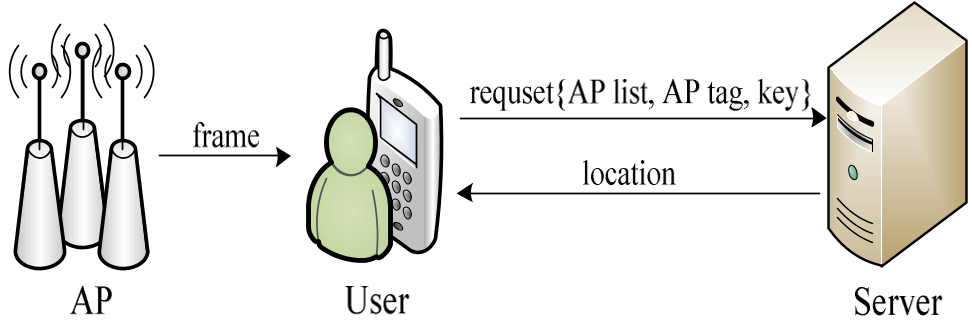
3. Fault-Tolerant Verification
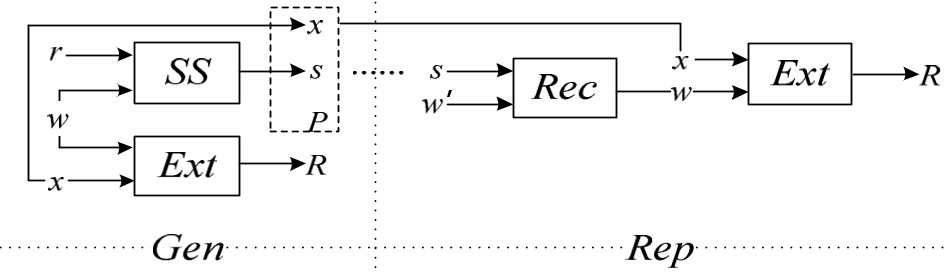
Because wireless signals are "noisy," two users standing next to each other won't capture the exact same frames. This is where Fuzzy Extractors come in.
- They allow the server to reconstruct a secret key even if the input tags are slightly different (within a Hamming distance threshold).
- If multiple users see the "same" AP but generate wildly different tags, the server flags that AP as a counterfeit.
Experiments: From Fuzhou to Taipei
The authors demonstrated a successful attack using an Android phone and aMap (Amap). By using WiGLE to harvest data from Taipei and MDK3 to jam local Fuzhou signals, they forced the phone to report its location thousands of miles away.
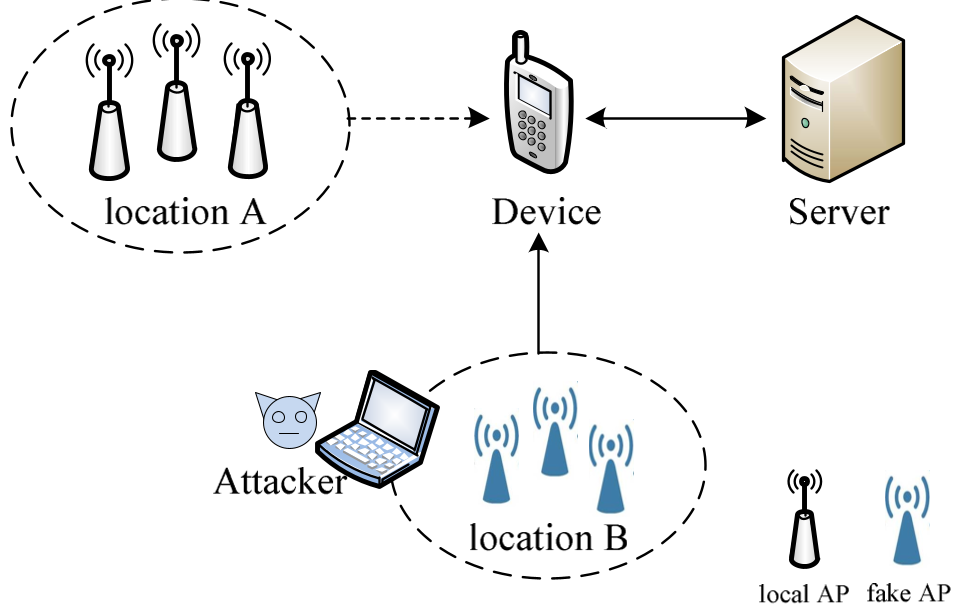
The defense mechanism effectively mitigates this by requiring a "consistency check." Since the attacker (in Fuzhou) cannot know the real-time frame sequence of a router actually located in Taipei, the forged AP Tag will fail the Fuzzy Extractor reproduction test at the server.
Critical Analysis & Conclusion
Takeaway
The paper shifts the security of positioning from "Identity" (MAC address) to "Evidence of Presence" (AP Tags). This is a significant step toward robust LBS.
Limitations
- User Density: The mechanism assumes at least two users are near each AP for consistency checking. In rural or low-traffic areas, this defense might degrade.
- Computational Overhead: Generating Bloom filters and running fuzzy extraction on the server adds latency to the positioning process.
Future Outlook
As we move toward "Proof of Location" in Web3 and autonomous logistics, techniques like these—which utilize the inherent noise and entropy of the physical environment—will become essential to provide trust in an increasingly spoofable world.