
Defensive Resource Allocation: Turning Social Networks into Strategic Battlegrounds
Defensive resource allocation in social networks
This paper presents a game-theoretic framework for defensive resource allocation in social networks, modeling a competition between an incumbent and a challenger. Utilizing the Voter Model for influence spread, the authors derive optimal marketing budgets (Nash and Stackelberg equilibria) across a network of potential customers.
TL;DR
This research tackles a core dilemma in digital marketing: How should a market leader (incumbent) distribute its budget to defend against an aggressive newcomer (challenger)? By integrating the Voter Model of social influence with Game Theory, the authors quantify the "Network Value" of customers and prove that being a first-mover in resource commitment (Stackelberg leadership) provides a massive strategic edge over simultaneous competition (Nash equilibrium).
Background: Beyond the Individual Value
Traditional direct marketing calculates a customer's value based on their individual purchasing power. However, in the age of viral influence, a customer's worth is the sum of their intrinsic value plus their Network Value—the influence they exert on their peers. This paper shifts the focus from targeting specific nodes (the discrete problem) to allocating continuous resources (the budget problem) in a competitive setting.
The Core Mechanism: From Random Walks to Budgets
The methodology relies on a brilliant bridge between graph theory and marketing:
- The Voter Model: At each time step, a customer picks a neighbor's opinion at random. Over time, the probability of a node adopting a specific brand is equivalent to the probability of a Random Walk starting from that node ending at a specifically "seeded" node.
- Network Value Calculation: The Authors define the network value by aggregating the influence a node has over the entire network of nodes , weighted by the transition matrix .
- Contest Success Function (CSF): The probability of winning a customer is modeled as the share of resources allocated to that customer relative to the total spend by both competitors ().
 Figure 1: The Voter Model dynamics where opinions spread based on neighborhood influence.
Methodology: Nash vs. Stackelberg
The paper compares two primary strategic scenarios:
- Nash Equilibrium (NE): Both firms decide their budgets simultaneously.
- Stackelberg Leadership: The incumbent (defender) moves first, anticipating the challenger's optimal response.
The authors prove Proposition 3: If valuations are proportional, the strategy is simple—allocate resources in direct proportion to the network value. However, the game becomes far more complex when different communities within the network have different values to different players.
Experimental Insights: The Power of Foresight
Through simulations of 100,000 customers divided into two communities, the study reveals several critical insights:
- The Divergence Threshold: When communities have similar valuations, NE and SE perform similarly. However, as the valuation gap () increases, the Stackelberg profit grows while the Nash profit begins to fall.
- The Budget Paradox: The advantage of being a Stackelberg leader is actually higher when the defender's budget is smaller relative to the attacker's. Strategic positioning compensates for financial weakness.
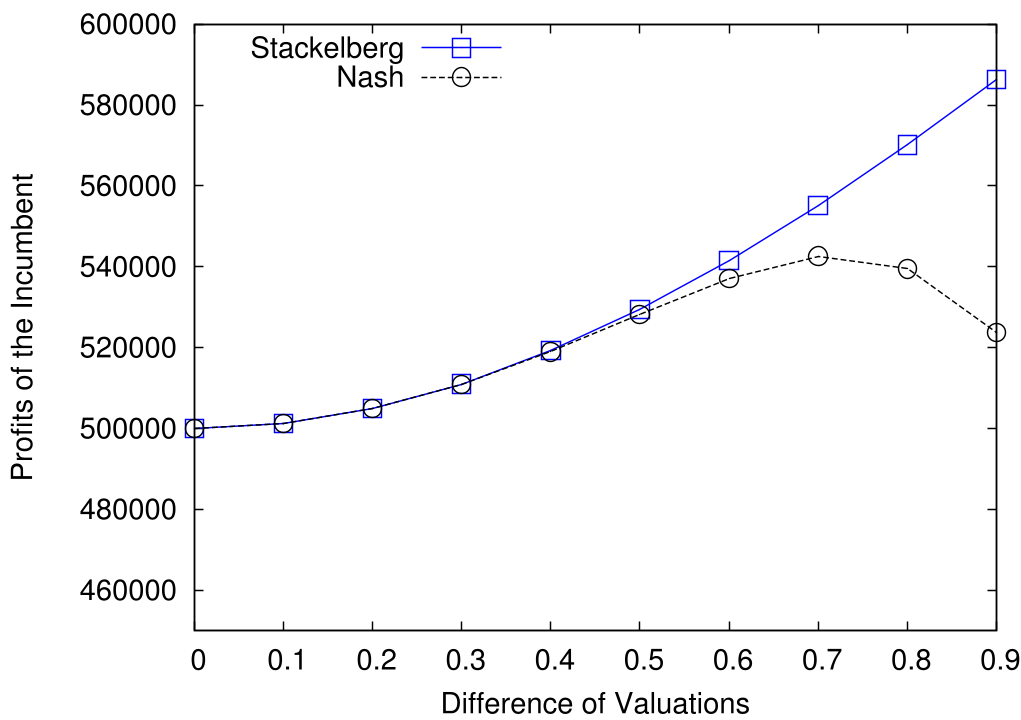 Figure 2: Profits for the incumbent (defender) vs. the difference in valuations (δ) for equal budgets.
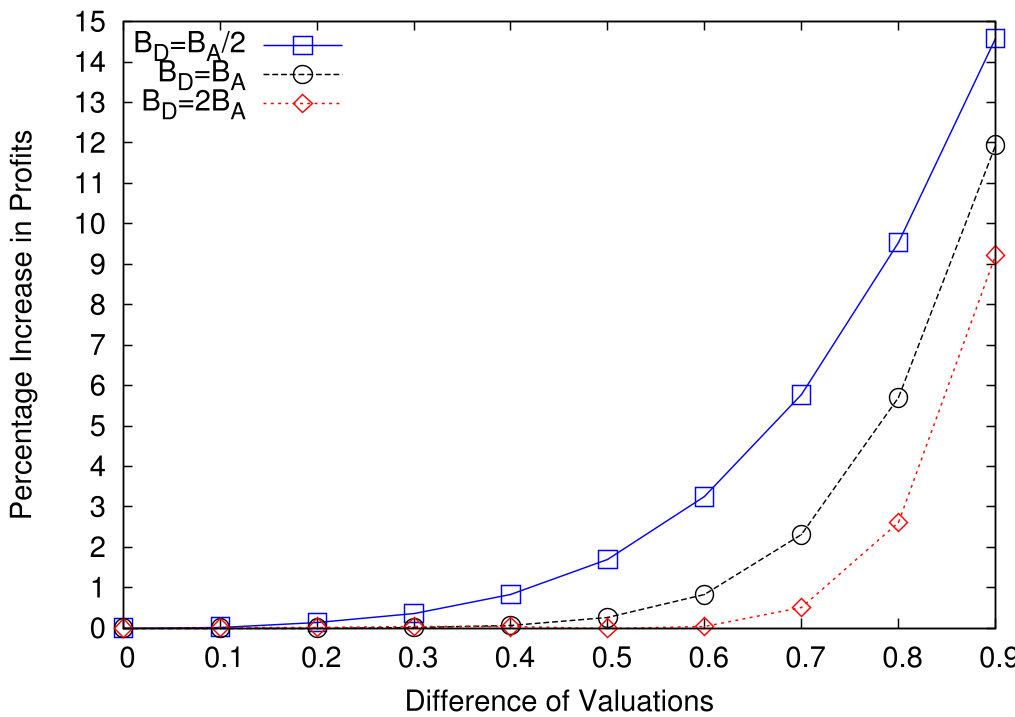 Figure 3: Percentage increase in profits for the incumbent by committing to the Stackelberg model versus Nash equilibrium.
Critical Analysis & Conclusion
The beauty of this work lies in its ability to convert a stochastic influence process (Voter Model) into a solvable deterministic game.
Takeaways:
- Strategic Commitment: For dominant players, "waiting to see" what a challenger does is a losing strategy. Pre-emptive resource allocation based on predicted responses is superior.
- Efficiency: In network games, simply "spending more" isn't enough; resources must be weighted by the influence transition matrix .
Limitations: The model assumes an undirected graph and a relatively simple linear probability for the CSF. Future work could explore more aggressive "winner-take-all" functions where the player with the maximum resources wins the node with 100% certainty, likely leading to even more polarized allocation strategies.