
Multi-layered Degree Centrality: Decoding Complexity in Modern Social Networks
A degree centrality in multi-layered social network
The paper introduces Cross-Layer Degree Centrality (CLDC) for Multi-layered Social Networks (MSN), a framework that quantifies node importance across multiple interaction types. Validated on a real-world Web 2.0 dataset (extradom.pl) with 10 layers, the method provides a tunable parameter α to focus on nodes with high cross-layer density.
TL;DR
As social media platforms evolve, a single "follow" or "friend" link no longer suffices to describe human relationships. This paper introduces a Multi-layered Social Network (MSN) model and a new metric called Cross-layer Degree Centrality (CLDC). By utilizing a tunable parameter , the researchers can filter social hubs based on the breadth of their multi-platform interactions, providing a much higher resolution of "social importance" than traditional single-layer graphs.
Background: Beyond the Single-Layer Graph
In classic Social Network Analysis (SNA), we treat connections as a simple 1:1 mapping. However, on a site like Facebook or YouTube, you might comment on a photo (Layer A), join a group (Layer B), and exchange private messages (Layer C). Treating all these as a single "interacted" edge loses the nuance of the relationship strength.
The authors argue that multi-layered structures are the only way to model the "interconnectedness" of modern IT systems without collapsing distinct behavioral data into a flat, noisy mess.
Methodology: Redefining Neighborhoods and Centrality
The core innovation lies in how the "neighborhood" of a node is defined across layers.
1. Multi-layered Neighbourhood ()
The authors define the neighborhood not just by who you know, but by how many ways you know them.
- Local Neighbourhood: Your standard neighbors in a single specific layer.
- Multi-layered Neighbourhood (): The set of nodes connected to node in at least distinct layers.
2. Cross-layer Degree Centrality (CLDC)
Centrality is recalculated to account for this cross-layer depth. The formula for CLDC integrates the weights of all edges across all layers, normalized by the number of layers and the total nodes.
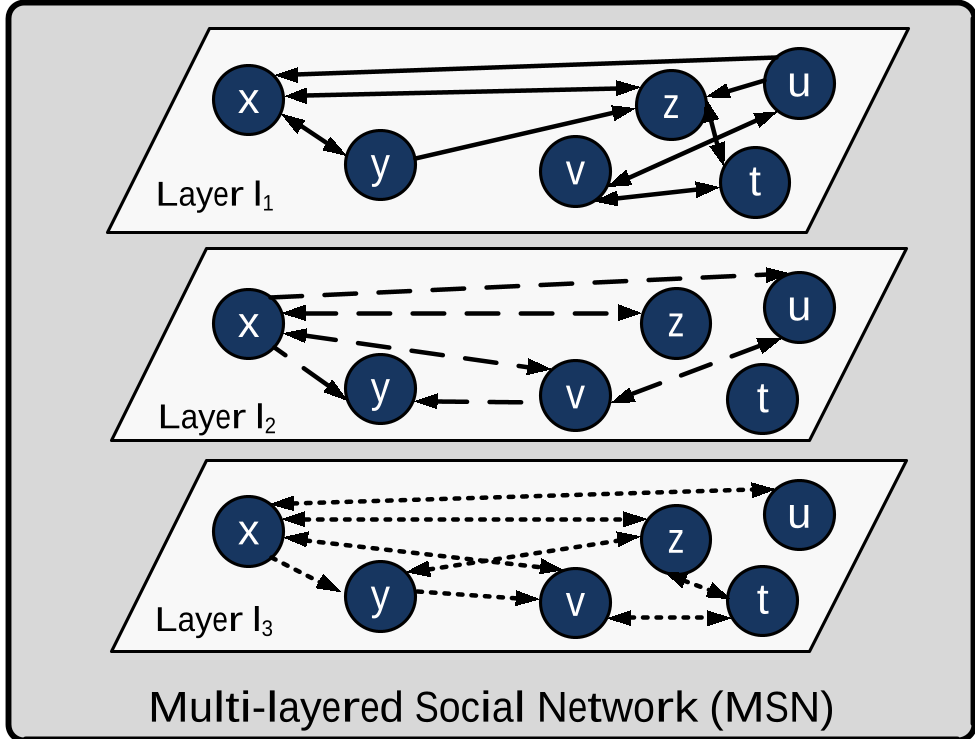 Figure 1: A 3-layered network example. Node x and y are connected in layers and , making their relationship more robust than a single-layer tie.
Experimental Insights: The Power Law and "The Stairs"
The researchers tested their theory on data from extradom.pl, a Polish social network. They extracted 10 layers ranging from "Photo Comments" to "Contact Lists."
Finding 1: Scale-Free Distribution
Even in a multi-layered context, the network follows a power-law distribution. Most people have very few multi-layered neighbors, while a tiny "elite" group is active across almost all layers.
Finding 2: The Persistence of "Stair-like" Patterns
As the threshold increases (requiring users to be connected in more layers), the distribution becomes "stair-like." This indicates clusters of users who share a specific, fixed number of interaction types, likely driven by the UI constraints of the platform.
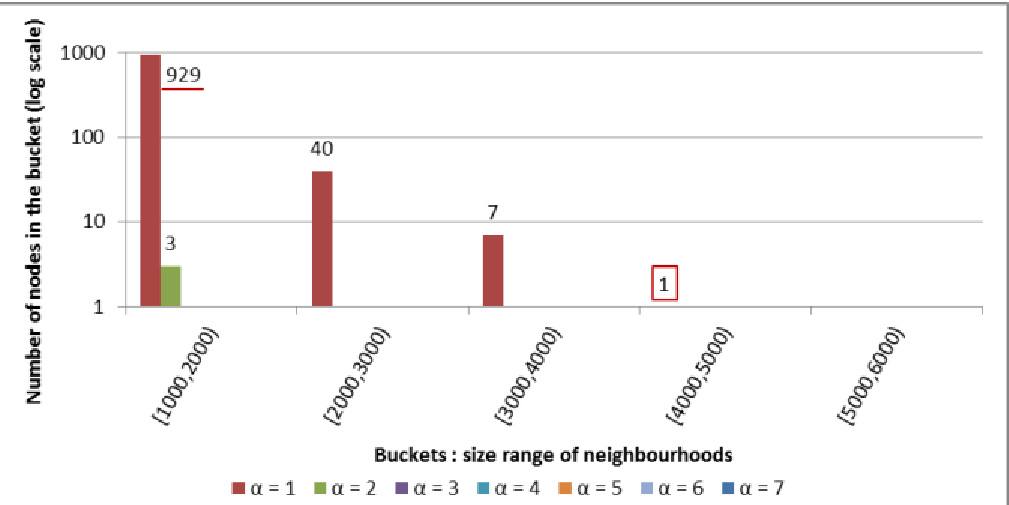 Figure 5: Local neighborhood distributions for each of the 10 layers, showing distinct behavioral patterns per layer.
Conclusion and Future Impact
The introduction of CLDC provides a mathematical foundation for identifying influential users who are not just "loud" in one area, but "broadly engaged" across the entire ecosystem.
Key Takeaways:
- Tunability: By adjusting , analysts can find "surface-level" influencers () or "deeply embedded" community pillars ().
- Data Density: Surprisingly, only 17% of nodes in the studied network had a non-empty multi-layered neighborhood, suggesting that true multi-layered interaction is a rare and valuable signal.
Limitations: The current calculation of CLDC can be computationally expensive for massive networks (millions of nodes/layers), which the authors suggest as a focal point for future algorithmic optimization.
Main Reference: Bródka, P., et al. "A Degree Centrality in Multi-layered Social Network."