
Delay-Aware Auctions: Incentivizing the "Smart City on Wheels" through Strategic Crowdsourcing
Delay-Aware Incentive Mechanism for Crowdsourcing with Vehicles in Smart Cities
The paper proposes a delay-aware incentive mechanism for vehicle-based crowdsourcing in smart cities using a reverse auction framework. The core method, based on a non-monotone submodular maximization model, selects vehicles based on both bidding prices and Estimated Time of Completion (ETC) to maximize requester utility.
TL;DR
As smart cities generate massive computing and sensing tasks, the idle resources of autonomous vehicles offer a scalable solution. However, getting vehicle owners to participate requires more than just money—it requires a system that understands the value of time. This paper introduces a delay-aware incentive mechanism that treats task completion time as a critical economic variable, using a reverse auction to ensure that the most efficient vehicles are recruited within a strict budget.
The "Time is Money" Problem in Crowdsourcing
Typical crowdsourcing rewards are static versions of "if you do X, I pay Y." In a high-mobility environment like a smart city, this is insufficient. A sensing task (like traffic monitoring) completed in 5 minutes is exponentially more valuable than one completed in 50 minutes.
Current state-of-the-art (SOTA) mechanisms for smartphone crowdsourcing often focus on coverage or cost minimization but fail to account for the dynamic mobility of vehicles. The challenge lies in creating an incentive that prevents "strategic gaming" (vehicles over-bidding) while prioritizing those who can actually meet tight deadlines.
Methodology: The Task Value Function & Submodular Logic
The authors define the utility of a service requester not as a fixed number, but as a function of time.
1. The Decay of Value
The "Task Value Function" quantifies how the value of a task drops as time passes. It typically follows an exponential decay: This means the auctioneer (the Service Provider) isn't just looking for the lowest bidder; they are looking for the best Value-to-Cost ratio where value is time-dependent.
2. The Mechanism Framework
The interaction is modeled as a Reverse Auction. Vehicles don't just submit a price ; they submit a tuple including their Estimated Time of Completion (ETC).
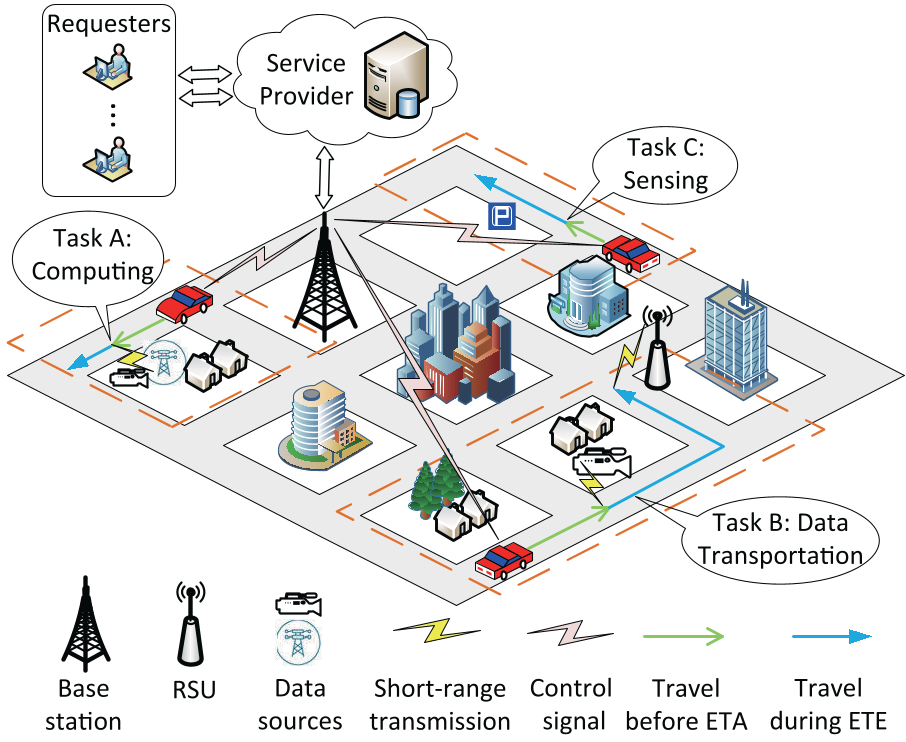 Fig 1: The architecture including Task A (Computing), B (Communication), and C (Sensing).
3. Winning Bid Selection
The problem is framed as a non-monotone submodular maximization problem. Because this is NP-hard, the authors propose a greedy algorithm that selects vehicles based on their marginal social welfare per unit cost.
Experiments: Balancing Cost and Quality
The simulation environment utilized a smart city road network with vehicles arriving via a Poisson process.
Key Insight: The Sensitivity of Delay
A standout finding in the results is how the mechanism adapts to different task types. When tasks have a high "descent rate" (meaning their value vanishes quickly), the system automatically pays a premium for speed.
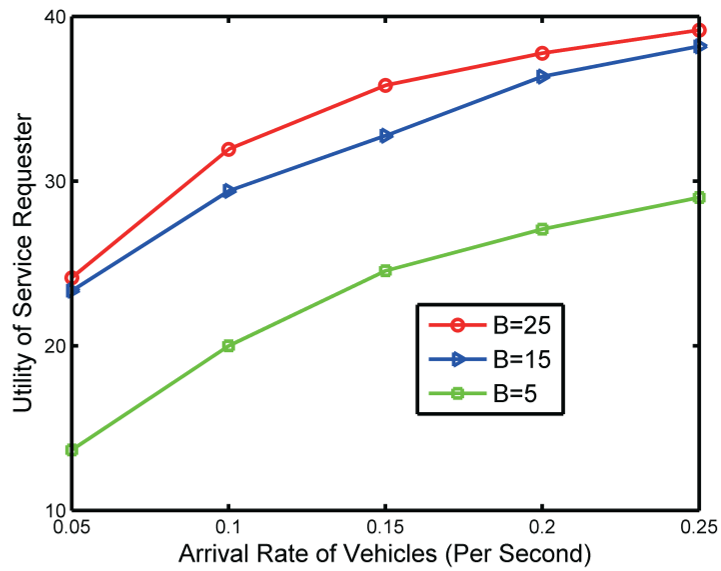 Fig 2: Requester utility increases significantly as the arrival rate of vehicles () grows, providing a larger pool for optimization.
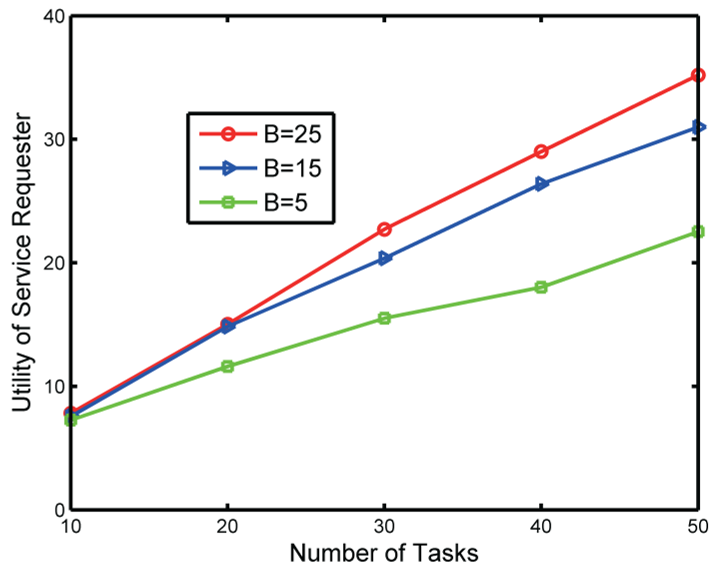 Fig 3: The correlation between budget, task volume, and the utility of the requester.
Critical Analysis & Conclusion
Takeaway
The paper effectively proves that truthfulness and budget feasibility are not mutually exclusive with delay-sensitivity. By allowing vehicles to report their own ETC, the platform can act as an efficient scheduler.
Limitations & Future Work
- Trust in ETC: The current model assumes vehicles report their ETC based on internal navigation systems. A "strategic" vehicle might lie about its ETC to win a bid. While the paper includes a penalty for late completion, future work could integrate reputation-based trust scores.
- Privacy: Bidding involves sharing trajectories, which is a privacy risk. Integrating Differential Privacy into the bidding phase would be a natural next step for this research.
In conclusion, this work provides a rigorous mathematical foundation for turning every car on the road into a potential node in a distributed urban supercomputer, provided the price—and the timing—is right.