
E-Government: From Digital Dictation to Deliberative Dialogue
Deliberative democracy and the conceptual foundations of electronic government
This article examines the conceptual foundations of electronic government (e-government), contrasting two diverging models: a participation-based foundation aimed at fostering deliberative democracy and a polarization-based foundation that reinforces government agendas. The author argues that without intentional design to present multiple viewpoints, e-government risks exacerbating social fragmentation and group polarization.
TL;DR
Is e-government merely a digital vending machine for services, or is it a pillar of democracy? This seminal work by Paul T. Jaeger argues that the current trajectory of electronic government risks fueling Group Polarization. By presenting only the perspectives of the party in power, government websites may be inadvertently dismantling the foundations of Deliberative Democracy. The author suggests a radical pivot: designing e-government to host a multiplicity of viewpoints to foster reasoned public reflection.
Background: The Invisible Foundation
Most research into e-government obsesses over two metrics: efficiency and accessibility. While it is undeniably useful to pay taxes or renew a license online, we have ignored the "conceptual foundation" of these digital spaces. Jaeger points out that an e-government site is never neutral. Its design, information hierarchy, and content selection send a powerful message about what the government deems "correct" or "acceptable."
The Core Problem: The Polarization Trap
The Internet was once hailed as a great equalizer, but it has become a powerful tool for Group Polarization. In psychological terms, when individuals with similar dispositions discuss an issue in isolation, they gravitate toward more extreme versions of their initial beliefs.
The paper identifies a dangerous synergy:
- Selective Exposure: Citizens use the internet to find "echo chambers" that share their views.
- One-Sided E-Gov: Government sites often act as "one-way" flows of information, promoting the ruling party’s agenda as "objective authoritative truth."
When these two forces meet, the middle ground of democratic deliberation—the "thoughtful weighing of various approaches"—is lost.
Methodology: The Deliberative Framework
To counter this, Jaeger draws upon the theories of John Rawls and Aristotle to propose a new architecture for e-government. Instead of a "virtual advertisement" for policy, the government should act as a curator of democratic discourse.
Architecture of Participation
The "Participation-based Foundation" involves a fundamental redesign:
- Multiple Perspectives: If a new education policy is posted, the site should include independent critiques, alternative proposals from opposition parties, and scholarly impact reports.
- Proactive Reminders: By placing links to opposing views on the same page, the site creates a "subtle but firm reminder" that other opinions exist, preventing the total avoidance of conflicting data.
 Note: The paper argues that current e-government sites (like the one pictured above) focus heavily on one-sided promotion.
Case Study: The "No Child Left Behind" (NCLB) Portal
Jaeger uses the U.S. Department of Education’s NCLB website as a primary example of the Polarization Foundation. At the time of writing, the site functioned as a propaganda arm:
- It trumpeted "better results" and "stronger communities."
- It completely omitted the fact that eight state legislatures had passed resolutions critical of the act, or that the Government Accountability Office (GAO) had raised implementation concerns.
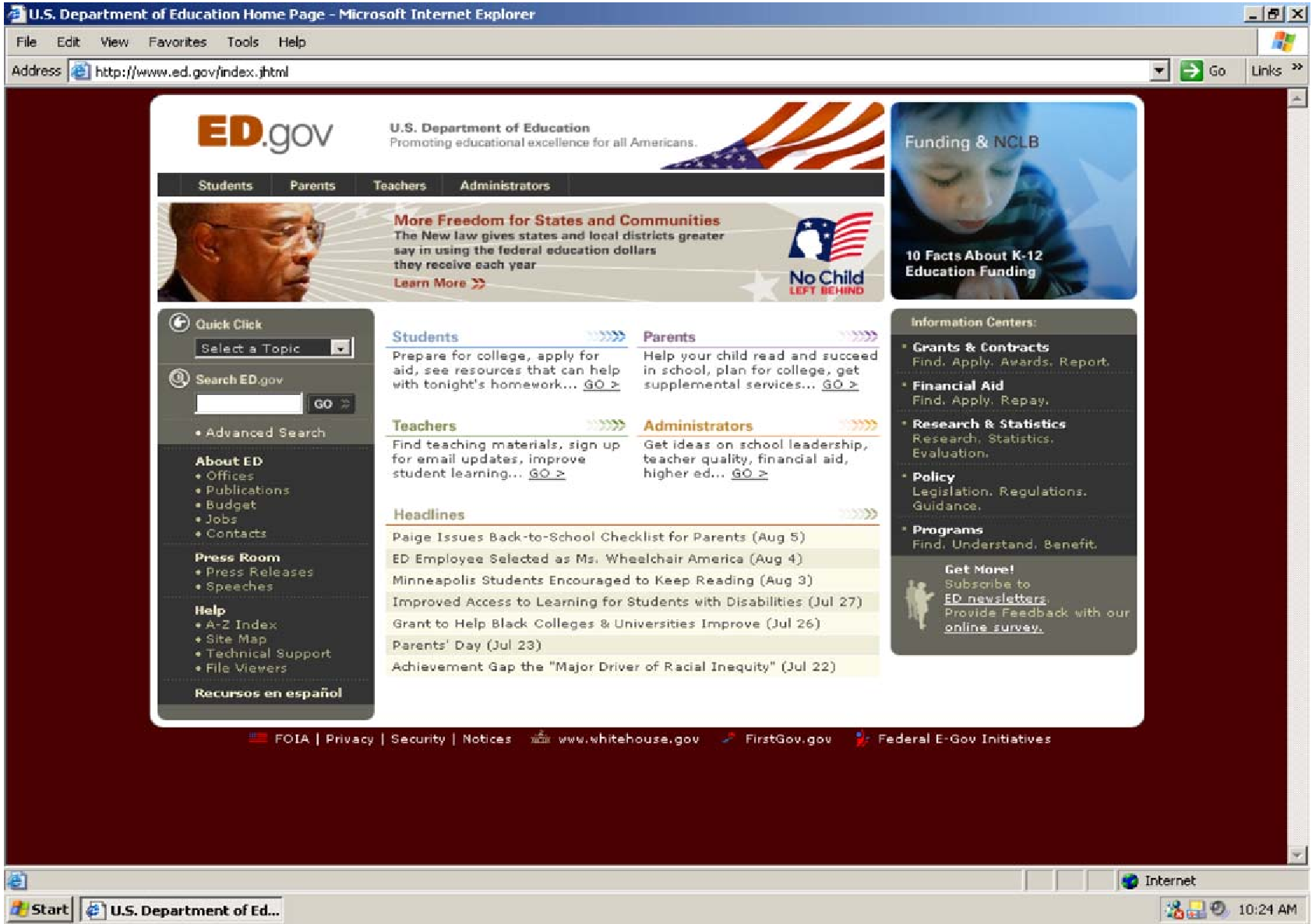 The image highlights how government sites often use a marketing-heavy approach to policy dissemination.
Critical Insight: The "Spirit of Liberty"
The paper concludes with a call to adopt the "Spirit of Liberty"—the willingness to admit that one might not be entirely right. If e-government sites continue to act as mirrors reflecting only the ruling party's success, they become impediments to the very democracy they are supposed to serve.
Limitations & Future Work
- Partisanship: It is politically difficult for a sitting administration to fund the presentation of its opposition's views.
- Implementation: How do we decide which "alternate views" are valid enough to be hosted on an official government portal?
- Legal Constraints: In the U.S., anti-lobbying statutes (18 U.S.C. § 1913) create a complex legal landscape for how interactive or "one-sided" a government site can be.
Conclusion
This work serves as a vital reminder that technology is not value-neutral. As we move toward more sophisticated AI-driven e-government, the risk of "automated polarization" grows. We must decide now: will our digital town halls be places of debate, or simply digital bulletin boards for the powerful?