
Deliberative Searcher: Mastering the Art of "Knowing What You Don't Know" in Search-Augmented LLMs
Deliberative Searcher: Improving LLM Reliability via Reinforcement Learning with constraints
Deliberative Searcher is a reasoning-primary framework that integrates search operations and confidence calibration into Large Language Models (LLMs). It utilizes constrained Reinforcement Learning (RL) with adaptive Lagrangian multipliers to jointly optimize for answer correctness and reliability, achieving a 96% reduction in false-certain rates while matching closed-source performance at the 72B scale.
TL;DR
One of the most dangerous failure modes of modern AI is "False & Certain" output—hallucinating with absolute confidence. Deliberative Searcher addresses this by transforming the LLM into a reasoning-primary agent that uses search as a surgical tool. By applying constrained reinforcement learning, the model learns to lower its confidence when information is missing and only "commit" to an answer after thorough verification. The result? A massive 96% reduction in overconfident errors and a 4x boost in inference efficiency.
The Problem: The Confidence-Correctness Gap
Traditional Retrieval-Augmented Generation (RAG) focuses on stuffing more information into the prompt. However, even with the best tools, LLMs often fail to synchronize their internal certainty with external evidence. They either ignore search results that contradict their internal bias or confidently repeat errors found in noisy search data.
The core issue is that standard training optimizes for correctness but ignores reliability. A model that is 50% accurate but 100% confident is far more dangerous than one that is 50% accurate but knows it is guessing.
Methodology: Constrained RL & The Deliberative Loop
The authors introduce a framework where the model doesn't just "read and answer." Instead, it follows a structured iterative process:
- Decomposition: Breaking down queries using
<think>tags. - Active Retrieval: Triggering
<search>calls only when knowledge gaps are found. - Continuous Calibration: Reporting
<confidence>scores at every step of the reasoning trajectory.
Optimizing for Reliability
The technical breakthrough lies in the training objective. Using a variant of Group Relative Policy Optimization (GRPO), the researchers added a constraint: the model's reliability must stay above a target threshold (e.g., 90%).
Instead of a fixed penalty, they used Adaptive Lagrangian Multipliers. If the model becomes overconfident (False & Certain), the multiplier increases, making the reliability penalty more severe. If the model is well-calibrated, the optimizer focuses more on improving accuracy.
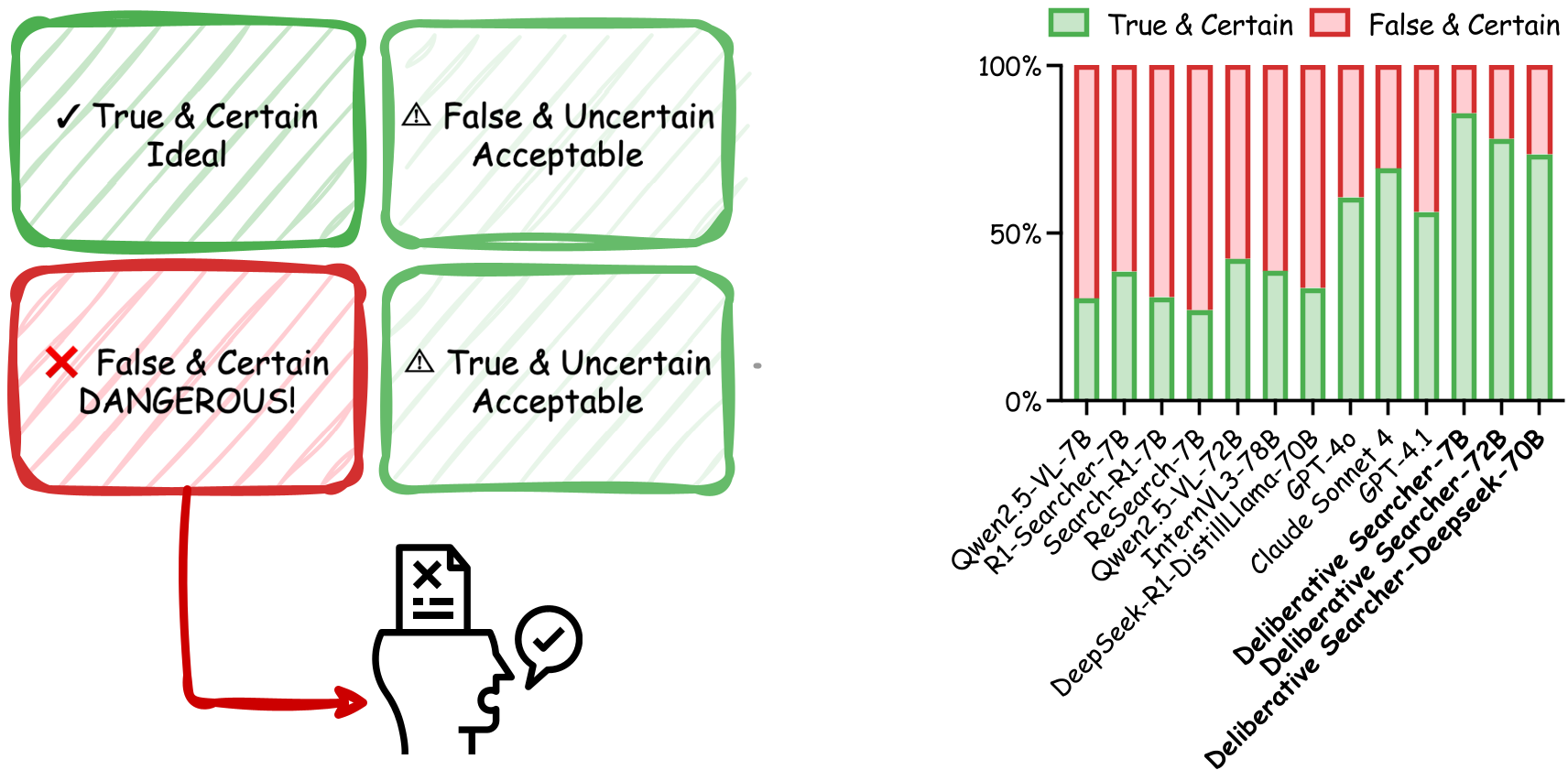 Figure 1: The framework maps outputs into four states, specifically targeting the reduction of the "False & Certain" quadrant.
Experimental Triumphs: Accuracy and Efficiency
The researchers tested the framework on multi-hop QA benchmarks (like HotpotQA) and real-world search tasks (GAIA).
- Calibration Miracle: The 7B model's false-certain rate plummeted from 54% to 2%. This suggests the model learned a "verification habit"—searching more when it felt uncertain.
- Scaling Inference: Standard LLMs use "Majority Voting" (Self-Consistency) to improve results, but this is compute-heavy. Because Deliberative Searcher's confidence scores are actually accurate, the researchers used Confidence-Weighted Aggregation.
- 4x Compute Savings: The 72B model achieved the same accuracy with 4 samples as a standard model did with 16 samples.
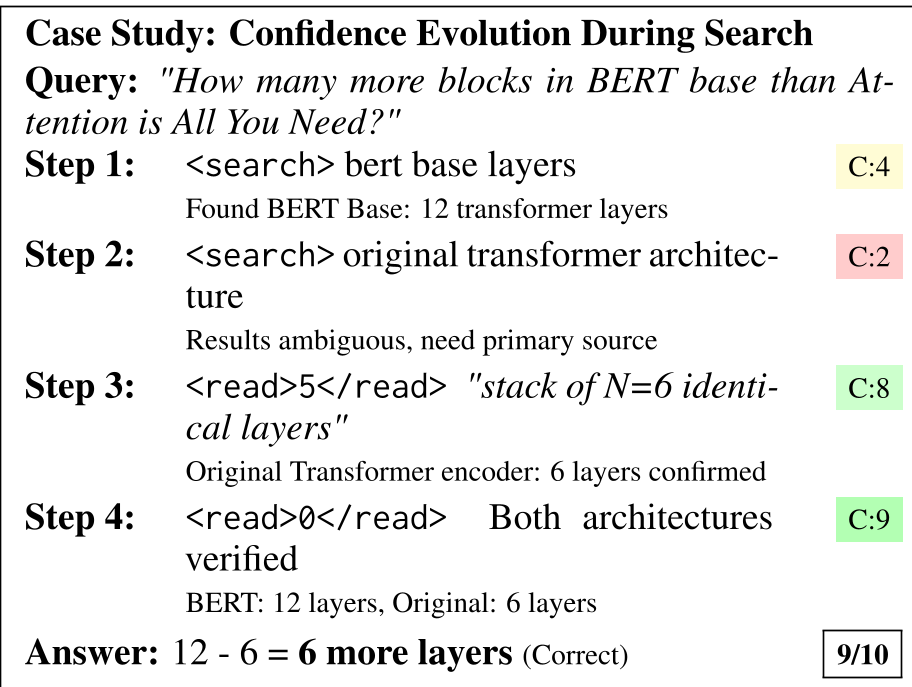 Figure 2: A case study showing how the model's confidence fluctuates as it finds ambiguous vs. authoritative information during a search task.
Deep Insight: Is Calibration an "Emergent" Property?
A key finding in the ablation studies was that model size alone does not solve calibration. Even 72B models, when untrained via constrained RL, remained wildly overconfident when wrong. This proves that "deliberation"—the ability to weigh evidence against internal belief—must be explicitly incentivized during the reinforcement learning phase.
Conclusion & Future Outlook
Deliberative Searcher represents a shift from "Information-Primary" AI to "Reasoning-Primary" AI. By making confidence an "earned outcome" of the search process rather than a random logit, we move closer to AI that can be trusted in high-stakes environments (medical, legal, or technical).
Future Work: The authors note that while they used Vision-Language models (Qwen2.5-VL), they haven't yet explored multimodal search (e.g., searching for images to verify a claim). This "Multimodal Deliberation" could be the next frontier for truly trustworthy agents.