
Optimized Content Delivery in CCMSNs: A Priority-Aware Approach
Delivering Content with Defined Priorities by Selective Agent and Relay Nodes in Content Centric Mobile Social Networks
The paper proposes a priority-based content delivery scheme for Content Centric Mobile Social Networks (CCMSNs). It introduces a systematic framework for selecting optimal agent and relay nodes while defining interest and data packet priorities based on content popularity and community properties to reduce transmission delay.
TL;DR
This research tackles the inefficiency of content delivery in Mobile Social Networks (MSNs) by integrating Content Centric Networking (CCN) principles. The authors propose a "dual-node" selection strategy (Agent and Relay) combined with a priority-ranking system for interest and data packets. By quantifying community interests and node encounter frequencies, the system significantly reduces delivery latency compared to baseline social-aware algorithms.
Problem & Motivation
Despite the rise of mobile services, current Mobile Social Networks still rely heavily on host-to-host structures that perform poorly under high mobility and intermittent connectivity. Content Centric Networking (CCN) offers a solution by focusing on the content (Name ID) rather than the location (IP).
However, applying CCN to a mobile social context introduces two major bottlenecks:
- Interest Management: A massive influx of interest packets can saturate the network.
- Node Selection: In an opportunistic environment, identifying which node should "represent" a community (Agent) and which should "carry" the data (Relay) is mathematically non-trivial.
Methodology: The Architecture of Priority
The paper proposes a hierarchical delivery flow involving three distinct phases: node selection, priority definition, and opportunistic transmission.
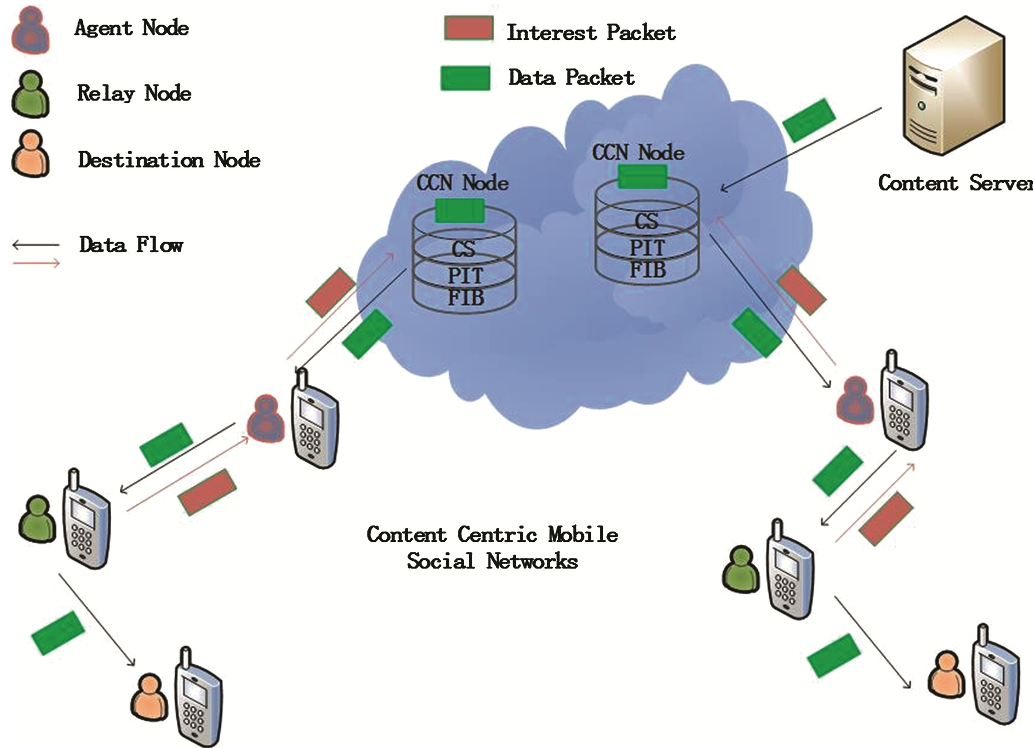
1. Selective Agent Node Positioning
Instead of broadcasting interests globally, each community elects an Agent Node. The selection follows a specific transmission ability formula that balances social connectivity (number of friends) and hardware resources (buffer space).
2. Priority Logic: Demand and Emergency
The core "intelligence" of this work lies in how it ranks packets:
- Demand Degree (): This ranks interest packets waiting to be sent out. It considers historical popularity () and the real-time number of requesters ().
- Emergency Degree (): This determines the order in which data is served. It integrates the community's relative priority with the demand degree of the content.
3. Relay Node Selection
Once data is retrieved, the Agent node must send it back to the moving requester. The paper uses Relative Encounter Frequency. If node A encounters the destination more frequently than node B, A is chosen as the carrier (Relay).
Experiments & Results
The authors validated their scheme using three communities (100 users each) against two baselines: Community Priority focus and Content Popularity focus.
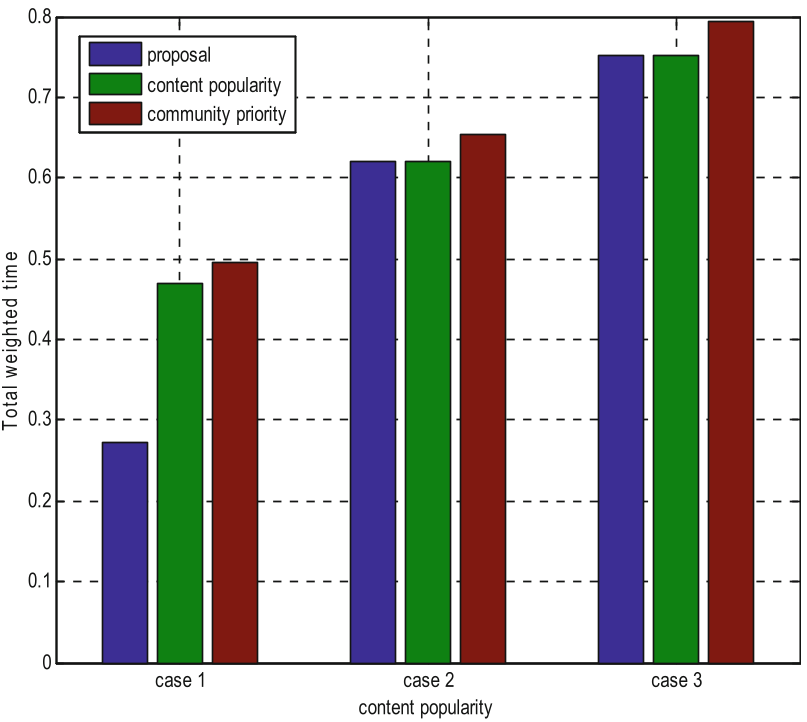
Performance Under Varying Content Popularity
As content becomes more "skewed" (concentrated popularity), the proposed method maintains a lower weighted delay.
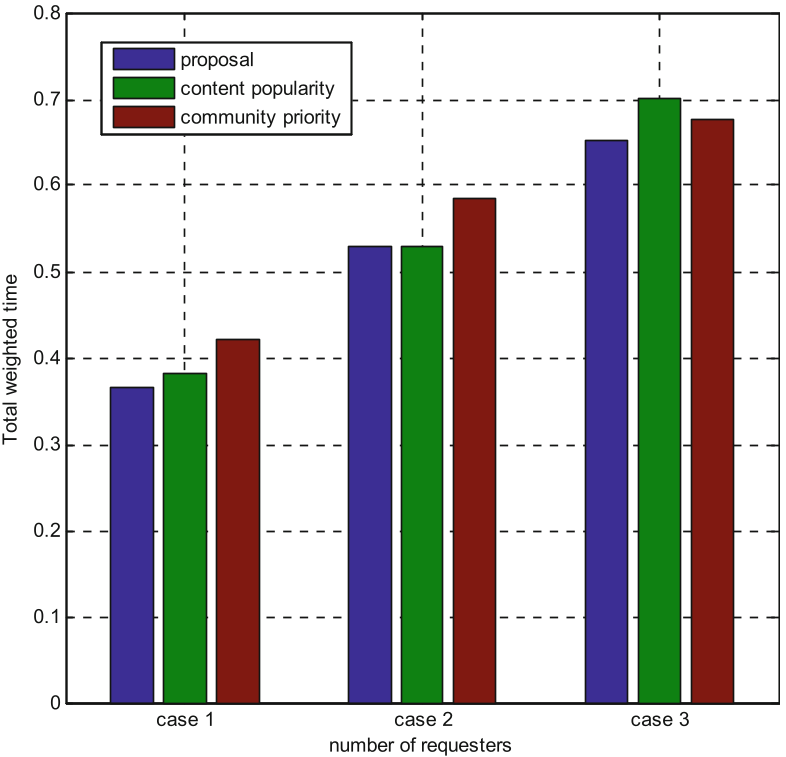
Performance Under Varying Requester Density
Even when the number of requesters shifts dramatically between communities (e.g., from 80 users to 10 users), the proposed model adapts its priorities effectively, outperforming traditional static priority schemes.
Critical Analysis & Conclusion
Takeaway
The paper successfully proves that social context (community properties) + content context (popularity) is a superior metric set for mobile networking than either metric alone. By decoupling the "forwarding" role (Agent) from the "delivery" role (Relay), the system maximizes the efficiency of opportunistic links.
Limitations
- Energy Overhead: While the paper optimizes for delay, the energy cost of frequent state updates for "encounter frequencies" isn't fully explored.
- Security: Agent nodes become central points of failure or potential targets for "interest flooding" attacks.
Future Outlook
This priority-based logic provides a strong foundation for Edge Intelligence. Future research could evolve these static "Weight Factors" () into dynamic parameters tuned by Reinforcement Learning (RL) based on real-time network traffic patterns.