
Delta Attention Residuals: Solving the Routing Collapse in Deep Transformers
Delta Attention Residuals
The paper introduces Delta Attention Residuals, a novel cross-layer routing mechanism that replaces cumulative hidden states with per-sublayer "deltas" (the specific change introduced by a layer). This method achieves significant performance gains, including an 8.2% validation perplexity improvement on a 7.6B parameter model compared to standard transformers.
TL;DR
As Transformer models grow deeper, the standard way we pass information between layers (additive residuals) becomes a "redundancy trap." Delta Attention Residuals breaks this by allowing layers to selectively "reach back" and grab specific changes (deltas) from previous layers. This simple shift from cumulative states to deltas prevents routing collapse, leading to an 8.2% perplexity boost at the 7.6B parameter scale with negligible parameter overhead.
The Problem: The Redundancy Trap and Routing Collapse
In a standard Transformer, each layer adds its output to the running sum of all previous layers: . While this keeps gradients flowing, it creates a massive redundancy problem. By layer 30, the hidden state is almost indistinguishable from .
Recent attempts to solve this, like Attention Residuals, tried to use Softmax attention to let the model choose which previous layers to listen to. However, because those previous layers are all nearly identical "running sums," the attention mechanism gets confused. The result is Routing Collapse: the model gives up on choosing and just averages everything (max attention weight drops to 0.2), rendering the expensive attention mechanism useless.
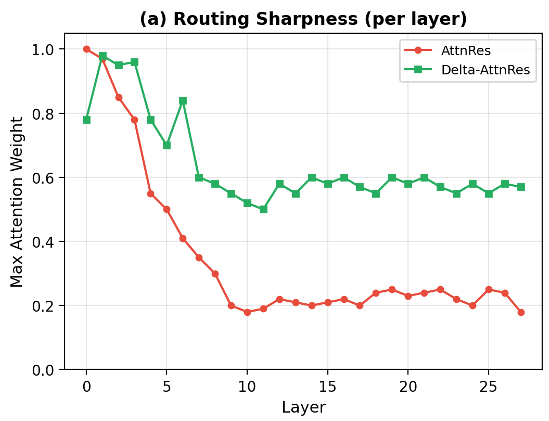 Figure 1: Comparison showing how standard Attention Residuals (AttnRes) collapse to uniform weights, while Delta methods keep routing "sharp" and selective.
The Insight: Route the Change, Not the State
The authors suggest a brilliant pivot: Don't route the state (), route the delta ().
The delta represents exactly what a specific layer contributed—the new information it extracted from the token. Because different layers focus on different features (e.g., syntax vs. semantics), these deltas are structurally diverse. When the routing mechanism looks at deltas, it sees a clear menu of distinct options rather than a blurry list of near-identical states.
Methodology: Additive Delta Routing
The core of the "Delta" approach rests on two pillars:
- Delta Sources: Using (sublayer outputs) or (block changes) as the keys/values for routing.
- Additive Formulation: Instead of replacing the current hidden state, the routed information is added back:
This additive approach is a surgical improvement over the original Attention Residuals (which used replacement). It preserves the existing residual stream and ensures that at initialization, the model behaves exactly like a standard Transformer, making it incredibly stable for training and fine-tuning.
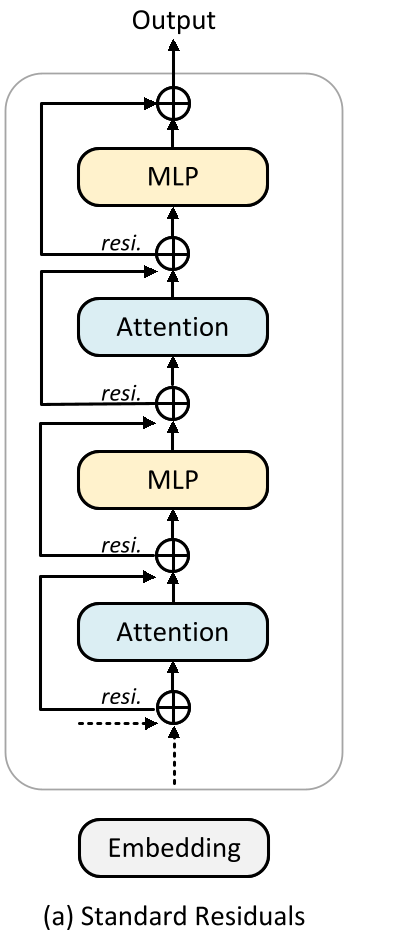 Figure 2: Architecture comparison between Standard Residuals, original Attention Residuals, and the proposed Delta Attention Residuals.
Performance and Scaling
The results are strikingly consistent across all model sizes. Whether at 220M or 7.6B parameters, Delta Attention Residuals outperform the competition.
- Efficiency: The "Delta Block" variant (grouping layers into blocks) achieves nearly the same gains as per-sublayer routing but with much lower memory overhead.
- The 8B Benchmark: On a Qwen3-8B architecture, Delta Block improved validation perplexity by 8.2%.
- Fine-tuning: Unlike prior cross-layer methods that cause massive "loss spikes" when added to pretrained models, Delta Block starts smoothly thanks to its additive identity-path at initialization.
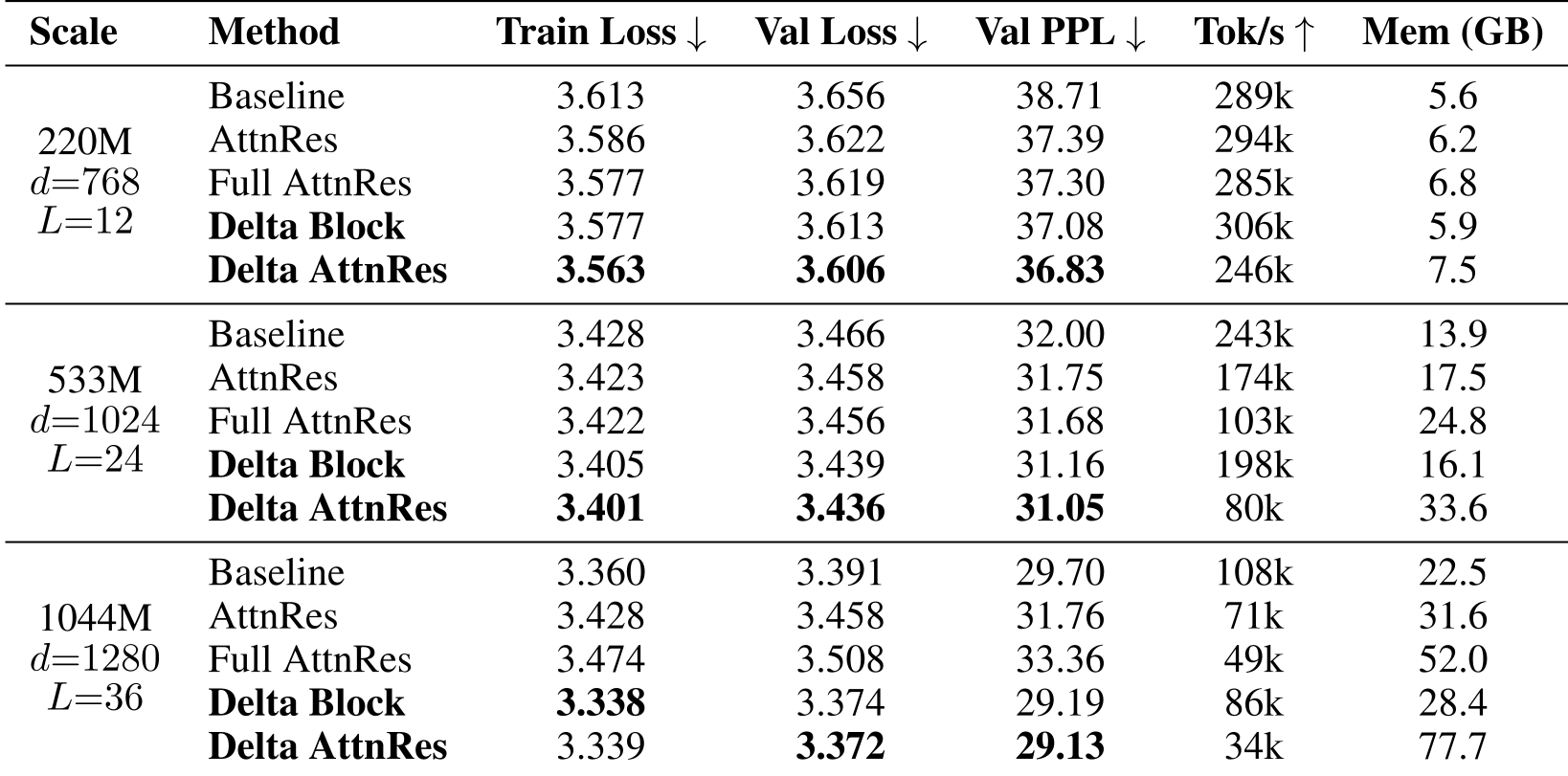 Table 1: Performance metrics showing Delta methods consistently leading in Perplexity (PPL) across various scales.
Deep Insight: Why Does It Work?
Visualizing the learned weights (Figure 6 in the paper) reveals that deep layers in a Delta-enabled model specifically "reach back" to the initial embeddings. This suggests that standard Transformers suffer from signal dilution—the original token identity gets lost in the noise of 30+ layers of processing. Delta routing allows the model to re-inject "pure" token information exactly when and where it's needed.
Conclusion & Perspective
Delta Attention Residuals represent a fundamental shift in how we think about the "Residual Stream." By treating the stream not just as a highway, but as a database of deltas that can be queried, we unlock a new level of architectural expressivity.
Takeaway for Practitioners: If you are training deep models or looking to "boost" an existing pretrained checkpoint through fine-tuning, switching from state-based routing to delta-based routing is a high-ROI architectural change. It solves the stability and redundancy issues that have plagued cross-layer research for years.