
Hierarchical Optimization: Balancing Profit and Welfare in Large-Scale Smart Grids
Demand Response Management in the Smart Grid in a Large Population Regime
This paper presents a hierarchical Stackelberg game framework for Demand Response Management (DRM) in smart grids, involving multiple Utility Companies (UCs) as leaders and a large population of residential/industrial consumers as followers. The authors derive closed-form expressions for the unique Stackelberg Equilibrium (SE) and introduce a novel distributed algorithm to optimize the number of providers in a large-scale regime.
TL;DR
As global electricity demand surges, the traditional grid's inability to dynamically balance supply and demand leads to inefficiency and instability. This paper proposes a hierarchical Stackelberg game framework that treats Utility Companies (UCs) as strategic leaders and consumers as followers. Beyond standard optimization, it proves that for large populations, simply adjusting prices isn't enough—adding more distributed providers is the key to maintaining a "win-win" for both UCs and end-users.
Problem & Motivation
Most Demand Response Management (DRM) studies are "small-world" oriented—they assume a fixed supply or a homogeneous group of users. However, real-world smart grids face two major hurdles:
- Macro-scale Coupling: Decisions by providers (setting prices) and consumers (adjusting demand) are interdependent.
- Large Population Saturation: In high-demand scenarios, prices hit a ceiling (), leading to a paradox where UCs must produce more power but cannot raise prices, causing their profits to plummet.
The authors argue that the "Smart Grid" vision requires a holistic planning-level solution that incorporates power generation, market pricing, and diverse consumer types (Industrial vs. Residential).
Methodology: The Core Architecture
The system follows a three-level hierarchy:
- Top Level (Generation): Costs are modeled via quadratic functions .
- Middle Level (Utility Companies): UCs act as the Leaders. They announce unit prices to maximize their individual profits ().
- Bottom Level (Consumers): End users act as Followers. They adjust their demand () based on price to maximize their welfare (Gain - Cost).
Model Architecture
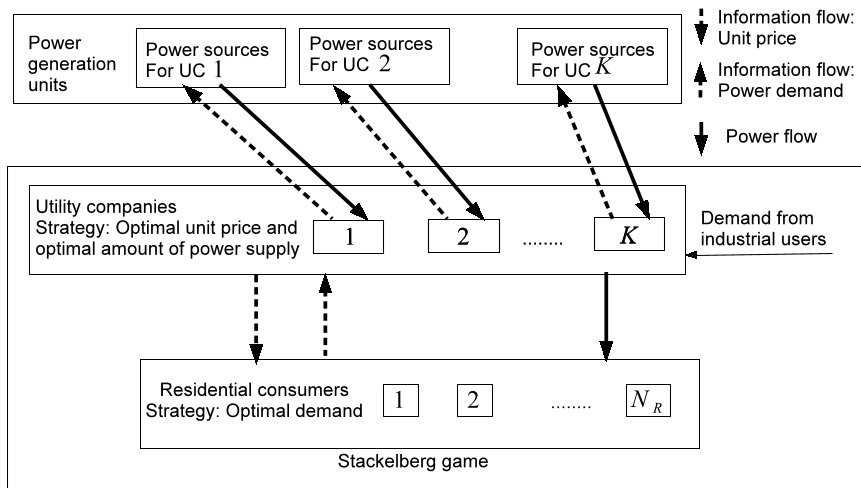
The authors provide closed-form expressions for the Stackelberg Equilibrium (SE). For example, under piecewise quadratic gain functions, the equilibrium unit price is derived by balancing the aggregate marginal costs of all providers against the aggregate marginal gains of all users.
The Large Population Regime: A New Dimension
The paper's most significant contribution is the analysis of what happens when the number of consumers () grows indefinitely. Traditionally, this leads to profit erosion for providers. The authors mathematically prove that there exists a unique optimal number of providers () that maximizes total industry profit.
Distributed Algorithm
To solve this in a real-world setting where UCs and consumers don't want to share private cost/utility functions, they propose Algorithm 1. The grid uses a "Control Unit" to iteratively broadcast prices; users and UCs report their quantities ( and ), and the price is updated based on the supply-demand gap.
Experimental Insights & Results
The numerical simulations corroborate several key theoretical findings:
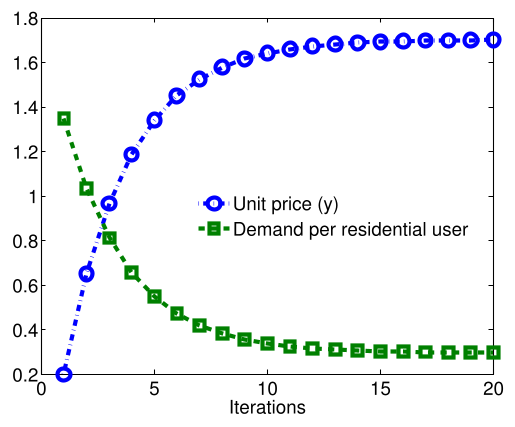
- Convergence: The decentralized price update mechanism is highly stable, reaching equilibrium within 16 iterations regardless of the starting price.
- The Welfare-Profit Tradeoff: As shown in the comparison below, while total UC profit peaks and then slightly declines as more providers are added (due to competition), consumer welfare grows exponentially.
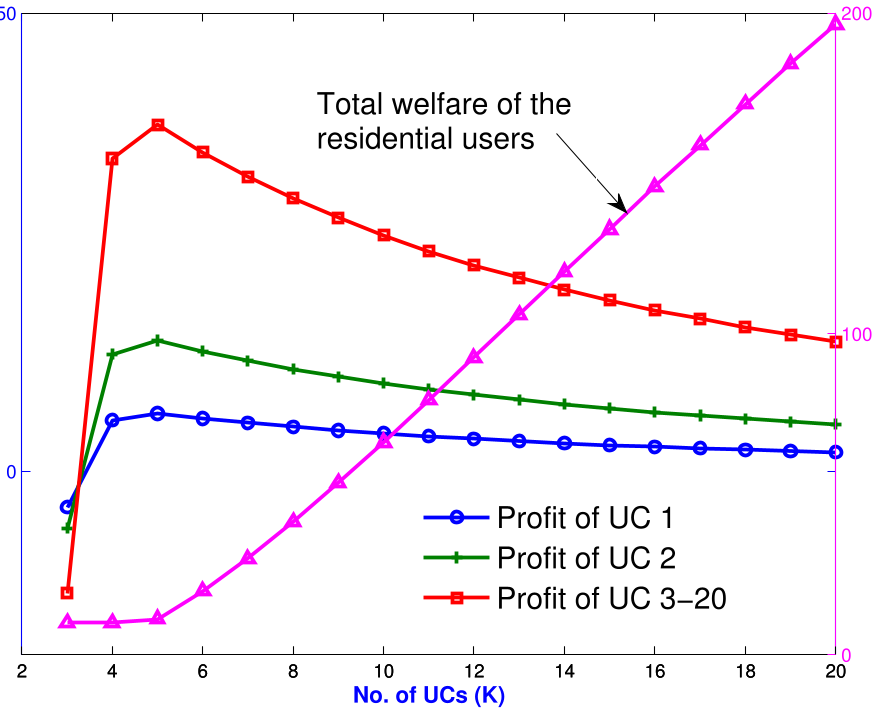
Specifically, adding a single provider beyond the "profit-maximizing" point resulted in a 78.5% gain in consumer welfare at the cost of only an 8% reduction in UC profits.
Critical Analysis & Conclusion
Takeaway
This research moves beyond simple "load shifting" and provides a rigorous mathematical foundation for distributed power generation. It suggests that the liberalizing of market entry for smaller UCs is beneficial for the smart grid infrastructure.
Limitations
- Perfect Competition Assumption: The primary model assumes providers cannot single-handedly manipulate market prices. While the Appendix provides a sketch for imperfect competition, a deeper dive into oligopolistic behavior would be valuable.
- Static Planning: The model targets "planning-level" decisions. Real-time fluctuations (e.g., solar/wind intermittency) are not explicitly handled in the current hierarchical equations.
Future Outlook
The logic of "Optimizing the number of providers" could be extended into the realm of Microgrids, where peer-to-peer energy trading might benefit from a similar Stackelberg structure involving prosumers (consumers who also produce energy).