
Beyond Labels: Demarcating Real Social Sub-Structures in P2P Networks
Towards Demarcation and Modeling of Small Sub-Communities/Groups in P2P Social Networks
The paper investigates the structural validity of self-declared groups in social networks and proposes a framework for modeling these sub-structures within decentralized Peer-to-Peer (P2P) social networks. By analyzing data from "StudiVZ" (a Facebook clone), the authors demonstrate that smaller declared groups exhibit high network density and clustering, justifying their treatment as socially meaningful entities rather than mere labels.
TL;DR
The digital manifestation of human groups is often messy—ranging from massive "interest labels" to tight-knit social circles. This research validates that small virtual groups (3-25 members) are mathematically dense "real" social units. More importantly, it provides a blueprint for how we can build these groups into decentralized P2P social networks, moving us away from the siloed walled gardens of centralized platforms.
The "Cross-Platform" Crisis and the P2P Answer
Why do we need P2P social networks? The authors point to the Cross-Platform Problem: our digital social lives are fragmented. You cannot easily bridge your professional network on LinkedIn with your private group on Facebook. While APIs like OpenSocial attempted to solve this, economic incentives usually prevent giants from truly opening their "walled gardens."
P2P social networking offers a paradigm shift—moving from control to incentives and from centralization to cooperation. However, for P2P to be viable, it must be able to model the fundamental unit of human society: the Small Group.
Are Virtual Groups "Real"?
Before modeling groups in P2P, the authors asked a critical question: Are the groups people join on platforms like Facebook actually cohesive social structures, or just tags?
Using a massive dataset from the German social network StudiVZ, they analyzed 157,033 groups.
- Physical Intuition: If a group is "real," members should know each other, leading to high Clustering Coefficients and Density.
- Findings: The average density of the whole network was a microscopic . In contrast, small declared groups showed significantly higher cohesion.
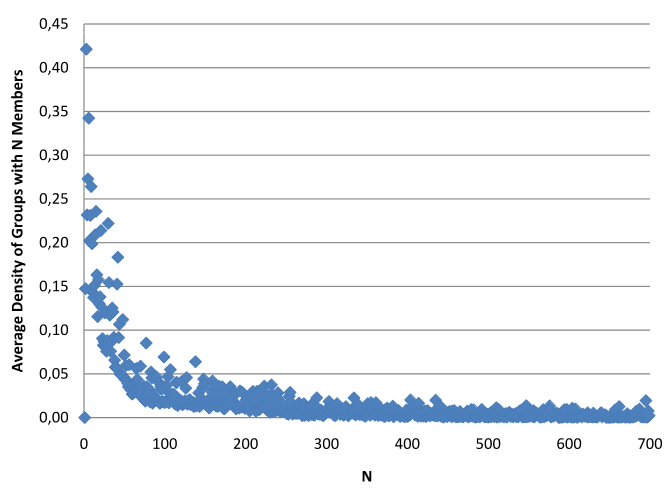 Figure 3: Comparison of average density between all groups (top) and totally connected groups (bottom) as group size increases.
Methodology: From Sociology to Graph Theory
The authors bridge the gap between sociological definitions (periodic interaction, common identity) and graph-theoretic models:
- Cliques & N-plexes: Used to identify the "hard core" of a group.
- Centrality: By calculating Closeness Centrality, they found that even in decentralized groups, there is almost always a "central agent" who is directly connected to nearly everyone else.
This mathematical finding is crucial for P2P architecture: it suggests that a "central agent" or "super-node" model is a natural fit for social groups.
Architectural Proposals for P2P Social Groups
How do we actually implement these groups in a world without a central server? The paper discusses three candidate approaches:
- Special Sub-structure Ties: Members send "group invites" that create a new type of edge in the P2P graph. No central node is needed; the group exists as a connected subgraph.
- Central Host-Agents: A specific peer (the group founder or the most central node) acts as the group's "server." While simple, this introduces a single point of failure.
- DHT-based Storage: Using Distributed Hash Tables to store membership info, ensuring the group's "memory" survives even if the founder goes offline.
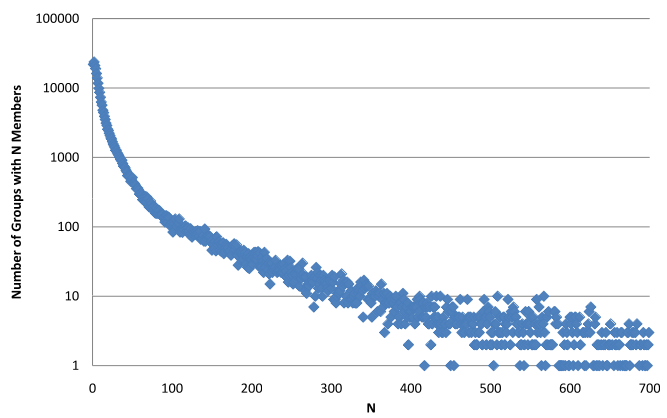 Figure 2: The study shows that the clustering coefficient significantly drops as group size exceeds the "small group" threshold (approx. 25 members).
Critical Insight & Future Outlook
This work highlights a key Inductive Bias for future social protocols: we should not treat all "groups" equally. "Pseudo-groups" (e.g., "I love Coffee") can be handled as simple tags, but "Social Groups" (e.g., a family or a project team) require dedicated structural modeling to support complex services like collective access control or private information sharing.
The future of the "Social Web" likely lies in Mobile P2P, where social situations are defined by small time and space scales. This paper provides the first necessary step: a rigorous way to demarcate where a group begins and ends in the vast, decentralized mesh of human connections.
Takeaway: Effective P2P social networks shouldn't just aggregate profiles; they must replicate the organic, dense textures of real-world sub-communities.