
Digital Democracy: Reclaiming Power in Virtual Communities via Design Patterns
Democratic power structures in virtual communities
This paper introduces a framework of 16 design patterns aimed at implementing democratic power structures in virtual communities. It specifically details the "Voting" pattern as a mechanism to balance power between platform operators and users, referencing implementations like Liquid Democracy and Wikimedia governance.
TL;DR
While our physical lives are grounded in democratic rights, our digital lives are often spent in "benevolent dictatorships" run by platform operators. This paper by Niels Seidel proposes a structured Pattern Language to bridge this gap, offering 16 specific technical and organizational blueprints—centered on a robust Voting mechanism—to decentralize authority and empower community members.
Context: The Digital Autocracy Problem
In the early industrial era, societies fought for the separation of powers and the right to vote. In the digital era, we have regressed. Whether it is Facebook's group admins or Reddit's subreddit moderators, power is often concentrated and life-long.
The author's core insight is that technology mirrors hierarchy. Because address spaces, file systems, and role-based access (RBAC) are inherently hierarchical, the social layers built on top of them naturally gravitate toward autocracy. For small groups, this is efficient; for platforms with millions of users, it is a systemic risk to the "res publica" (the public interest).
Methodology: A Three-Layered Approach
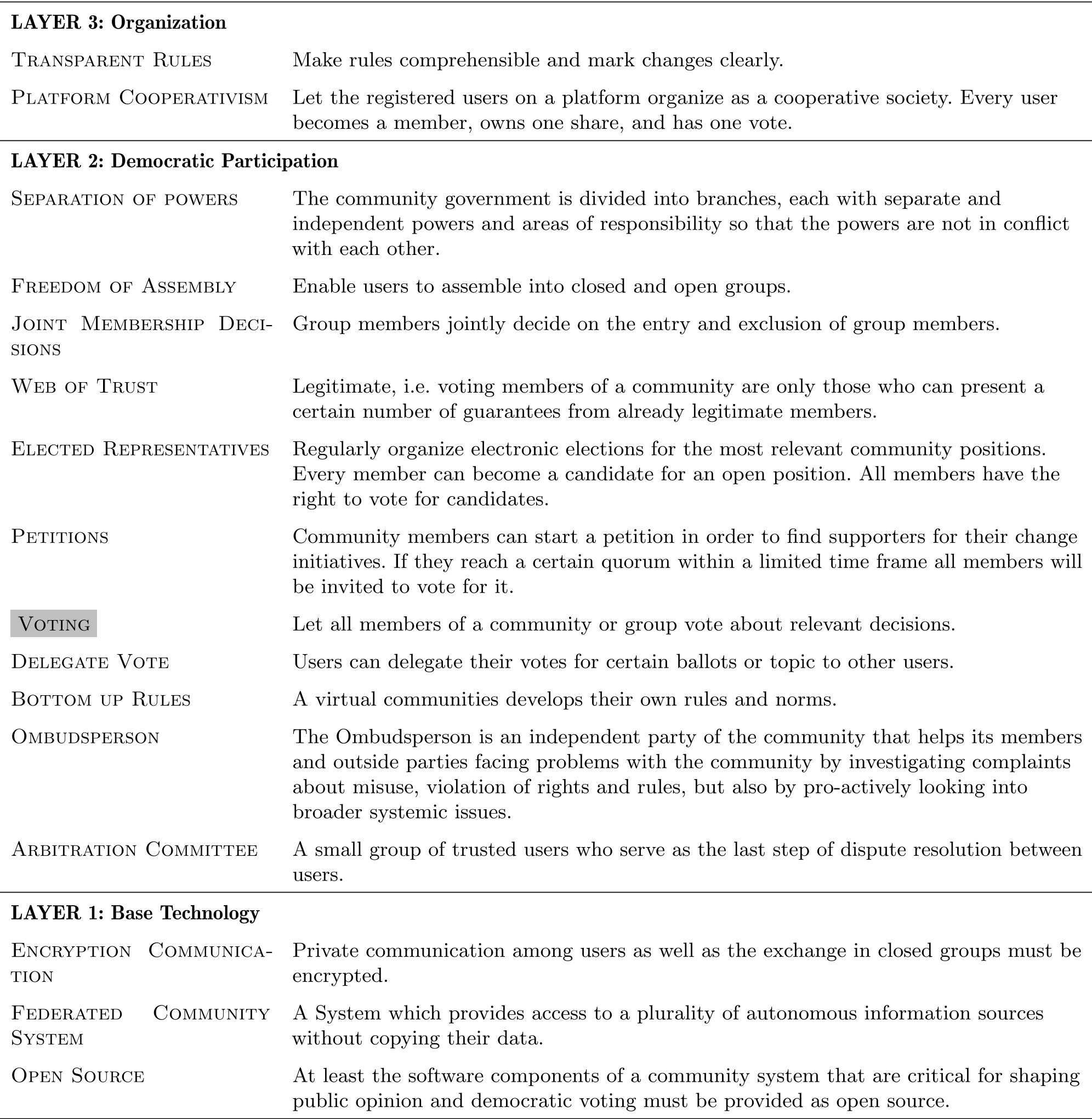
Seidel doesn't just call for "democracy"; he provides a functional taxonomy for building it. He breaks down the necessary interventions into three layers of a "Cooperative System."
The Democratic Pattern Stack
| Layer | Focus | Key Patterns |
|---|---|---|
| Layer 3: Organization | Structural Ownership | Platform Cooperativism, Transparent Rules |
| Layer 2: Participation | Governance Processes | Voting, Separation of Powers, Petitions |
| Layer 1: Technology | Infrastructure | Open Source, Federated Systems, Encryption |
Deep Dive: The Voting Pattern
The heart of the paper is the Voting pattern. The author argues that for a community to evolve legitimately, it must move beyond mere "A/B testing" or non-binding surveys.
The Five Pillars of Digital Balloting
To prevent fraud and ensure fairness (mitigating the "Sybil attack" where one person creates many accounts), the paper insists that digital voting must be:
- General: Every member can vote.
- Immediate: Votes have a direct, quantifiable effect on the result.
- Free: No coercion or algorithmic manipulation.
- Equal: A moderator's vote carries no more weight than a newcomer's.
- Secret: To prevent social disadvantage or "retaliation" voting.
Real-World Implementation & Challenges
The paper cites several SOTA (State-of-the-Art) examples of "Cyber Democracy":
- Apache Software Foundation: Uses a "-1" veto system to ensure consensus-based development.
- Liquid Democracy Tools: (e.g., Liquid Feedback, Adhocracy) allowing for "Transitive Proxy Voting," where users can delegate their vote to trusted experts on specific topics.
The "Effort" vs. "Participation" Paradox
A critical takeaway from the Ablation-style analysis of these governance models is the friction of participation. Designing a democratic system is more "expensive" than an autocratic one. High voting frequency leads to "voter fatigue." The author suggests Delegated Voting (Delegate Vote) as a key technical solution to keep the system scalable without sacrificing legitimacy.
Critical Insight & Conclusion
The true value of this work lies in its Socio-Technical Realism. Seidel acknowledges that "voting with your feet" (leaving a platform) is no longer a viable check on power when network effects make platforms monopolies.
Future Outlook: The proposed patterns suggest that the next generation of social platforms shouldn't just be "decentralized" (like Mastodon), but "democratically constituted." The transition from being a user (a consumer of a service) to a citizen (a stakeholder in a system) is the next great frontier for Human-Centered Computing.
Limitations
- The paper focuses heavily on the structure of voting but acknowledges that reliable Authentication (knowing a user is a unique human) remains a significant technical hurdle in anonymous digital spaces.
- Most patterns are still "proto-patterns" requiring further field experimentation to reach the maturity of traditional software design patterns.