
Architecting Reusability: The Democratization of ML Features
The Democratization of Machine Learning Features
This paper introduces the concept of "ML Feature Democratization" as a strategic framework to streamline enterprise AI development. It proposes the implementation of a centralized "Feature Store" to manage curated, reusable machine learning features, aiming to eliminate redundant data engineering and establish architectural SOTA for ML pipelines.
TL;DR
In the modern enterprise, Machine Learning (ML) development is often slowed down not by model complexity, but by the "Feature Engineering Tax." Jayesh Patel’s paper argues that the solution lies in ML Feature Democratization. By implementing a centralized Feature Store, organizations can transform features from localized, disposable code into global, reusable assets, drastically reducing the time-to-live for AI applications.
The "Feature Engineering Case": A Productivity Bottleneck
In academic settings, we often receive "clean" datasets like ImageNet or GLUE. In the enterprise, however, data is messy, siloed, and fragmented.
The author points out a stark reality: despite the democratization of raw data (Data Lakes), engineers still spend the vast majority of their time massaging data. This leads to two critical failures:
- Redundancy: Different teams recreate the "Total Customer Revenue" feature dozens of times across different silos.
- Inconsistency: Subtle differences in how a feature is computed (e.g., handling nulls or date ranges) lead to "Training-Serving Skew," where a model performs well in the lab but fails in production.
Methodology: The Anatomy of a Feature Store
To solve this, the paper proposes a transition from fragmented pipelines to a unified Feature Store. This isn't just a database; it’s a management layer that sits between the raw data and the ML models.
The Core Components
- Storage Layer: A hybrid of NoSQL, MPP databases, or distributed file systems (like Snowflake or Cassandra) designed for both high-throughput historical lookups and low-latency online serving.
- Metadata Registry: Acts as a "Wikipedia for Features," allowing scientists to discover existing features, view business logic, and track lineage.
- Unified Interface: A REST API or SQL interface that ensures the exact same code is used to fetch features for training and real-time prediction.
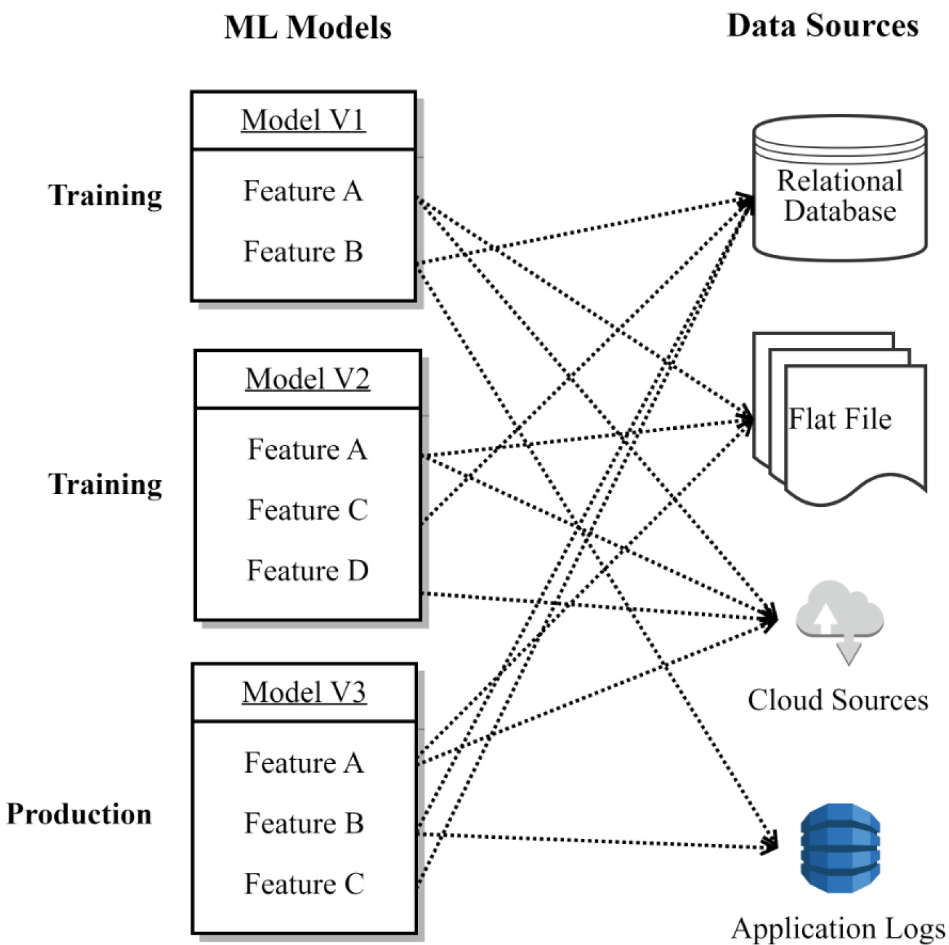 Fig 1: The standard approach where features are locked within individual models, leading to recursive engineering effort.
Shift in Logic: Compute Once, Use Everywhere
The fundamental "How" of this paper relies on the shift from Model-Centric Pipelines to Feature-Centric Ecosystems.
In the proposed architecture (see Fig 2 below), "Feature A" is ingested and processed once. When Model V1, V2, and V3 need it, they simply query the store. This provides an Abstraction Layer; the Data Scientist no longer needs to worry about the underlying ETL—they simply consume the "curated" feature.
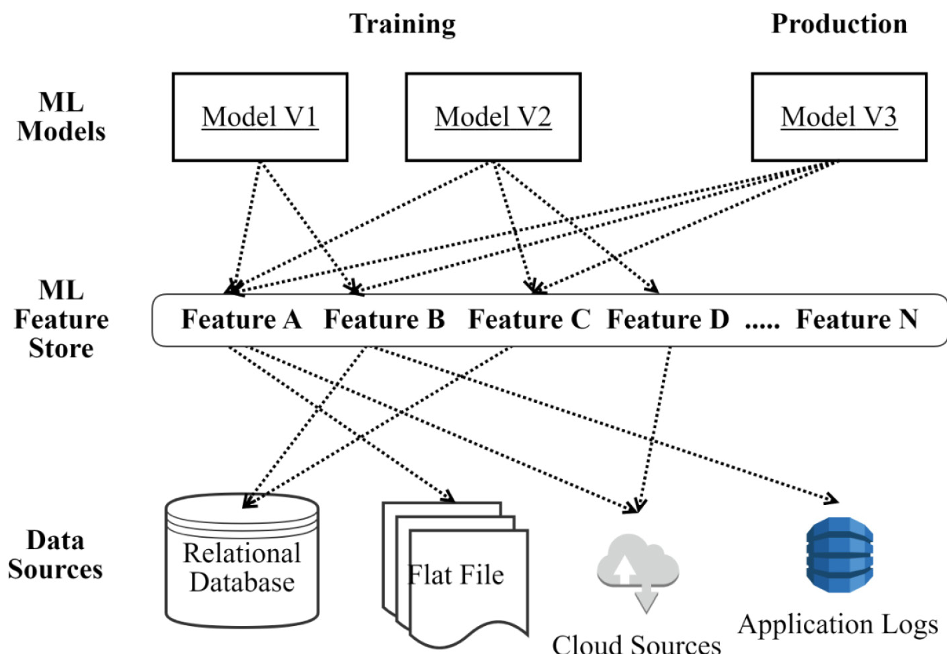 Fig 2: The democratized landscape where the Feature Store acts as the central hub for model training and serving.
Critical Insight: Why This Matters
The "Secret Sauce" described by Patel isn't about a new neural network architecture; it's about Organizational Inductive Bias. By standardizing how features are built, an organization creates a "flywheel effect." As more features are added to the store, the cost and time to build the next model drop significantly.
Future Challenges
While the paper provides a robust roadmap, it acknowledges that building a Feature Store is a significant financial and engineering investment. The industry is currently moving toward open-source implementations (like Feast) to lower this barrier to entry.
Conclusion
The democratization of ML features is the final step in moving Machine Learning from a "craft" practiced by a few specialists to an "industrial process" that is scalable, repeatable, and efficient. For any enterprise seeking to scale their AI efforts beyond the "pilot phase," a Feature Store is no longer optional—it is a foundational requirement.