
Empowering the Crowd: Democratizing Disaster Response via Linked Data and App Inventor
Democratizing mobile app development for disaster management
The paper introduces a framework to democratize mobile app development for disaster management by extending MIT App Inventor with Linked Data technologies. It enables non-programmers to build apps that consume and publish structured semantic data (RDF/SPARQL) from sources like Twitter and government databases.
TL;DR
In the wake of natural disasters, information is often as fragmented as the infrastructure itself. This paper presents a novel framework that empowers non-programmers to build sophisticated, interconnected mobile apps for crisis management. By extending MIT App Inventor with Linked Data (Semantic Web) capabilities, the authors enable volunteers to create apps that "talk" to global databases without writing a single line of complex code.
The Silo Problem: Why Disaster Tech Fails
In crisis scenarios—like the Beijing flash floods of 2012 or Hurricane Sandy—information flows through Twitter, Facebook, and government portals. However, most relief organizations build apps in silos. Data is trapped in localized databases or, even worse, manual spreadsheets.
The two primary blockers are:
- The Expertise Gap: Developing apps that integrate heterogeneous data sources requires high-level engineering skills.
- Interoperability: Different organizations use different "languages" (schemas) for their data, making real-time collaboration nearly impossible.
The Insight: Visual Programming meets the Semantic Web
The authors propose a "Democratization" strategy. They leverage App Inventor, a block-based visual programming tool, and infuse it with Linked Data principles.
Linked Data is the "Web of Data." It uses ontologies (standardized vocabularies) to ensure that when one app says "Shelter," another app understands exactly what that means. By embedding these concepts into a drag-and-drop interface, the framework hides the "scary" math and logic of RDF and SPARQL from the user.
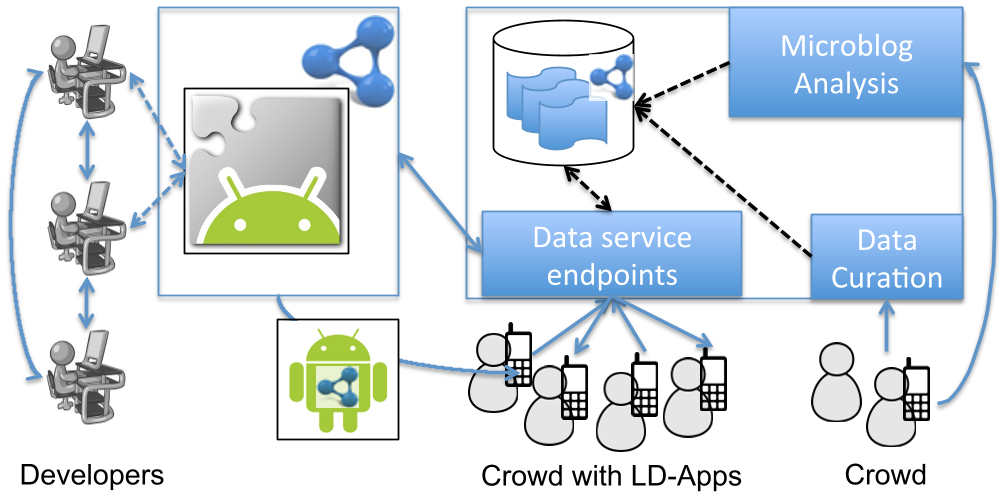 Figure: The system architecture showing how App Inventor components interact with Semantic Web ontologies and remote triple stores.
Methodology: Semantic Blocks
The core of the work lies in three new features added to the App Inventor ecosystem:
- Semantic Autocompletion: When a user wants to define a field (e.g., "Water Source"), the designer interface suggests existing ontological terms from standards like MOAC (Management Of A Crisis) or HXL (Humanitarian eXchange Language).
- The Semantic Web Component: This block handles the heavy lifting—it executes SPARQL queries to fetch nearby resources (e.g., "Find all water donations within 3 miles") and parses the results into a mobile-friendly format.
- Semantic Forms: These allow users to identify specific fields that should be published as "Linked Data," automatically creating RDF triples that other relief organizations can immediately consume.
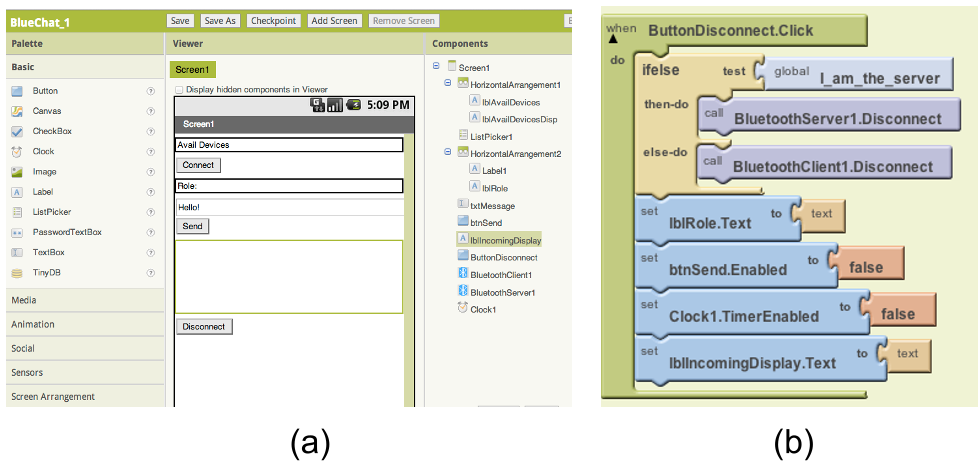 Figure: The block-based logic used to define app behavior without traditional coding.
Experimental Prototypes: "Donate-N-Request"
To prove the concept, the team developed two apps:
- Donate-N-Request: A match-making service for resources. A donor can see a map of people needing specific items (like water or bandages) by querying a shared semantic backend.
- WeReport: A crowdsourcing tool where citizens take photos of damage (e.g., a fallen tree) and "tag" it. These tags are instantly linked to global geolocation ontologies.
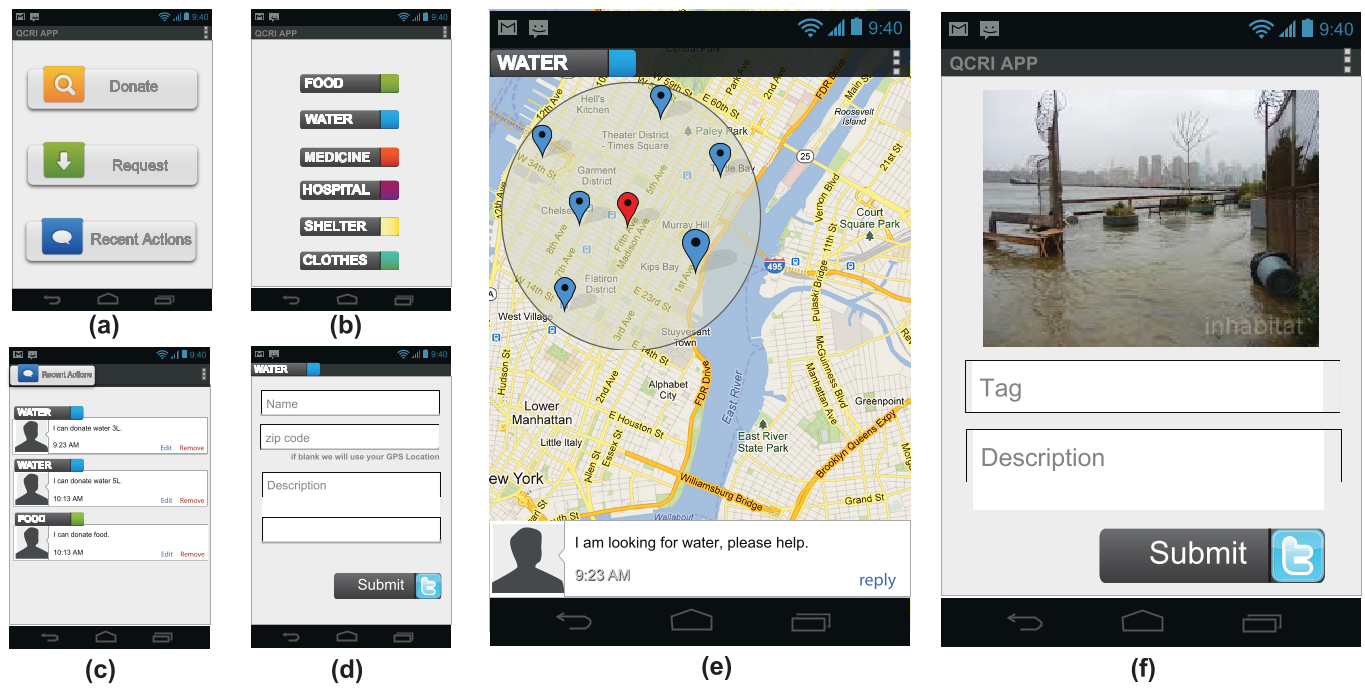 Figure: Screenshots of the prototype apps showing resource requests and incident reporting.
Critical Analysis & Future Outlook
While this work significantly lowers the entry barrier for disaster tech, it highlights a major challenge: Ontology Overlap. Currently, no single vocabulary covers everything from "structural damage" to "donation logistics."
The authors are working on "Data Wrappers"—pre-built templates for common datasets (like NYC demographics)—which will further simplify the process.
Takeaway: This research marks a shift from "Systems for Professionals" to "Systems for the People." By turning complex Semantic Web technologies into Lego-like blocks, we can transform every smartphone user into an active, coordinated node in a disaster relief network.