
Rationalizing Social Links: Integrating Demographics and Structure in Network Evolution
Demographic and Structural Characteristics to Rationalize Link Formation in Online Social Networks
The paper introduces a hybrid network generation model that combines demographic profiles (age, gender, location) with structural dynamics (triadic closure, preferential attachment) to rationalize link formation. Tested on real-world Facebook datasets, the model successfully replicates key topological features including density, clustering coefficients, and geodesic distances.
TL;DR
Why do we connect with others online? Is it because we share interests (Demographics) or because we have mutual friends (Structure)? This paper proposes a unified network generation model that treats link formation as a mathematical function of both. By testing against real Facebook data, the authors demonstrate that combining these two forces is essential for creating synthetic networks that actually look like real human communities.
Context: Beyond Random Graphs
In the world of network science, we've moved past simple random graphs. We know about Small-World effects (where everyone is a few hops away) and Scale-Free properties (where a few "hubs" have most of the connections). However, most models like the Barabási-Albert (BA) model focus purely on the topology—the "rich-get-richer" logic of Preferential Attachment. They often ignore the fact that in the real world, a student at Caltech is more likely to befriend another Caltech student not just because they have friends in common, but because they share a "categorical" attribute: their university.
The Problem: The Missing Human Element
The authors argue that existing models are too one-dimensional:
- Structural Models: Focus on Triadic Closure (friend-of-a-friend) but ignore who the people are.
- Spatial Models: Use abstract "social distances" but often simplify the complexity of real-world attributes like gender, age, or major.
The challenge is creating a mechanism that balances these factors dynamically as the network grows.
Methodology: The Unified Similarity Equation
The core innovation is a flexible equation that calculates the probability of a link between two individuals and :
1. Handling Demographics ()
The model treats data types with academic precision:
- Categorical (e.g., Major): Binary match (1 if same, 0 if different).
- Ordinal/Numerical (e.g., Age, Year): Normalized difference, ensuring that people with "closer" values (like a junior and a senior) have higher similarity than those further apart.
2. Handling Structure ()
- Triadic Closure (FoF): Calculated as the intersection of friends divided by the minimum degree of the two nodes. This prevents penalizing "hubs."
- Preferential Attachment (PA): Newer nodes are still drawn to higher-degree nodes, maintaining the scale-free nature of the network.
 Fig. 1: Step-by-step construction of the network, iterating from initial demographic assignment to structural link formation.
Experiments and Results
The authors validated their model using five American university Facebook datasets. By tuning parameters like the probability of triad formation () and the number of triads (), they were able to replicate:
- Clustering Coefficients: Nearly identical to the original datasets.
- Geodesic Distances: Successfully captured the "Small-World" nature.
- Density: Matched the node-to-edge ratios of the benchmark colleges.
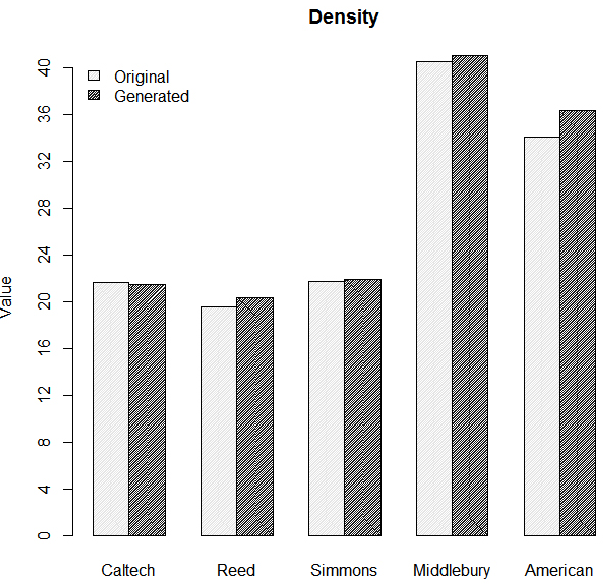 Fig. 2: Comparative analysis across five datasets showing the model's ability to mirror real-world network density.
One interesting finding was the Power-Law Fit. While the model generated scale-free networks (slopes of 1.9 to 3.1), the original Facebook data often sits outside this "classic" range. This suggests that while Preferential Attachment is a powerful rule, real-world social platforms are even more nuanced than our standard scale-free theories suggest.
Critical Insight & Future Work
This work provides a robust framework for generating "Realistic Synthetic Data." As privacy concerns make it harder to share real social network data, models that can generate structurally and demographically accurate "digital twins" of these networks are invaluable for testing algorithms in marketing, epidemiology, and sociology.
Limitations: The current model does not explicitly enforce "Community Structure" (modularity) or "Assortative Mixing" (the tendency of high-degree nodes to stick together). The authors aim to introduce these as future refinements to make the generated worlds even more lifelike.
Conclusion
By bridgeing the gap between Sociology (demographics) and Graph Theory (structure), this model offers a more "rational" explanation for why we click "Add Friend." It isn't just because someone is popular, and it isn't just because you share a class—it's a weighted interaction of both identities.