
The Mis-Match Mystery: Why Human Progress Isn't Just About Bigger Brains
Demography and cultural complexity
This paper examines the "mis-match problem" between hominin morphological evolution and material culture complexity, specifically critiquing the demographic-cultural learning hypothesis. It distinguishes three causal pathways—efficiency of cultural selection, specialization, and learning efficiency—concluding that population redundancy and specialization are more robust explanations for technological shifts than the commonly cited "Henrich-style" learning models.
TL;DR
Human evolution presents a strange paradox: our brains grew steadily, but our tools stayed the same for millennia, followed by sudden, scattered bursts of "modern" behavior. This paper by Kim Sterelny challenges the popular idea that these bursts were simply due to larger populations making cultural learning easier. Instead, Sterelny argues that social networking, redundancy, and specialization are the true engines of cultural complexity, while the "learning efficiency" of large groups is often overrated.
The Mis-Match Problem
If you look at the fossil record, there is a striking disconnect. Hominins like Homo erectus appeared with significantly larger brains around 1.7 million years ago, yet technological "spikes" like the Levallois technique or microliths didn't become consistent until much later.
Why the lag? Three theories dominate the field:
- Hidden Biology: Genetic "re-wiring" happened that we can't see in fossils.
- Demographic Shift: Social worlds got bigger, making us better at keeping and building on ideas.
- Cognitive Gadgets: We "learned how to learn" through cumulative culture.
Sterelny focuses on the second point—Demography—but adds a much-needed layer of nuance.
Beyond the "Treadmill": Three Ways Size Matters
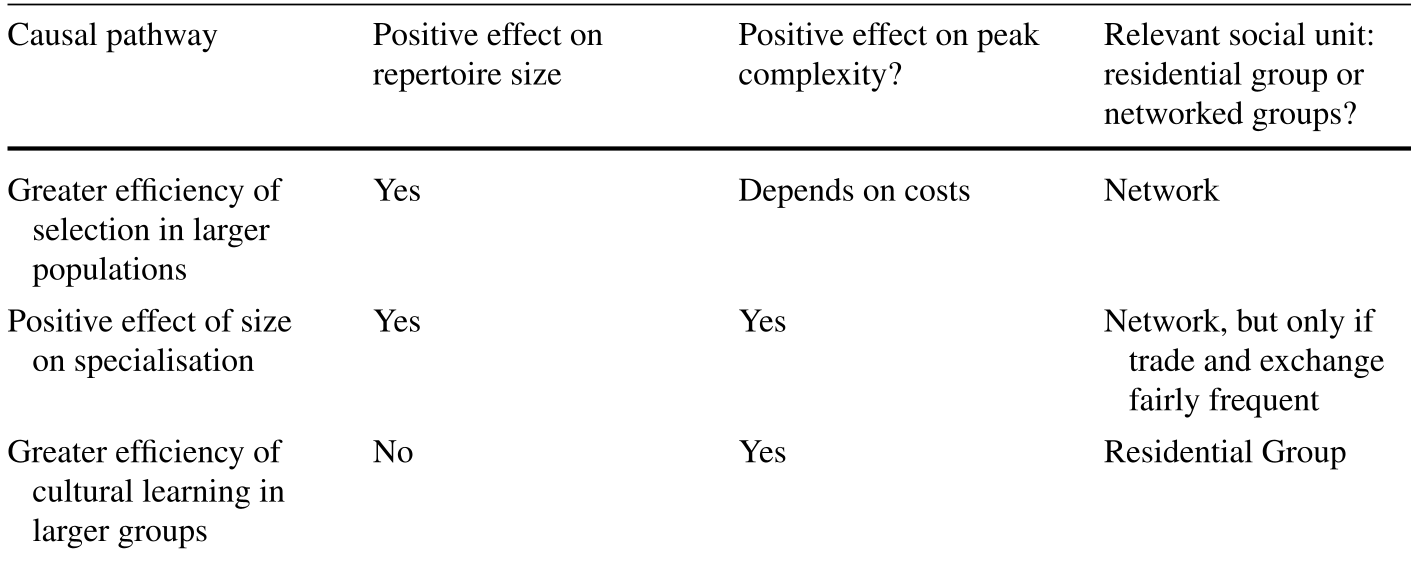
Most people cite Joseph Henrich’s "treadmill model"—the idea that in small groups, "noise" in learning causes skills to degrade (the "Tasmanian effect"). Sterelny breaks this down into three distinct pathways:
1. Redundancy and Drift
In a non-literate world, information is stored in heads. If the only person who knows how to make a kayak dies in a storm, that technology is gone. Larger populations act as a "buffer" against this bad luck. This is effectively Natural Selection applied to culture.
2. The Specialization Engine
Specialization depends on "market size." A tiny band of 20 people can't support a full-time toolmaker. But a networked community of 500 can. Specialization allows individuals to invest in high-level skills (like Solutrean knapping) that a generalist simply wouldn't have the time to master.
3. Learning Efficiency
This is the most controversial path. The theory suggests larger groups provide more "expert" models to copy. However, Sterelny points out a major flaw: forager apprentices usually learn from their immediate residential group, not the whole "meta-population." If the residential group size hasn't changed much in 500,000 years, why would total population size affect learning efficiency?
Deconstructing the Tasmania Myth
The "poster child" for demographic loss is Holocaust-era Tasmania. When it was cut off from Australia by rising seas, the population shrank and supposedly "lost" complex tools like bone points and cold-weather clothing.
Sterelny (citing Hiscock and others) deconstructs this:
- Economic Logic, Not Loss: Tasmanians likely stopped fishing because the land became more "wallaby-friendly." It was a rational shift in diet, not a loss of intelligence.
- Invisible Complexity: Many complex tools (like woven baskets and bark canoes) were actually maintained.
- The Arctic Counter-Example: Small Inuit communities (some under 200 people) maintained incredibly complex tech (harpoons, kayaks, fitted parkas) because they had to. This suggests that environmental risk is a bigger driver of complexity than population size.
Insights: "Soft" vs "Hard" Constraints
The core takeaway is that population size is a soft constraint.
- Small groups can maintain complex tools if they are willing to pay the "price"—investing more hours in practice or tolerating more construction failures.
- Connectivity is King: It’s not about how many people exist in total (Census size), but how often they meet and share information (Network density).
Conclusion: A Networked Future
Sterelny concludes that while the "learning efficiency" models are elegant in lab simulations, they often fail the "real-world" test of ethnography and archaeology. Human culture didn't take off just because there were more of us; it took off because we became better networked, allowing for specialization and creating a safety net against the "drift" of lost knowledge.
The leap to "behavioral modernity" was less about a single genetic or demographic "threshold" and more about the slow assembly of social structures that made innovation worth the cost.