
MACRO: Demystifying Manifold Constraints as the New Foundation for LLM Pre-training
Demystifying Manifold Constraints in LLM Pre-training
The paper introduces MACRO (Msign-Aligned Constrained Riemannian Optimizer), a provably convergent, single-loop Riemannian optimization framework for LLM pre-training. It systematically demystifies manifold constraints (Frobenius, Spectral, and Oblique), demonstrating that they can achieve SOTA performance while replacing traditional stabilization heuristics.
TL;DR
Researchers from Rice University and Columbia University have unveiled MACRO (Msign-Aligned Constrained Riemannian Optimizer), a framework that proves manifold constraints on weight matrices can replace two of the most critical "black magic" heuristics in deep learning: normalization layers (RMSNorm) and weight decay. By treating optimization as a geometric problem on a manifold, MACRO achieves superior stability and performance across models up to 1B parameters.
Background: The Heuristic Crutch
Why do we use RMSNorm or Weight Decay? Conventionally, these are seen as essential stabilizers to prevent activation explosions and improve generalization. However, they are often tuned heuristically. The authors of this paper ask a bold question: Do the intrinsic geometric properties of manifold constraints subsume these heuristics?
The answer is a resounding yes. By constraining weights to specific "spheres" (Spectral or Frobenius), we can mathematically guarantee that activations stay within a healthy range without needing learnable parameters to "fix" them post-hoc.
Methodology: The MACRO Framework
The core innovation is the Msign-Aligned Constrained Riemannian Optimizer (MACRO). Unlike previous "double-loop" methods that were too slow for large-scale training, MACRO uses a streamlined single-loop process:
- Tangent Space Projection: Gradients are projected onto the local tangent space of the manifold.
- Steepest Descent via Matrix Sign: It applies the
msignoperator (SVD-based) to find the most efficient update direction. - Manifold Retraction: Weights are projected back onto the manifold (e.g., a Frobenius sphere) to prevent drift.

Why the Spectral Sphere Wins in the Extreme
The paper distinguishes between two main constraints:
- Frobenius Sphere: Controls average-case activation scales.
- Spectral Sphere: Controls worst-case activation scales (singular value bounding).
When learnable normalization is removed entirely, the Spectral Sphere proves more robust because it strictly prevents the maximum possible amplification of any input signal.
Disentangling Weight Decay and Normalization
The most profound insight of this work is how geometry replaces training dynamics:
- Replacing Weight Decay: Standard weight decay heuristically tries to balance the "rotation" of weights. MACRO locks the relative learning rate and enforces rotational equilibrium from Step 1.
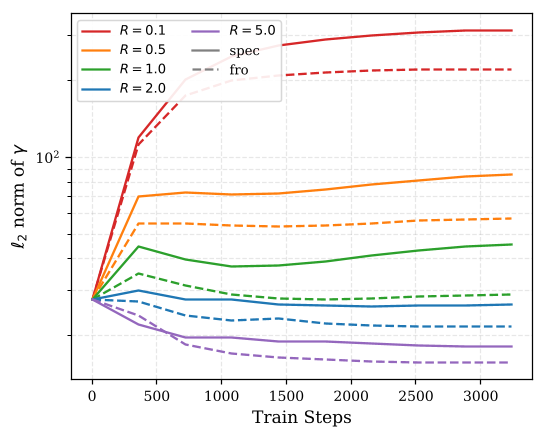
- Replacing RMSNorm: As shown in the experiment below, as the manifold radius increases, the model's internal learnable affine parameters () naturally shrink, proving they were performing redundant work.
Experimental Battleground: Normalization-Free Training
Most impressively, the researchers successfully trained a 330M parameter model without any learnable normalization layers. While standard optimizers like Muon diverged (NaN), MACRO remained stable and achieved competitive losses.
| Optimizer | 3e-3 | 5e-3 | 1e-2 (Standard LR) |
|---|---|---|---|
| Muon (Baseline) | 2.912 | 2.849 | NaN |
| MACRO-spec (Ours) | 2.820 | 2.768 | 2.739 |
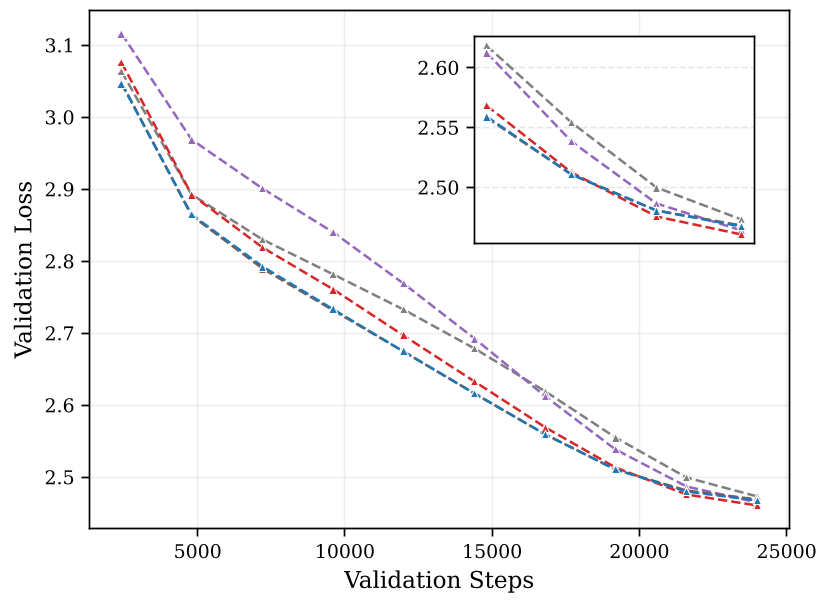
At the 1B scale, MACRO consistently outperformed or matched high-performance baselines like Muon and MuonH.
Deep Insight: Toward Principled Symmetries
This work signals a shift from "tuning" LLMs to "designing" their geometric environment. By using MACRO, we gain:
- Mathematical Convergence: Rigorous proofs match the rate of non-convex optimization.
- Parameter Efficiency: Removing learnable norms simplifies the architecture.
- Stability: Zero-shot P (Maximal Update Parameterization) transfer is naturally enabled by the manifold structure.
Conclusion & Future Outlook
MACRO demystifies manifold constraints as more than just a "trick" for stability—they are a principled alternative to the overhead of normalization and weight decay. While the paper notes that learnable norms still offer a slight performance edge (due to layer-specific adaptation), the path is clear: future LLMs may focus on layer-specific geometric constraints rather than manually tuned heuristic layers.
Takeaway: If you want a more stable, theoretically grounded LLM, stop tuning your weight decay and start optimizing on the manifold.