
Stigmergic Routing: Protecting Privacy and User Attention in Ad Hoc Q&A Networks
A deniable and efficient question and answer service over ad hoc social networks
The paper proposes a decentralized Question and Answer (Q&A) service for ad hoc social networks using a stigmergic routing protocol inspired by ant foraging behavior. This approach achieves high-quality expert retrieval while ensuring plausible deniability and significantly reducing user attention overhead compared to traditional flooding.
TL;DR
Researchers have developed a decentralized Q&A protocol that routes questions to experts using "ant-inspired" logic. Unlike centralized platforms that log your every move, this system uses virtual pheromones to navigate an anonymous network, delivering high-quality answers while shielding user identities and—crucially—preventing "notification fatigue" by minimizing the human attention required to filter questions.
The Hidden Cost: Why Your Attention is the Real Resource
In the world of Information Retrieval (IR), we often talk about CPU cycles and bandwidth. But in a social network, the most expensive resource is Human Attention.
Traditional decentralized systems often rely on Flooding (sending a question to everyone). While this ensures you find an expert, it is socially catastrophic: if every user in a 1,000-person network receives every question, the noise becomes intolerable. Conversely, Random Routing protects your peace of mind but usually fails to find a high-quality answer.
The authors identify a third gap: Privacy. Users often want to ask sensitive questions (health, relationships) without them being archived under a permanent identity.
Methodology: Thinking Like an Ant
To solve the triangle of Quality, Privacy, and Attention, the paper turns to nature.
1. Stigmergy and Virtual Pheromones
When an ant finds food, it leaves a pheromone trail. Other ants follow the scent, reinforcing it. In this Q&A network, each node maintains a routing table of "scents" for specific categories (e.g., "Science" or "Health").
- Successful Answer: If a link leads to a good answer, the pheromone for that category increases.
- Positive Feedback: If the asker likes the answer, a "strong scent" is sent back along the path.
- Evaporation: Over time, pheromones fade, allowing the network to adapt if an expert leaves the network.
2. Plausible Deniability
The system uses a random network topology. When you forward a question, you only know your immediate neighbor—not the original source or the final destination. By using Poisson-distributed Time-to-Live (TTL) values, even a neighbor can't certain if you wrote the question or are just passing it along.
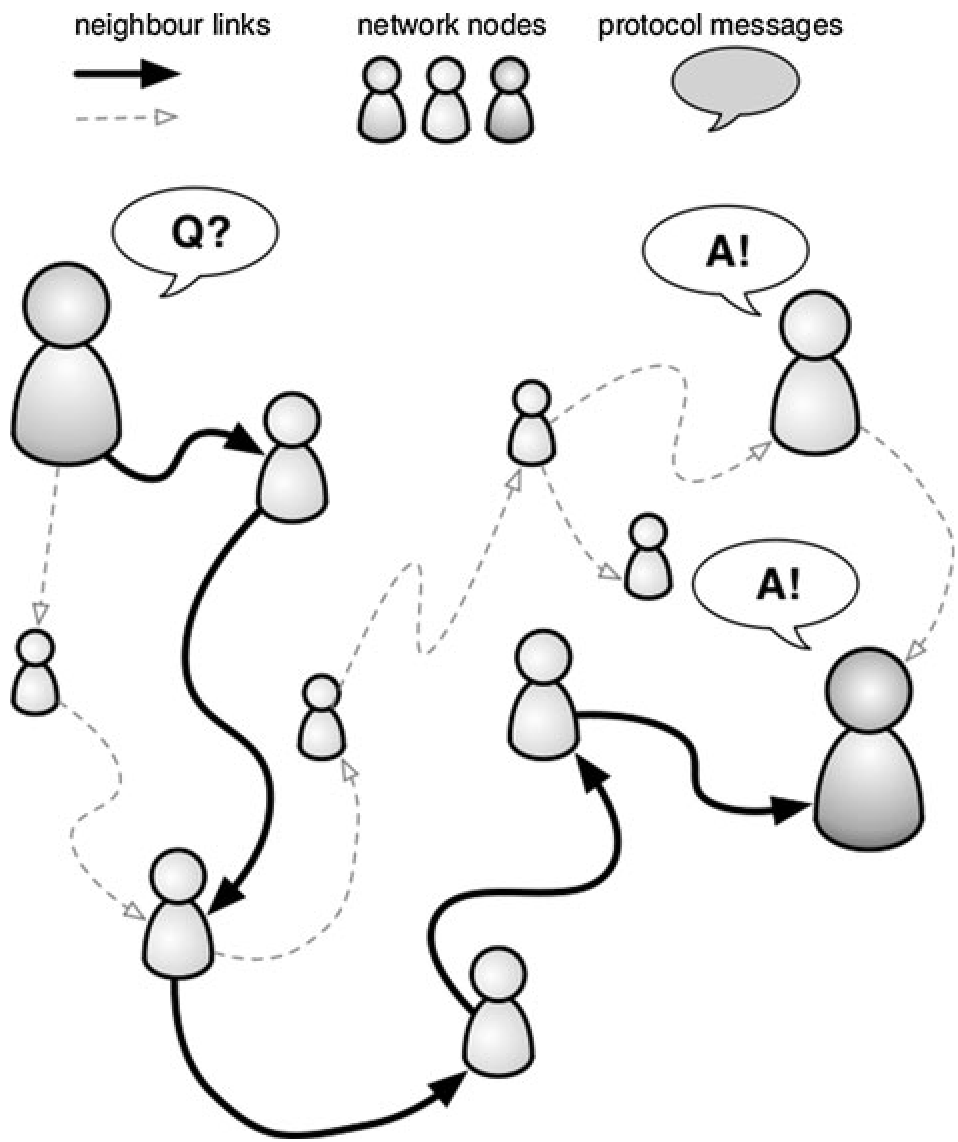 Fig 1: The path of a question through intermediate nodes, ensuring no single entity knows the full route.
Experiments: Performance Under Pressure
The researchers simulated the system using real-world data from Yahoo! Answers, covering 4 million questions across 27 categories. They tested three versions of their stigmergic protocol (V1, V2, V3) against Flooding and Random baselines.
Key Findings:
- Attention Efficiency: The stigmergic approach reduced the attention required per question by orders of magnitude compared to flooding.
- Quality Retention: Despite the reduced reach, the system consistently identified top-tier experts, achieving quality scores nearly as high as flooding but much higher than random walks.
- Resilience to Churn: The system remained effective even when users frequently joined and left the network (a common trait of mobile ad hoc networks).
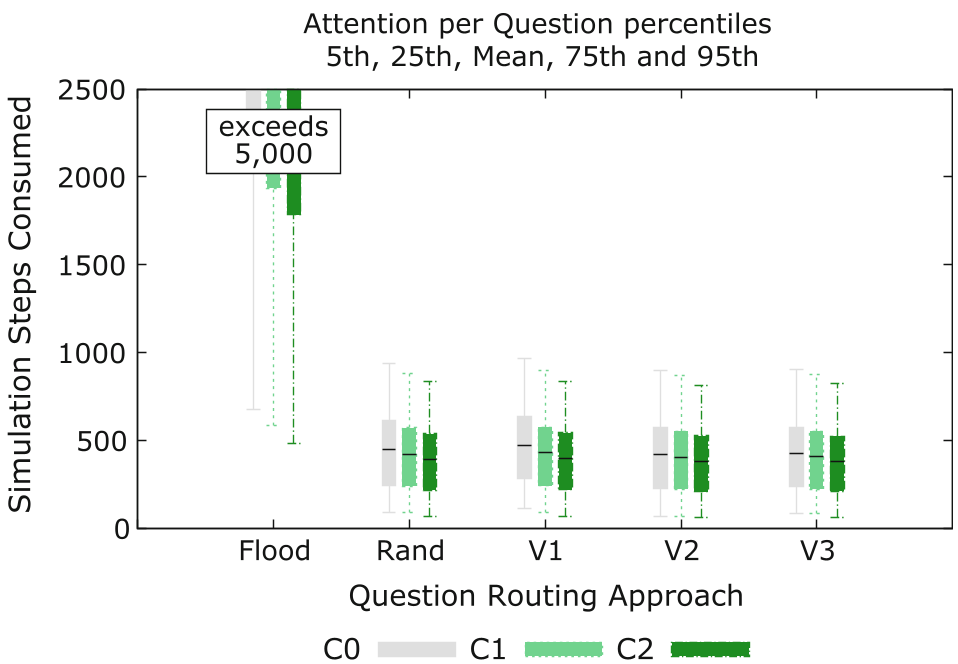 Fig 2: Comparison of human attention consumed. Note the massive overhead of flooding compared to the efficient stigmergic versions.
Critical Analysis & Future Outlook
The genius of this work lies in treating Human Interest as a routing variable. By using a "loopback" entry (V2 and V3), the protocol actually learns whether the local user is an expert. If you stop providing good answers, the protocol stops "bothering" you with questions in that category.
Limitations:
- Warm Start: The network needs time to "learn" where the experts are. Initial questions are essentially random until pheromones build up.
- Eager Answerers: Malicious users could try to "hijack" routes by answering everything, though the authors' V3 (load balancing) mitigates this by penalizing over-used links.
Conclusion
This paper shifts the focus from "finding data" to "finding the right person" at the right time. By treating the network as a living, breathing organism that learns through interaction, we can build social services that respect both our privacy and our limited time.