
YOLO26 in Dentistry: Transforming Panoramic Radiographs into Automated Diagnostic Maps
Summary
Problem
Method
Results
Takeaways
Abstract
This paper introduces the first application of YOLO26 to automated dental panoramic radiograph analysis, specifically targeting tooth detection, FDI-based numbering, and multi-class disease segmentation. Using the DENTEX benchmark, the authors developed a dual-task framework where the YOLO26m-seg model achieved a SOTA precision of 0.976 for tooth enumeration, while YOLO26l-seg established the first baseline for comprehensive dental disease segmentation.
## Executive Summary
**TL;DR**: This research marks the debut of **YOLO26** in the dental field, presenting a unified deep learning pipeline that not only counts and numbers teeth (FDI notation) but also segments four types of dental diseases. By achieving a **0.976 mAP** on tooth enumeration, it significantly surpasses previous YOLOv8 baselines, while establishing the first benchmark for disease segmentation on the DENTEX dataset.
**Academic Positioning**: This work represents a shift from simple object detection to **comprehensive instance segmentation** in dental AI. It bridges the gap between basic tooth identification and complex clinical pathology, positioning itself as a state-of-the-art (SOTA) utility for real-time clinical decision support.
## The Problem: The Cognitive Load of the "Big Picture"
Panoramic radiography (orthopantomography) is a double-edged sword: it offers a comprehensive view of the entire dentition at the cost of visual complexity. Clinicians must identify up to 32 teeth, assign FDI labels, and spot subtle pathological density changes—all while dealing with overlapping structures and varying image quality.
Prior efforts, such as those using YOLOv8 or Mask R-CNN, focused primarily on "where the tooth is." They often ignored "what is wrong with the tooth" or struggled with the dense, overlapping nature of dental arches.
## Methodology: Why YOLO26?
The authors transitioned to YOLO26 to utilize four specific architectural shifts that directly solve dental imaging hurdles:
1. **NMS-Free Inference**: In dense dental X-rays, teeth are packed tightly. Traditional Non-Maximum Suppression (NMS) often accidentally deletes a "true positive" tooth, thinking it's a redundant box. YOLO26's end-to-end head eliminates this.
2. **STAL (Small-Target-Aware Label Assignment)**: Crucial for detecting tiny carious lesions (cavities) that are often just a few pixels wide.
3. **ProgLoss**: Helps the model focus on "rare" diseases (like periapical lesions) instead of being overwhelmed by the common "caries" class.
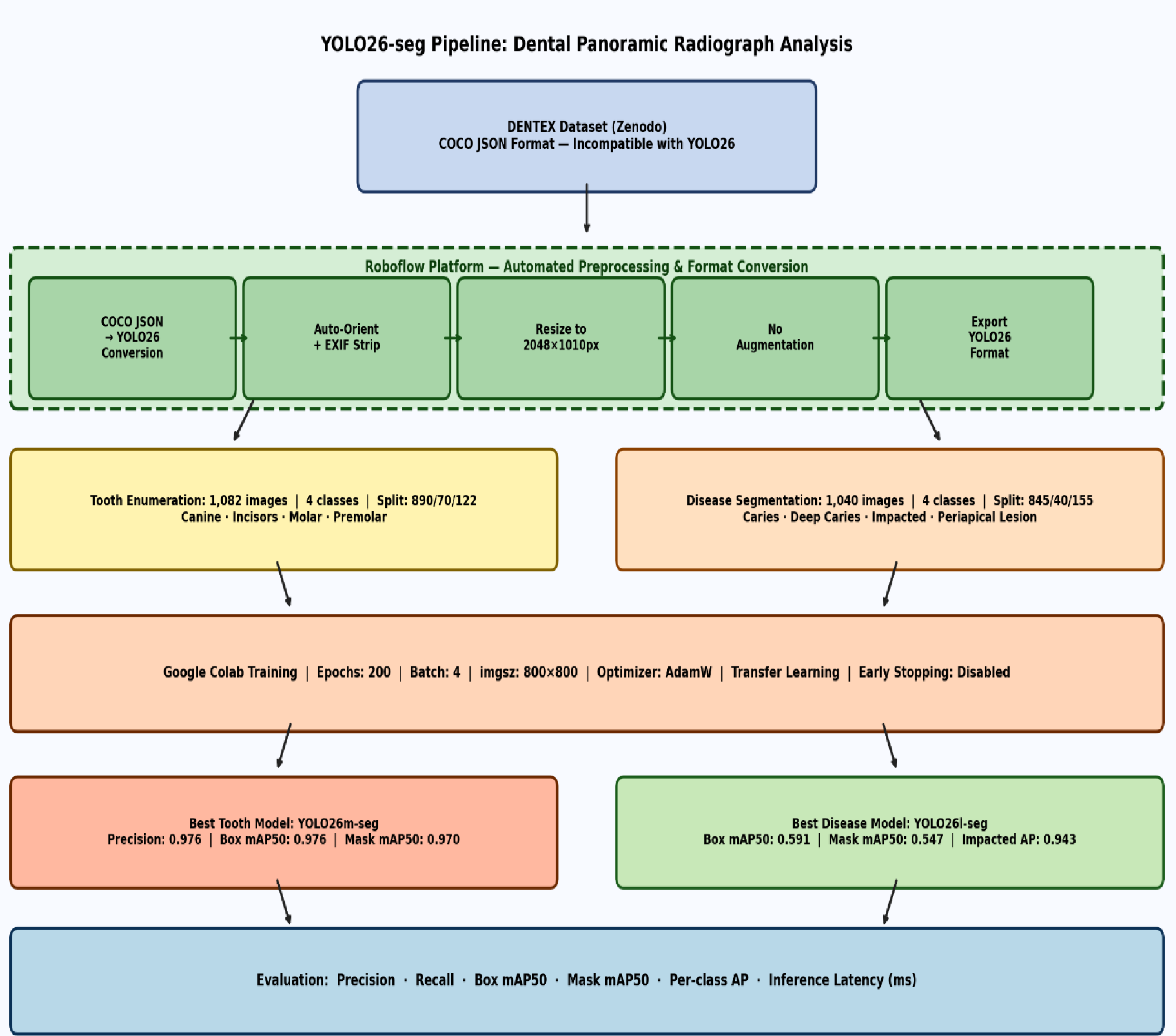
*Fig 1: The dual-task workflow involving Roboflow preprocessing and YOLO26-seg training.*
## Experimental Results & Insights
### 1. Tooth Enumeration: Crushing the Baseline
The **YOLO26m-seg** (medium) model emerged as the "Goldilocks" solution—large enough to be accurate, but small enough to maintain a 29.4ms latency. It outperformed YOLOv8x across every metric:
* **Precision**: +4.9% (reaching 0.976)
* **mAP50**: +3.3% (reaching 0.976)
### 2. Disease Segmentation: The "Distinctiveness" Factor
The most fascinating insight came from the disease analysis. **Impacted teeth** achieved a staggering **0.943 AP**, while **Caries** (cavities) only managed **0.463 AP**, *despite Caries having 3 times more training data*.
**The Reason?** Visual Morphological Clarity. An impacted tooth has a distinct, unmistakable "displaced" shape. A cavity is a subtle "gray smudge" that mimics many other structures. This proves that in medical AI, **quality of visual features > quantity of labels.**
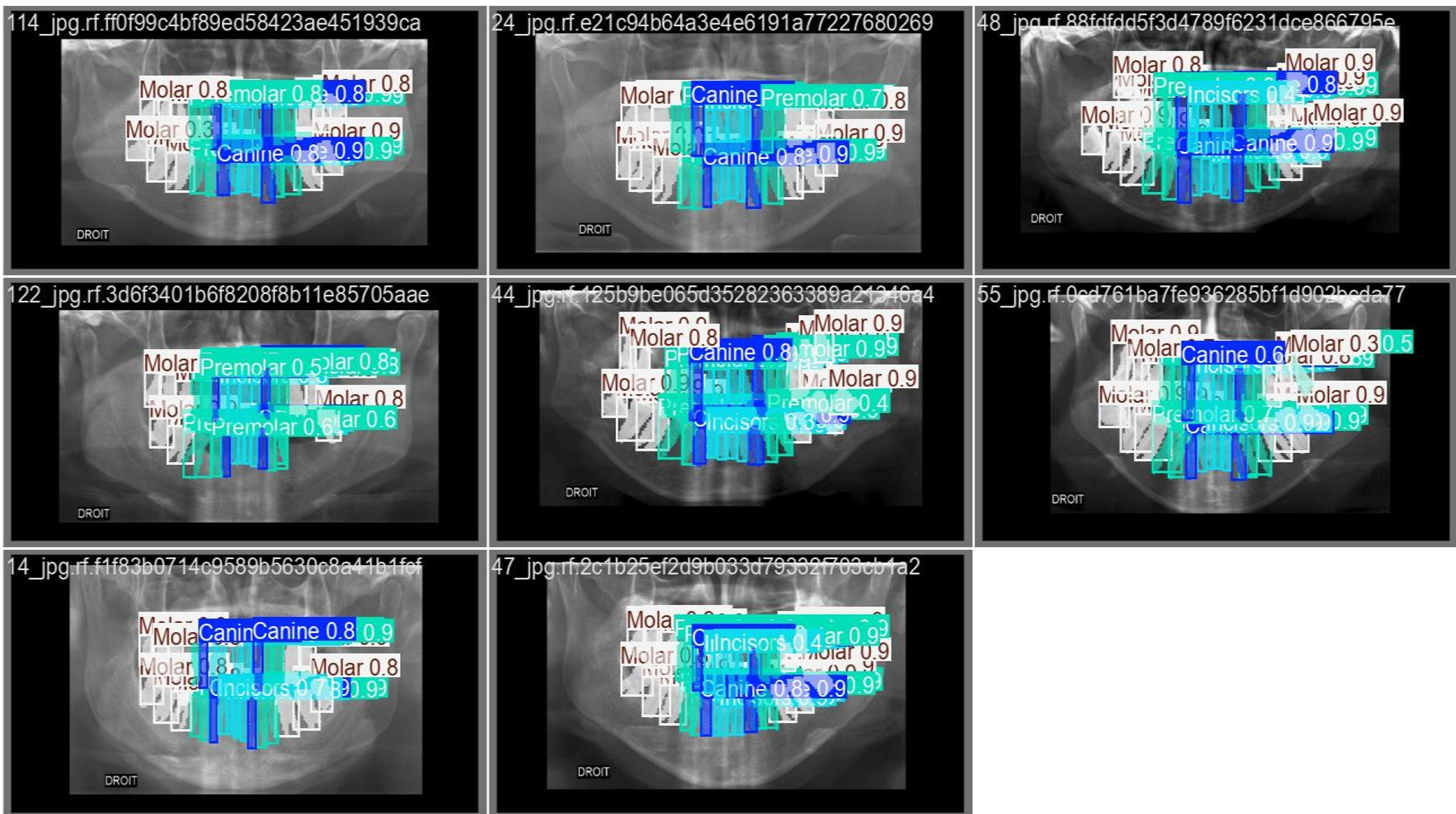
*Fig 2: Qualitative outputs showing both tooth detection (FDI labels) and exact mask-level segmentation.*
## Critical Analysis & Future Outlook
**The Good**: The transition to 800x800 resolution and the use of the AdamW optimizer with ProgLoss resulted in incredibly smooth convergence curves (see Fig 2 in the paper). The automated preprocessing via Roboflow also removes the reproducibility crisis common in "manual" X-ray cleaning.
**The Limitations**:
* **Class Imbalance**: Periapical lesions (infections at the root tip) are still poorly detected (0.384 AP) due to their extreme rarity in the dataset.
* **Compute Constraints**: Training was limited to 800x800 due to hardware limits; moving to the native 2048x1010 resolution would likely unlock even higher precision for subtle disease markers.
**Conclusion**: This work sets a high bar for 2026’s dental AI standards. By proving that YOLO26 can handle both the "geometry" of teeth and the "texture" of diseases, it paves the way for a single AI tool that could potentially replace multiple legacy CAD systems in dental clinics.