
Quantifying the Unseen: A Hierarchical Framework for IoMT Dependability and Security
Dependability and Security Quantification of an Internet of Medical Things Infrastructure Based on Cloud-Fog-Edge Continuum for Healthcare Monitoring Using Hierarchical Models
This paper proposes a comprehensive threefold hierarchical modeling framework to quantify the dependability (reliability/availability) and security of an Internet of Medical Things (IoMT) infrastructure. The framework integrates Cloud, Fog, and Edge (CFE) computing paradigms and utilizes Fault Trees (FT) for high-level architecture and Continuous-Time Markov Chains (CTMC) for low-level component behaviors, achieving detailed analysis of complex healthcare monitoring systems.
TL;DR
In the context of global health crises, the Internet of Medical Things (IoMT) must operate with near-zero downtime. This paper introduces a sophisticated threefold hierarchical modeling framework ({}) that combines Fault Trees (FT) and Continuous-Time Markov Chains (CTMC). By bridging the gap between high-level Cloud-Fog-Edge (CFE) architectures and low-level hardware/software failure modes—including cyber-attacks and software aging—the authors provide a roadmap for designing resilient digital healthcare infrastructures.
Background Positioning
While Cloud and IoT reliability have been studied independently, this work is a systematic integration in the CFE continuum. It addresses a critical gap: the lack of a unified framework that can handle the structural complexity of "system-of-systems" while accounting for fine-grained operational behaviors like "Mandelbugs" and proactive software rejuvenation.
Problem & Motivation: The Fragility of Healthcare Connectivity
Prior research often treated IoMT systems as monolithic or overly simplified entities. However, real-world healthcare monitoring involves a chain of dependency: if an Edge gateway fails, the backend Cloud's superior processing power becomes irrelevant. The authors identify three major pain points:
- Heterogeneity: Integrating wearable sensors with centralized cloud servers.
- Security-Dependability Tradeoff: How cyber-attacks directly manifest as availability loss.
- Scalability: Modeling thousands of devices without hitting "state-space explosion" in mathematical models.
Methodology: The Threefold Hierarchy
The core of this work is its hierarchical decomposition, ensuring that the math remains manageable even as the system grows.
1. The Architecture
The framework utilizes a top-down approach:
- Top Level (System): Uses FTs to model how the Cloud, Fog, and Edge interact ().
- Middle Level (Subsystem): Models specific clusters, such as Redundant Cloud Servers or Sensor Pools ().
- Bottom Level (Component): Uses CTMCs to simulate 10+ states, including "Under Attack," "Software Rejuvenation," and "Degraded Performance" ().
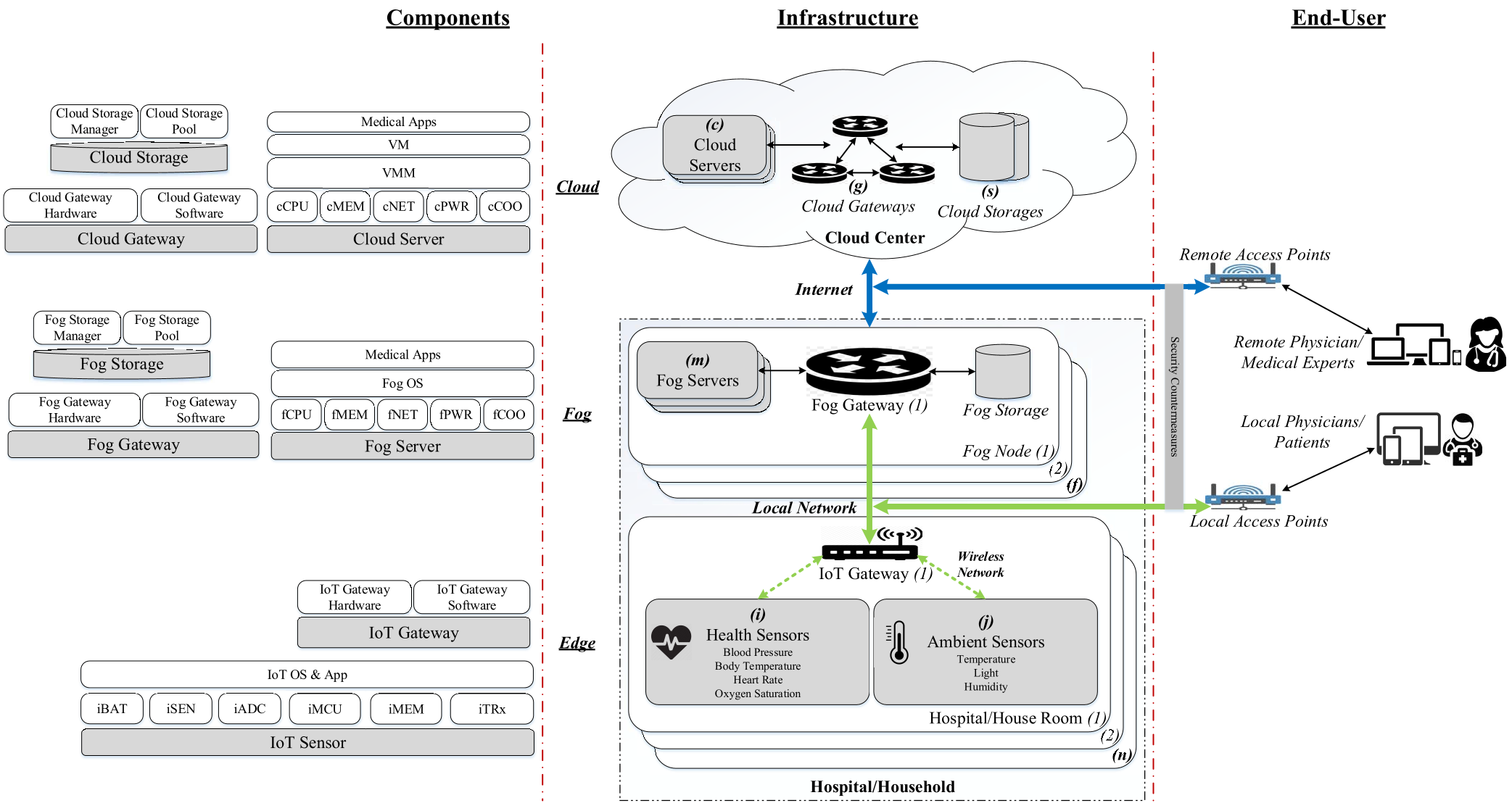 Figure: The Proposed IoMT Physical Infrastructure across Cloud, Fog, and Edge layers.
2. Failure and Recovery Modes
The model is unique because it doesn't just look at "Up/Down" states. It incorporates:
- Mandelbugs: Non-deterministic software bugs.
- Cyber-Attacks: States representing "Vulnerable," "Compromised," and "Under Attack" (incorporating IPS/IDS effects).
- Hardware Wear: Parallel processing element (PE) failures in high-end CPUs.
Experiments & Results
The authors tested five case studies (configuration changes) and four operational scenarios.
Key Quantification Results:
- Baseline Availability: The default system provides "2.6 nines" of availability (~20.27 hours downtime per year).
- The Power of Redundancy: Moving to a redundant cloud setup (Case II) dramatically cuts downtime by nearly 7 hours annually.
- The Fog Bottleneck: Interestingly, the Fog and Edge gateways were found to be the most sensitive to cyber-attack intensity. A small increase in attack frequency on these nodes leads to a vertical drop in system availability.
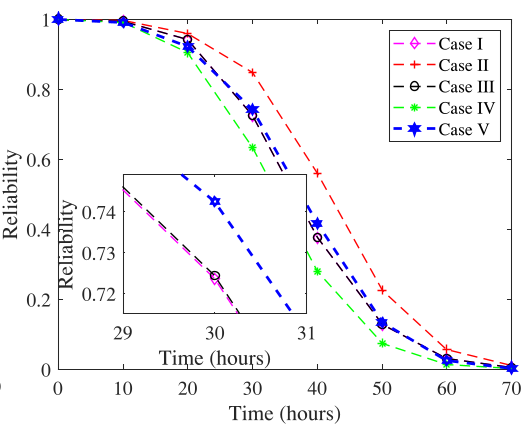 Figure: Reliability Comparison - Showing the rapid decline in reliability over time without recovery strategies.
Critical Analysis & Conclusion
Takeaways
The paper proves that in a CFE continuum, proximity does not equal reliability. While Fog computing reduces latency, it introduces new failure points. For designers, the most effective "bang-for-buck" in reliability comes from Cloud redundancy and Hardening Edge Gateways, rather than simply adding more sensors.
Limitations
- Networking Simplification: The model assumes wired internal connections are largely perfect, which might not hold in massive-scale hospital deployments.
- Deterministic Charging: The battery model for sensors is ER-10 (Deterministic), whereas real-world usage patterns can be significantly more stochastic.
Future Outlook
This framework sets the stage for Automated Dependability Tools. In the future, a system architect could input their IoMT topology, and the tool would automatically generate these FT/CTMC hybrids to predict QoS before a single device is deployed.