
Deriving Marketing Intelligence: Why Credibility Matters in Microblog Summarization
Deriving Marketing Intelligence over Microblogs
This paper introduces a summarization framework to derive marketing intelligence from microblogs like Twitter by converting massive unstructured posts into compact numeric scores. The system integrates topic detection, SVM-based sentiment classification, and a novel aggregation method that weights opinions by user credibility and sentiment quality.
TL;DR
With billions of daily posts, microblogs are a goldmine for brands, but manual monitoring is a lost cause. This paper presents a framework that doesn't just "read" tweets but evaluates the authority of the sender and the intensity of the sentiment. By weighting opinions using a new Credibility Score and Opinion Quality metric, the authors achieved an automated scoring system that mirrors real-world public opinion far more accurately than standard averages.
Background: The Noise in the Machine
Microblogs (like Twitter) are unique due to their brevity and real-time nature. However, for a marketing manager, 20% of posts might mention a brand, but those posts range from high-value consumer feedback to rambling spam. The authors identify a critical gap: existing sentiment tools are "democratic" to a fault—they give a bot's tweet the same weight as a tech influencer's review.
Methodology: Beyond Simple Word Counts
The framework operates through four sophisticated modules:
1. Topic Detection (TTS)
Instead of just looking for frequent words, the system uses Topic Tendency Score (TTS). It combines TF-IDF with Meronym Pattern Partition (MPP).
- Insight: If a word like "Maps" frequently appears in patterns like "Google's Maps" or "Maps for Google," it’s highly likely to be a relevant product feature rather than random noise.
2. Sentiment and Quality (SS)
An SVM classifier (trained via "distant supervision" using emoticons like :) and :() determines polarity. But the system goes further by calculating Opinion Quality (OQ)—the density of subjective words. A post screaming with emotional intensity gets more weight than a dry, objective statement.
3. The Credibility Filter (CS)
This is the "secret sauce." The Credibility Score evaluates:
- Source Credibility: Based on a modified follower-following ratio to penalize spammers.
- Content Credibility: Measured by how often a user's posts are "retweeted," serving as a proxy for social validation.
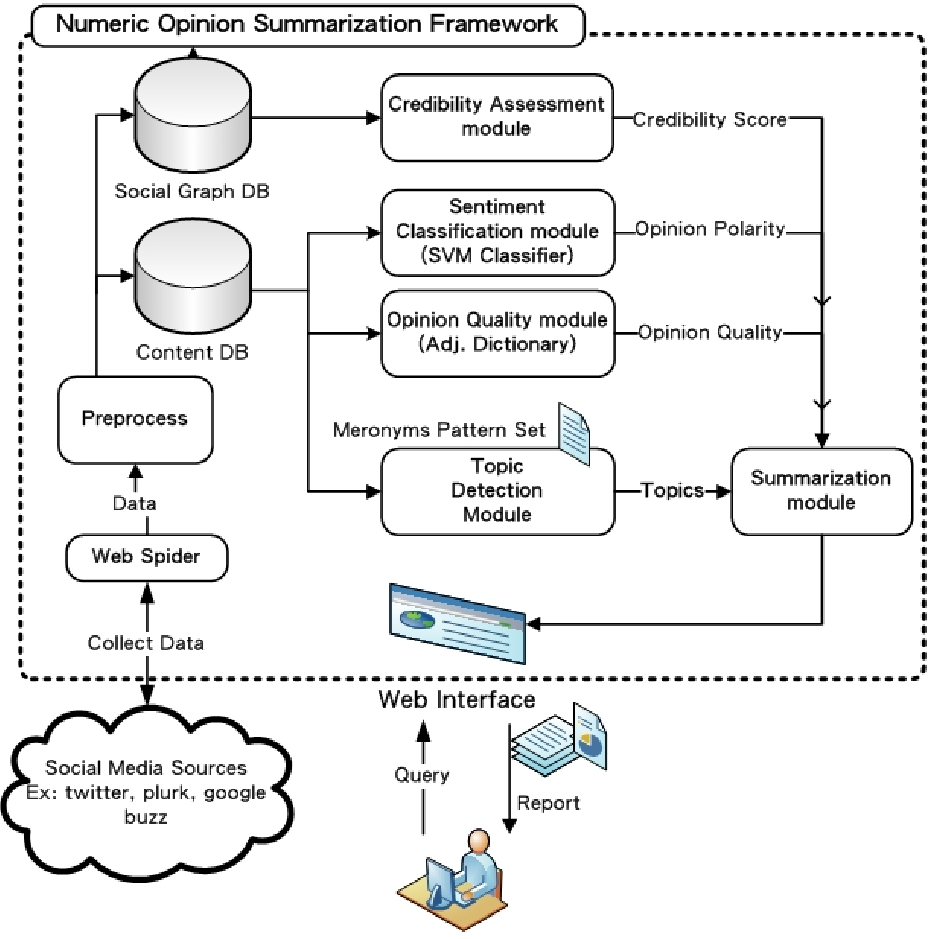 Figure 1: The proposed framework from data collection to numeric summarization.
Experiments and Results
The authors tested their system on brands like Google, Microsoft, and Apple.
Topic Precision
The TTS method significantly outperformed hashtag-based extraction. It turns out hashtags are often used for jokes or broad categories, whereas Meronym patterns pinpointed actual product features with high precision (e.g., 97.3% for Google).
The "Truth" Test
To see if the system actually worked, the authors compared its scores against a Likert-scale questionnaire given to real humans on Facebook.
- Baseline (No weighting): MAE 0.57
- Proposed Method (Credibility + Quality): MAE 0.33
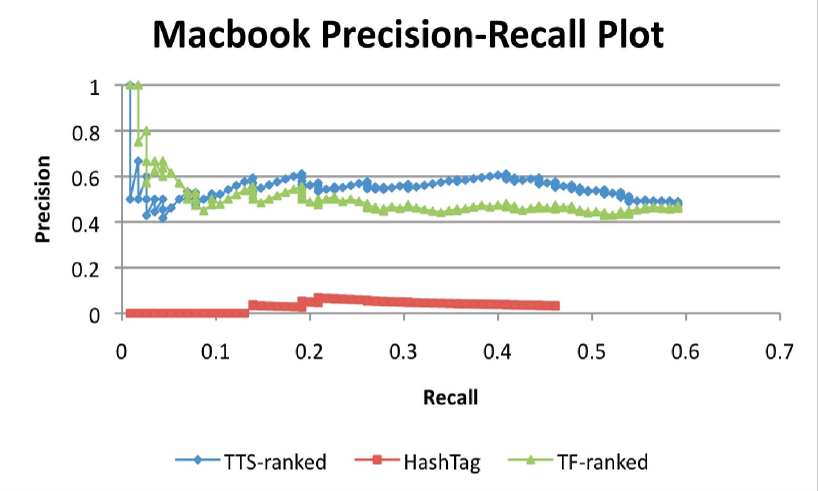 Figure 2: Precision-Recall curves showing the superiority of TTS-ranked topic discovery.
The statistical Paired t-test confirmed that ignoring credibility leads to results that are significantly "different" from public opinion, while the proposed weighted method provided a near-perfect proxy for human sentiment.
Critical Insight & Conclusion
The biggest takeaway here is the transition from Quantity to Quality. In the early days of social listening, we just counted mentions. This research proves that for microblogs—where the signal-to-noise ratio is notoriously low—we must identify the authority behind the post.
Limitations: The system relies heavily on predefined Meronym patterns (like "X of Y"). In an era of evolving slang, these patterns might need constant AI-driven updates. Additionally, the system currently treats posts as single units; future work could benefit from sentence-level analysis to handle "mixed sentiment" tweets.
Future Outlook: For brands, this justifies the shift toward "Influencer-weighted" sentiment dashboards. It's not just about what is being said, but who is saying it and how much "soul" they put into the post.