
Dig-Event: Bridging the Gap Between Scheduling and Executing Social Activities
The Design of Activity-Oriented Social Networking: Dig-Event
Dig-Event is an activity-oriented social networking system designed to facilitate event-based collaboration and discovery among trusted social circles. It extends traditional calendaring by integrating a "gadget reasoning engine" for functional event organization and achieves a seamless experience through mashups of existing social media and calendar services.
TL;DR
Dig-Event is a novel social networking system that transforms the humble calendar from a static time-tracking tool into a dynamic activity hub. By shifting the focus from "official" public events to day-to-day social coordination among trusted peers, and by introducing "gadgets" that help users actually do the activity, the paper proposes a "User-Generated Event" (UGE) paradigm.
Context: Beyond the "What" and "When"
For decades, electronic calendars have been trapped in the "Groupware" mindset—tools designed for enterprise efficiency, focusing strictly on the 4Ws: What, When, Where, and Who.
However, the authors identify a critical missing dimension: The "How." Knowing you have a "French Course" at 6 PM is one thing; having the map, the dictionary, and the social forum to coordinate carpooling with friends for that course is another. Dig-Event argues that social networking should not just be about "catching up" on news feeds but about "together-doing" (Do-it-together).
The "How" via Gadget Reasoning
The core technical innovation of Dig-Event is its Gadget Reasoning Engine. Instead of leaving the user with an empty description box, the system analyzes the event type and context to recommend functional "gadgets" (mashup services).
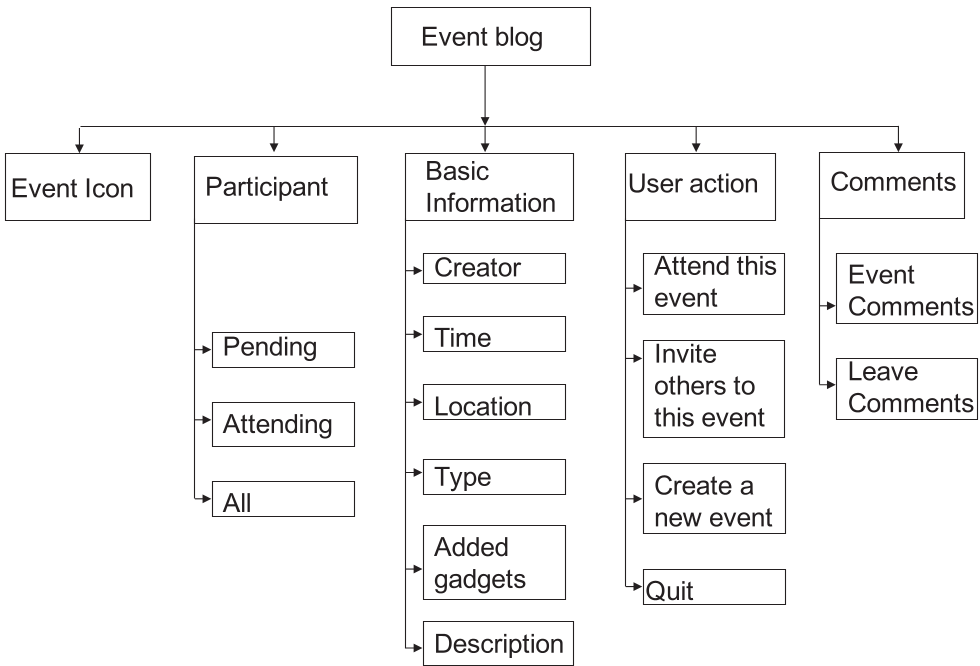 Figure: The Dig-Event System Framework illustrating the Logic layer's reasoning engine.
The Workflow of an Event:
- Creation: User inputs activity metadata.
- Reasoning: The engine matches the event category against a database of gadgets (e.g., a "Cinema" event triggers a 'IMDB' or 'Ticket Booking' gadget).
- Mashup: These gadgets are overlaid directly onto the Google Calendar interface using APIs, creating a unified workspace for the activity.
Social Design: Circles and Asymmetry
The paper takes a significant stance on privacy and discovery. Moving away from the "all-or-none" privacy of early enterprise calendars, Dig-Event adopts an Asymmetric Sharing Model.
- Customized Circles: Similar to Google+, it allows users to share a "Work Lunch" only with colleagues while keeping "Museum Visits" for family.
- Low Friction Discovery: By allowing one-way follows, it reduces the social "cost" of seeing what others are planning, encouraging spontaneous participation.
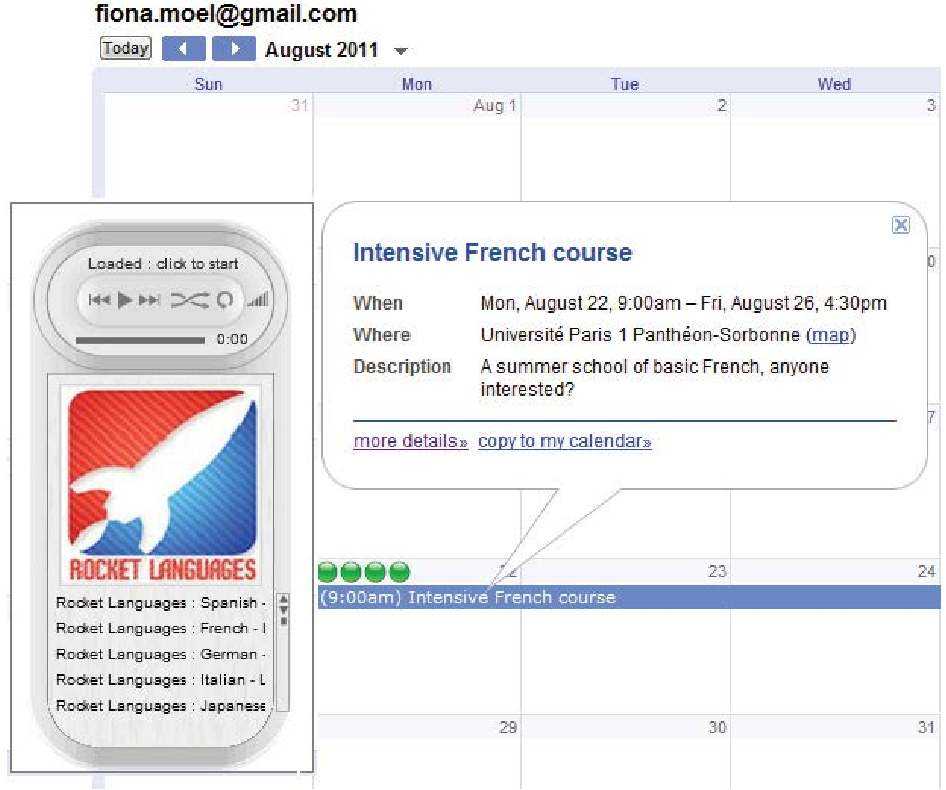 Figure: Functional gadgets mashed up directly on top of the calendar view to assist in event execution.
Impact and Results
The authors validated the concept through a usage scenario where users like "Fiona" and "Vincent" could collaborate on a French course. Key findings included:
- Value-Adds: Users appreciated the "Event Blog" (the socialization aspect around an event) more than standard bulletin boards.
- Recommendation Engine: By matching event titles and locations, the system successfully surfaced relevant activities to users who hadn't been explicitly invited, boosting "organic" social interaction.
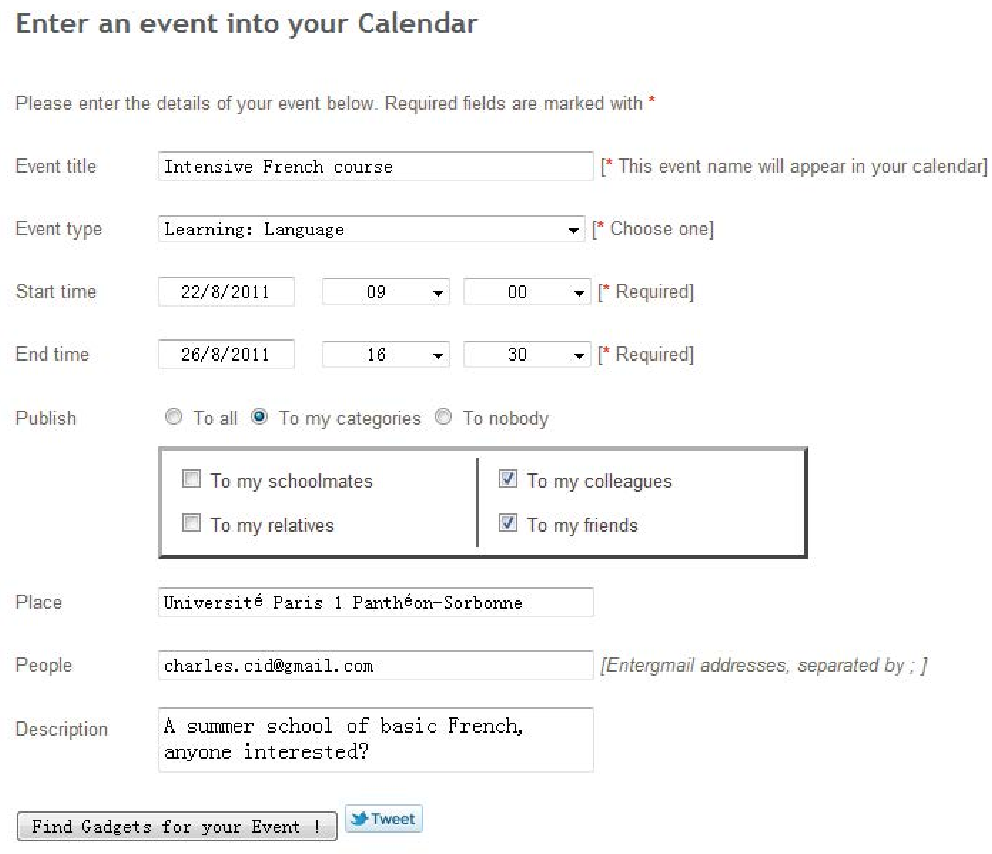 Figure: The public calendar interface showcasing the "Event Recommendation" area for discovery.
Critical Insight & Limitations
The primary strength of Dig-Event is its non-replacement strategy. Rather than building a new calendar from scratch, it leverages the ubiquity of Google Calendar and focuses its innovation on the social interaction layer.
However, looking back from a modern perspective, the dependence on "iGoogle-style Gadgets" was a product of its time (2011). Today’s ecosystem would likely replace these with "Mini-apps" or deep-linking into mobile applications. Furthermore, the paper lacks a large-scale user study to quantify exactly how much "activity stickiness" was gained, focusing instead on system architecture and design rationale.
Future Outlook
Dig-Event paved the way for the "Social Productivity" tools we see today. The takeaway for current developers is clear: Don't just show users when their friends are busy—show them what they are doing and give them the tools to join in with a single click.