
Crowdsourcing the Aesthetic: Beyond Pixel-Matching in Design Search
Searching for design examples with crowdsourcing
This paper introduces a crowdsourcing-based pipeline for design example search, leveraging Amazon Mechanical Turk (AMT) to handle subjective queries that traditional algorithms struggle with. The method uses a multi-image query-by-example representation and consistently outperforms Google Images in relevance and diversity.
TL;DR
Finding the perfect design inspiration is more about "feeling" than "folders." While Google Images can find a "blue website," it fails to find an "elegant website with a hint of color." This paper solves the "black box" of subjective design search by building a crowdsourced pipeline that uses human intelligence to bridge the gap between abstract concepts and visual results, significantly outperforming algorithmic baselines in relevance and diversity.
The "Vibe" Gap: Why Algorithms Fail Designers
Designers rely on examples to get inspired and avoid design fixation—the tendency to stick to a limited set of familiar ideas. However, existing algorithmic tools have a major blind spot: Subjectivity.
An algorithm sees a dark background as a histogram of low-value pixels. A human sees it as "calm," "mysterious," or "sophisticated." Prior work in design mining has pushed the boundaries of structural analysis, but capturing the "long tail" of design needs (e.g., "spacious but cozy") remains an AI bottleneck. This paper argues that if the machine can't see the "vibe," we should let the crowd do it.
Methodology: Engineering the Crowd
The researchers didn't just ask people to "find cool images." They iterated through several pipeline configurations to find the "Goldilocks" zone of efficiency and quality:
- Index-Driven Over Search-Driven: Allowing workers to search the open web led to redundant, low-quality results. Instead, the authors pre-crawled high-quality design galleries (like CSS Design Awards), forcing workers to choose from a curated pool.
- Multi-Image Queries: Representing a design need with a single image is ambiguous. Using three query images allows the crowd to triangulate the specific "style" the designer is targeting.
- The "Strike" Pattern: To keep costs low and engagement high, multiple Micro-tasks (HITs) were grouped into continuous sessions.
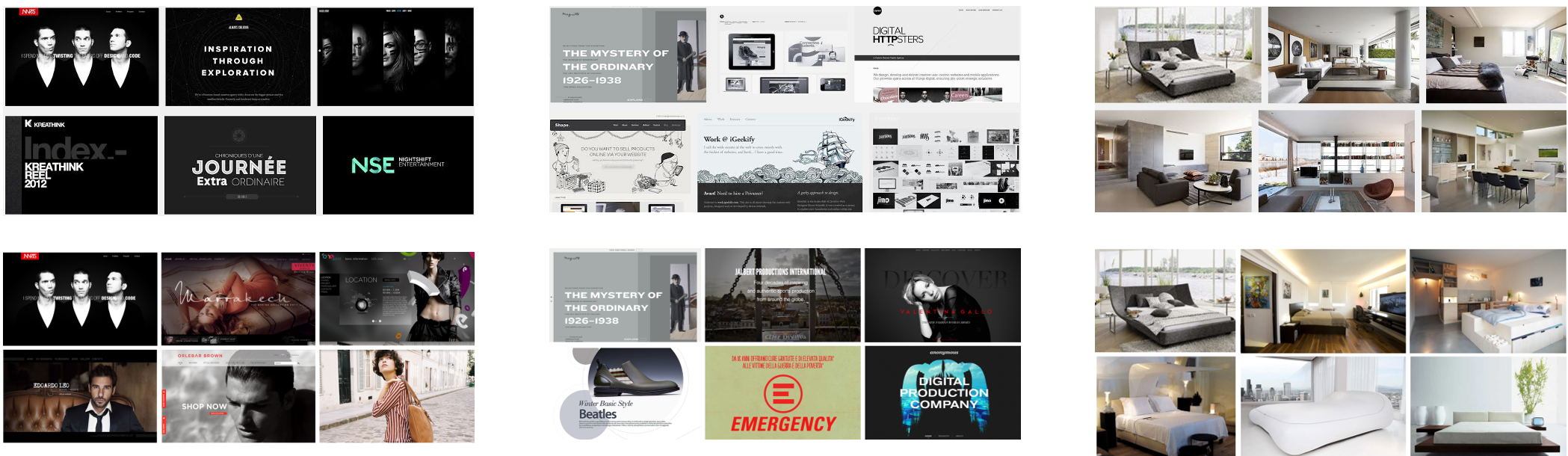 Figure 1: Comparison between Google Images (Top) and the Crowdsourced Results (Bottom). Note the higher diversity and thematic consistency in the bottom row.
Proving the Human Advantage
The study compared their crowd pipeline against Google Images across three domains: Web Design, Typography, and Interior Design. To ensure a fair fight, they restricted Google's search to the same galleries.
Performance Highlights:
- Precision @ 50: In Interior Design, the crowd achieved 0.60 precision compared to Google’s 0.16.
- Relevance: Expert designers who reviewed the results (blindly) consistently rated the crowd's selections as more aligned with the subjective text descriptions.
- Diversity: While Google often returned near-duplicates of the query, the crowd provided visually distinct images that shared the same "underlying soul" of the design need.
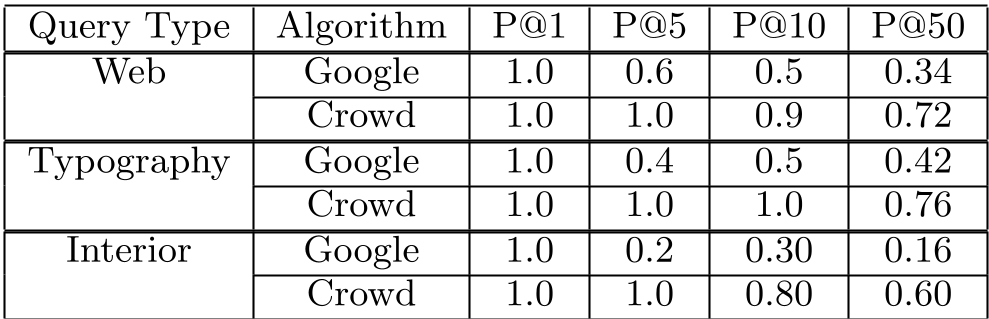 Table 1: The crowd consistently outperforms the algorithm across all precision metrics (P@1 to P@50).
Critical Insight & Future Outlook
This work demonstrates that for creative tasks, Precision isn't everything—Diversity is equally vital. If a search engine gives you 50 identical images, it hasn't helped you explore; it has locked you in a room. By using human workers, this method naturally captures the "semantic variance" of a query.
Limitations: The obvious hurdle is latency and cost. While an algorithm is free and millisecond-fast, a crowd takes time and money. However, as we move into the era of LLMs and Multi-modal AI, the "best practices" identified here—like using multi-image prompts and focusing on curated indexes—provide a vital roadmap for training the next generation of "Aesthetic AI."
Conclusion
This paper serves as a reminder that "Design" is a human-to-human communication. When we search for design, we aren't looking for pixels; we are looking for ideas. By leveraging the crowd, we can finally search for the "hint of color that makes it less boring."