
IdeaWorks: Bridging the Gap Between Online Education and Social Learning Theory
The Design of IdeaWorks: Applying Social Learning Networks to Support Tertiary Education
This paper introduces IdeaWorks, a specialized Social Learning Network (SLN) platform designed for tertiary education. Built on Social Learning Theory, it integrates idea management, project collaboration, and social discovery to transform passive online learning into proactive, socialization-driven engagement.
Executive Summary
TL;DR: This paper presents IdeaWorks, a web-based platform that uses Social Learning Networks (SLN) to support university education. Unlike standard Learning Management Systems (LMS), IdeaWorks focuses on interaction, networking, and collaborative innovation. While it successfully replicates student satisfaction and "presence" found in traditional classrooms, it highlights a persistent challenge: replicating the fluid communication of face-to-face instruction.
Academic Positioning: This work serves as an empirical bridge between educational psychology (Social Learning Theory) and system design, offering a blueprint for the next generation of "socialization-first" e-learning platforms.
Problem & Motivation: The Loneliness of the Online Learner
Most online education systems treat students as data sinks—receptacles for videos and PDFs. This ignores Bandura’s Social Learning Theory, which posits that human behavior is learned through observation, imitation, and modeling within a social context.
The authors argue that the current bottleneck in tertiary education isn't the access to information, but the lack of social ties that foster innovation and motivation. They ask: Can we build a system that supports "learning through socialization" as effectively as a physical classroom?
Methodology: Designing for Socialization
IdeaWorks is architected around two core environments: Search Space and My Space.
- Search Space (Discovery): Allows students to break out of class-centric silos. They can hunt for "learning buddies," find expert advisors, and discover public projects based on shared interests.
- My Space (Management): A hub for "My Ideas" and "My Projects." It serves as a repository for nascent thoughts that transition into formalized group collaborations.
- Third-Party Integration: By embedding tools like Skype and Google Docs, the system acknowledges that specialized collaboration tools are often superior to "all-in-one" generic platforms.
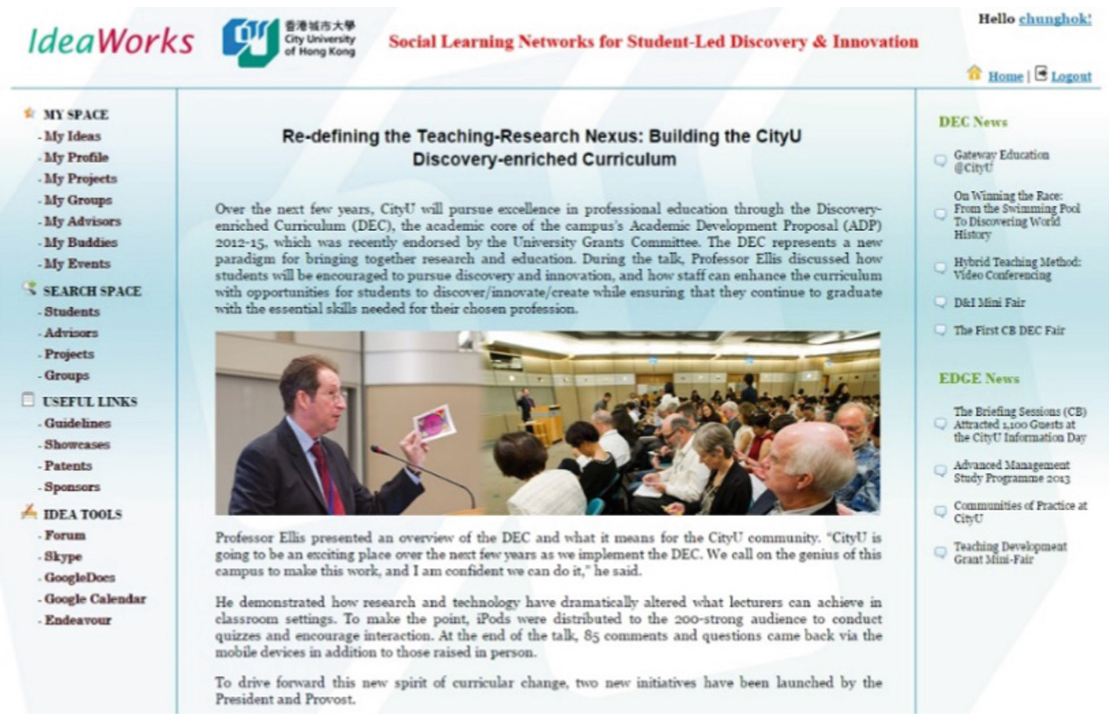 Figure 1: The interface design highlighting the focus on social networking and project management.
Experiments & Results: Classrooms vs. Algorithms
The authors conducted two distinct studies: a Usability Study (focused on UX) and an Impact Study (focused on educational outcomes using an English learning program).
Key Findings:
- Success in Presence: There was no significant difference between IdeaWorks and traditional classrooms in terms of Social Presence (the feeling of being with others) and Cognitive Presence (the ability to construct meaning). This is a major win for SLNs.
- The Communication Gap: Despite the high satisfaction, traditional classrooms were statistically superior in Instructional Communication (5.90 vs. 5.26) and Group Communication (5.93 vs. 5.17). This indicates that digital latency and lack of non-verbal cues still hinder deep instructional dialogue.
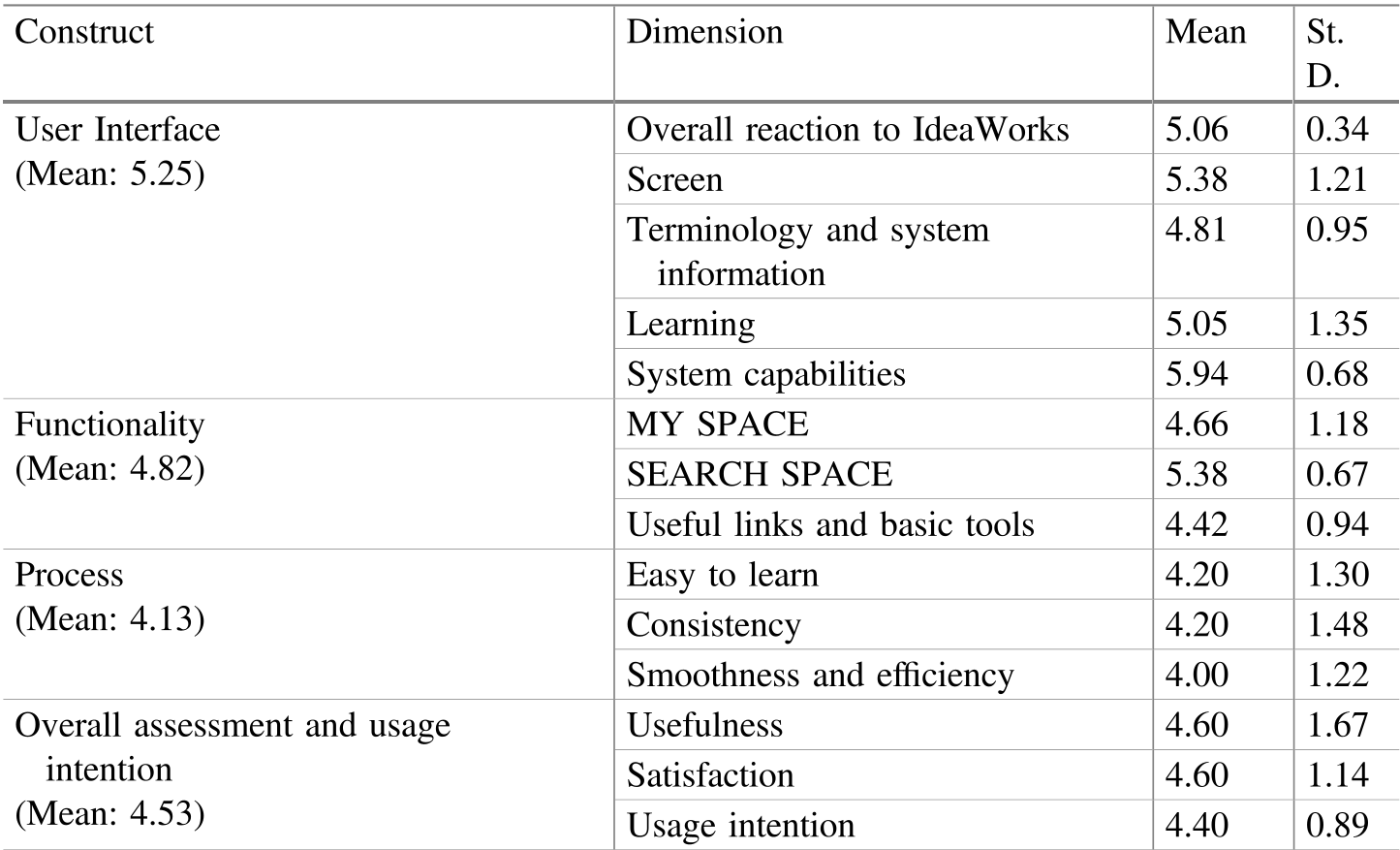 Table 1: Usability metrics showing strong performance in Search Space and System Capabilities.
Critical Analysis & Conclusion
Takeaway
IdeaWorks demonstrates that Social Learning Networks can go beyond simple content hosting to foster a genuine sense of community and innovation among students. It proves that the "social" aspect of learning can be digitized efficiently.
Limitations & Future Work
The study honestly notes that the platform felt "dull" to some students and struggled to match the speed of face-to-face Q&A sessions. Future iterations should look into:
- Gamification: To increase the "attractiveness" of the platform.
- Synch-Tech: Better real-time interaction modules to reduce the friction in instructional communication.
- Scalability: Moving beyond the small sample size (33 students) to test how these social networks behave at a cross-university scale.
In conclusion, IdeaWorks is a significant step toward Blended Learning that actually respects the social nature of human cognition.