
Social Storage: Turning Co-worker Relationships into Enterprise Infrastructure
Design Process of a Social Network System for Storage and Share Files in the Workplace
This paper presents the design process of a decentralized, social-network-based storage system for the workplace. By leveraging unused local storage on employees' devices (estimated at 55% idle capacity), the authors propose a peer-to-peer (P2P) sharing model that reduces reliance on expensive centralized servers.
TL;DR
Enterprises are drowning in data, yet 55% of the storage on individual laptops remains unused. This paper explores the design of a decentralized social storage system that leverages these idle resources. By treating co-workers as nodes in a peer-to-peer network, the authors propose a system that reduces server costs while aligning with natural workplace social dynamics.
Background: The Hidden Inefficiency of the Modern Office
In the current enterprise landscape, we face a paradox: while companies pay for massive, expensive server farms, the combined storage capacity of employee laptops represents a vast, untapped "dark" infrastructure. Simultaneously, workers are frustrated by a fragmented experience—using Chat for small files, Email for "official" versions, and Cloud links for large assets. This paper analyzes why this happens and how a Social Network Storage System can fix it.
The Core Insight: Social Proximity = Data Relevance
The authors' research suggests that people are more likely to need files from their immediate team members or department. Traditional clouds treat every file as a distant object on a server; this paper suggests storing copies of files locally on your teammates' machines.
Key advantages include:
- Reduced Bandwidth: Fetching a file from a peer on the same Local Area Network (LAN) is faster than downloading from a remote cloud.
- Resilience: By creating "social replicas" (multi-copy redundancy), files remain available even if the original owner is offline.
- Integrated Workflow: The system merges storage with communication, allowing users to request storage space via chat.
Methodology: From Interviews to 20 Commandments
The researchers conducted deep-dive interviews with 10 employees across various roles (from Research Scientists to Supply Chain Analysts). They discovered that "versioning" is a major pain point—users frequently overwrite files or lose track of the "latest" version.
From these insights, they derived 20 Design Recommendations. Key highlights include:
- Recommendation 9: The system must not affect the host's machine performance.
- Recommendation 16: Traceability of who sent what and who has the last version is mandatory.
- Recommendation 20: Provide incentives—users get back a proportional amount of remote space based on the local space they contribute.
Architecture & Prototype
The proposed system replaces the traditional Client-Server model with a Peer-to-Peer (P2P) architecture.
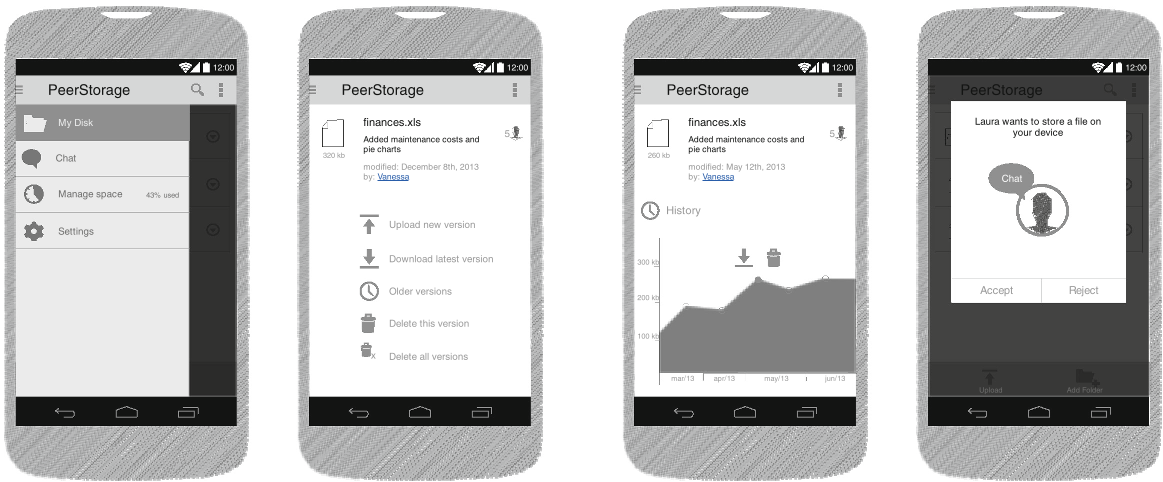 Caption: The prototype interface shows (a) Storage settings, (b) File management with social sharing counts, (c) A timeline for versioning, and (d) Social request chat logic.
The low-tech prototype focuses on Transparency. Users can see who is storing files on their machine, ensuring a sense of security and accountability. Files are encrypted, ensuring that while your co-worker's laptop holds the bits, they cannot read the content without permission.
Experimental Analysis: The Reality of Storage Usage
The study highlights a significant gap between perception and reality. While most interviewed participants felt they were using 50% to 75% of their disk space, industry data suggests actual usage is much lower. This "perception gap" is an opportunity; users are more willing to share space when they realize how much they actually have to spare.
Furthermore, the researchers noted a redundancy of 54% in file counts within typical workgroups. A social storage system can implement "deduplication," keeping only a few copies across the team rather than everyone storing the same file individually.
Critical Insight & Future Outlook
While the paper successfully builds a bridge between social interaction and technical storage, it leaves some questions about Availability. In a mobile-first workplace, what happens when an entire team goes offline?
The future of this work lies in Hybrid Models: combining the cost-efficiency of P2P social storage for "warm" data (files currently being worked on) with minimal cloud backup for "cold" data (archived projects).
Takeaway for Architects
If you are designing enterprise tools, stop thinking of storage as a "bucket" and start thinking of it as a "network." Leveraging the social graph of an organization can lead to more intuitive version control and significantly lower infrastructure overhead.
Author Analysis: This work serves as an excellent case study in Human-Computer Interaction (HCI) meeting Distributed Systems. It reminds us that technical bottlenecks are often best solved by observing human behavior rather than just increasing server capacity.