
Leveraging the "Trusted Circle": A New Paradigm for Alcohol Moderation Apps
4542_Designing a Mobile Social Tool that Moderates Drinking.
This paper introduces a novel mobile social tool designed to moderate binge drinking among young women by leveraging peer support. The application integrates social networking features like shared event timelines, drink counters, and a "trusted circle of friends" to create social pressure and real-time awareness, moving beyond traditional single-user health apps.
TL;DR
Researchers have developed a mobile social tool specifically for young women that shifts the focus of alcohol moderation from clinical tracking to social accountability. By integrating features like a shared event timeline and a collective "drink table," the app utilizes peer dynamics to encourage responsible drinking in real-time.
Context: The Social Gap in Health Apps
Most health interventions for alcohol consumption struggle with a fundamental paradox: binge drinking is a social activity, yet most apps are designed for the solitary user. Governments use legislation and ads, but young people—particularly those who identify as "social drinkers"—often feel these warnings don't apply to them.
The authors of this study identified that young women are particularly vulnerable to the physical and social harms of intoxication but are also highly protective of their peer groups. The insight was simple: Instead of acting as a digital scold, the mobile tool should act as a medium for friends to look out for one another.
Methodology: Designing for the Night Out
The tool focuses on three stages of a social event: before (planning), during (monitoring/safety), and after (reflection).
1. Peer-Support Network
Unlike public social networks like Facebook, the tool operates within a "confined social circle." Users create an event and invite a specific group. This privacy encourages honest sharing and reduces the stigma of "monitoring" one's behavior.
2. The Intuitive Drink Table
To solve the friction of manual logging, the developers created a "Drink Table" interface. Users tap and hold a virtual table to add drinks, mimicking the physical action of ordering another round.
- Visibility as Deterrent: Every time a drink is added, the timeline broadcasts this to the peer group. This creates a "soft" social pressure where visibility leads to self-regulation.
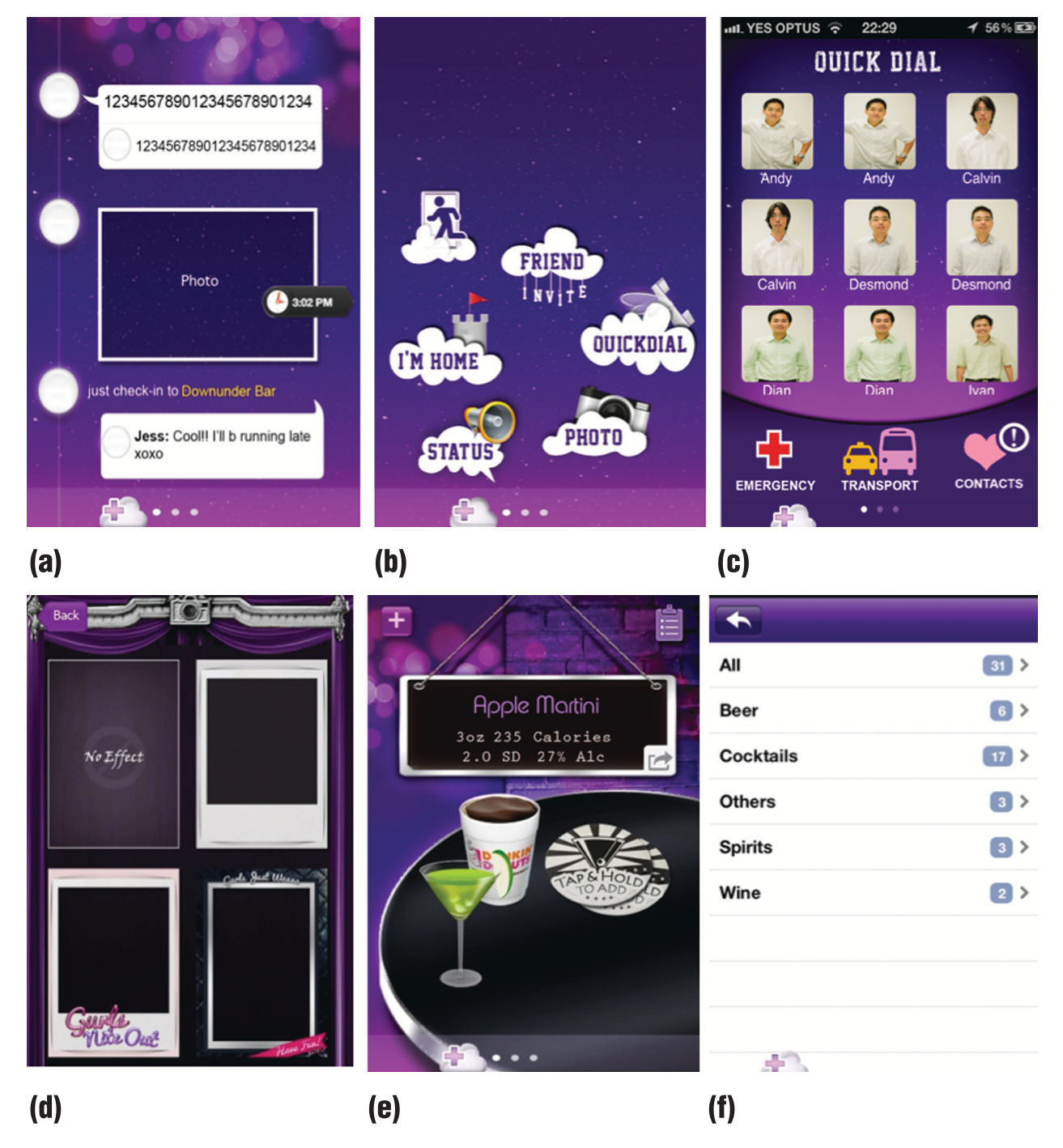 Figure 1: (c) Quick Dial screen, (d) Photo booth, (e) Drink table showing consumption tracking.
3. Safety-First Functionalities
The "I’m home" button was one of the most praised features. It automates the "text me when you're back" ritual common among female peer groups, providing peace of mind without the need for a full phone call.
Experiments & Results
Through focus groups and a field trial, several key findings emerged:
- Privacy is Paramount: Participants were firm about keeping drinking data off mainstream platforms like Facebook to avoid "bad photos" reaching parents or bosses.
- Awareness Through Sharing: Trial participants noted that seeing their drinks pop up on a shared timeline made them "more conscious" of their limits compared to private counters.
- Motivational Drivers: Interestingly, users were often more motivated by the "cost" of drinks and "calories" (fitness goals) than by blood alcohol content (BAC) warnings.
 Figure 2: The event creation and timeline interface designed to facilitate coordination.
Critical Insight: The "Facebook Add-on" Future
One persistent challenge identified was the "barrier to entry." Participants suggested that for such a tool to achieve mass adoption, it should exist as an "add-on" to existing platforms—allowing for discovery on Facebook but transitioning to a private, moderated "safe space" once the drinking session begins.
Conclusion
This work demonstrates that technology’s role in public health is moving away from just "data collection" and toward "social orchestration." By aligning with the existing protective instincts of young women's social circles, the tool turns peer pressure—usually a driver of binge drinking—into a powerful mechanism for moderation.
Limitations: The study notes that estimations of BAC are subjective and risky to include without high precision. Future work will need to balance the "fun" social aspects with the "serious" medical accuracy required for high-risk users.