
Designing with AI: Bridging the Gap Between Creative Intuition and Data-Driven Marketing
Designing with AI for Digital Marketing
The paper introduces an interactive, real-time AI-driven dashboard designed for digital marketing professionals to predict the click-through rates (CTR) of email content during the design phase. By decomposing content into interpretable features of Pathos, Logos, and Ethos, the system achieved an AUC of 0.80 on historical data and demonstrated a 22% lift in CTR during A/B preference testing.
TL;DR
Adobe researchers have developed a real-time interactive dashboard that allows digital marketers to predict the success of their email campaigns while they are still designing them. By translating complex AI predictions into the "Three Pillars of Persuasion" (Ethos, Pathos, and Logos), the system achieves a 22% lift in predicted click-through rates (CTR) and high praise from industry professionals.
Background: Beyond the Black Box
In the current digital marketing landscape, AI is usually a "post-mortem" tool. Data scientists analyze why a campaign failed after the money has been spent. This paper shifts the paradigm by bringing AI into the creative seat. The goal is to provide Actionable Interpretability: not just telling a designer that an email will fail, but showing why based on image quality, text formality, or placement.
The Problem: The "Creativity-Data" Divide
Designers often rely on years of experience, while AI models rely on millions of data points. The disconnect arises because:
- AI results are often opaque: Scores don't tell a designer which image to swap or where to move a button.
- Timing: Insights come too late in the production cycle.
- Language Barrier: Designers think in terms of "emotions" and "balance," while AI thinks in "feature vectors" and "weights."
Methodology: The Three Pillars of Persuasion
The researchers mapped quantifiable AI features to ancient rhetorical concepts to make the dashboard intuitive for humans.
1. Pathos (Emotional Appeal)
The system analyzes Image Quality and Memorability. It uses features like the "Rule of Thirds," color harmony, and symmetry to quantify the aesthetic "pull" of a visual.
2. Logos (Logical Layout)
This focuses on Spatial Reasoning. The AI evaluates the size ratio of images and their placement (top, middle, or bottom).
3. Ethos (Credibility)
Credibility is analyzed through Text Readability and Sentiment. Using Flesch readability scores and VADER sentiment analysis, the system predicts if the "tone of voice" matches the brand's goal.
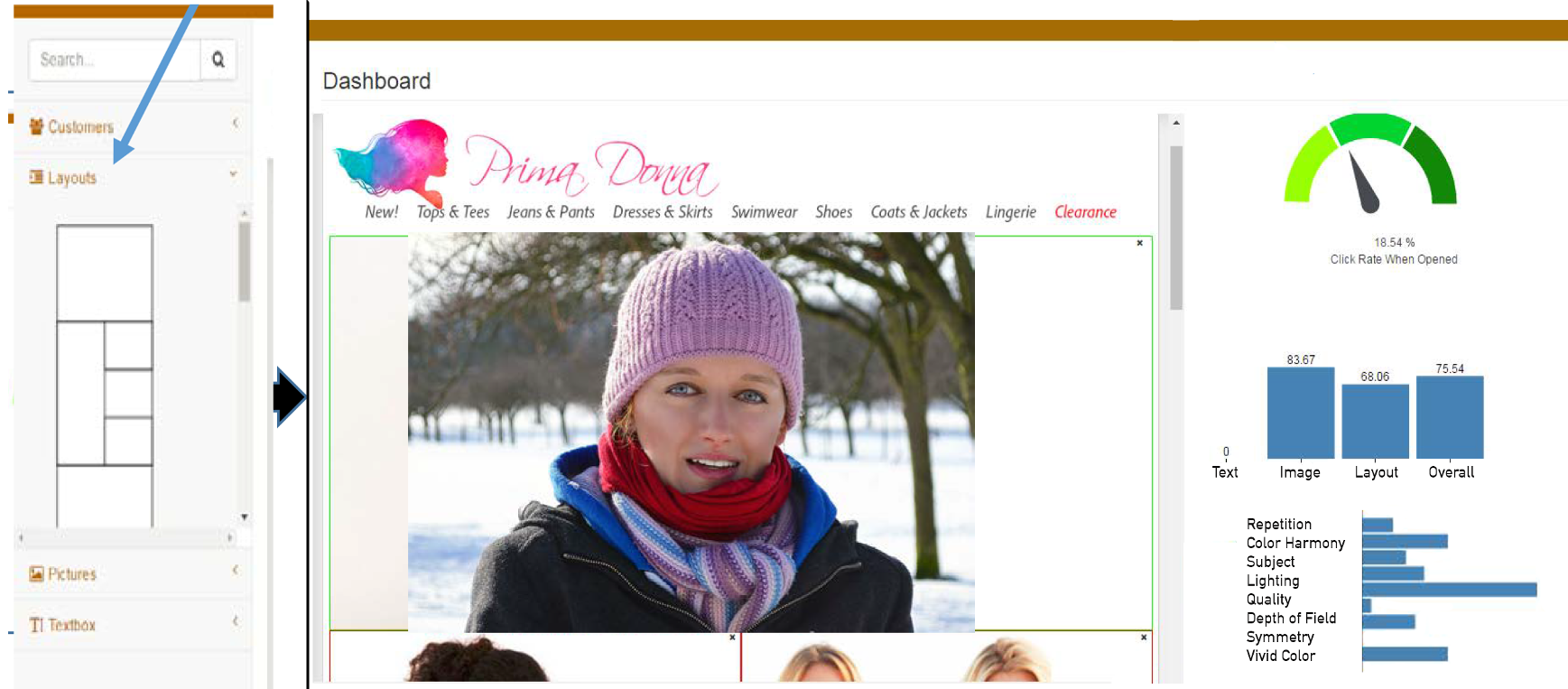 Figure 1: The interactive dashboard showing real-time CTR probability and feature contribution bars.
Why it Works: Rare Event Correction
Technically, the paper addresses a common data science hurdle: Imbalanced Data. Only ~5% of opened emails result in a click. The authors used Logistic Regression with a correction factor for undersampling negative samples, ensuring the model (which achieved an AUC of 0.80) remained computationally efficient enough for real-time UI updates.
Experimental Results: Proving the Gains
The team conducted A/B testing on Amazon Mechanical Turk (AMT) to see if AI-recommended designs actually "won" against human-only designs.
- Placement is King: Content placement recommended by AI was preferred 72% of the time, leading to a 22% lift.
- Visuals Matter: AI-chosen images provided a 16% lift.
- Text involves nuance: Text recommendations saw a more modest 7% lift, likely because short marketing fragments are harder to analyze via standard NLP metrics than long-form text.
 Figure 2: Examples of A/B preference tests where AI-guided choices outperformed alternatives.
Critical Insight: The Expert Verdict
While the quantitative results were strong, the Expert User Study revealed a vital "Human-AI Interaction" (HAI) lesson: Transparency is non-negotiable.
Some professionals were skeptical not of the score, but of the data source. They wanted to know:
- "What was the demographic of the training data?"
- "How recent is this data?"
This suggests that for AI to be truly adopted in creative fields, it must not only be accurate but also provide "Provenance"—proving its advice is relevant to the specific audience being targeted today.
Conclusion
This work marks a significant step toward Augmented Creativity. By translating machine learning weights into human-centric concepts like Pathos and Ethos, Adobe has demonstrated that AI can be a "creative partner" rather than just a critic. The 22% CTR lift proves that even simple, interpretable features can drive massive business value when placed in the hands of a skilled professional at the right time.