
Deciphering Digital Imagery: A Framework for Analyzing Visual Communication in Social Ecosystems
Designing and building systems and tools to analyze visual communications on social networks
The paper presents a work-in-progress research project focused on building a specialized software ecosystem to analyze visual communications on social networks like Instagram and Flickr. It introduces a suite of tools designed to facilitate both qualitative and quantitative research into how users utilize visual language, imitation patterns, and non-formal communication without explicit visual literacy.
TL;DR
Social networks have sparked a global "visual conversation" where billions of photos are uploaded daily, yet most users lack formal training in visual grammar. This paper introduces a sophisticated research suite designed to analyze these non-formal communication patterns. By combining automated API data retrieval with manual qualitative tagging, the authors aim to uncover how we "learn by imitation" in the age of Instagram and Flickr.
Background: The Rise of the Visual Illiterate?
We currently live in an era where more photos are taken in two minutes than were produced throughout the entire 19th century. Despite this explosion in visual production, a fundamental question remains: Can people communicate effectively using a language they haven't formally studied?
The authors argue that "visual communication" in social networks is driven largely by imitation. Users replicate filters, angles, and subjects not out of technical expertise, but as a social behavior. The limitation of current research lies in the lack of tools that can simultaneously handle massive datasets (quantitative) while allowing researchers to dive into the semiotic meaning of an image (qualitative).
Methodology: Bridging the Gap Between Metadata and Meaning
The researchers at the University of Salamanca developed a technical stack designed for flexibility and depth.
1. The Tech Stack
- Backend: Django (Python) framework for robust web management.
- Data Integrity: NoSQL databases (MongoDB) to handle the heterogeneous and ever-changing structures of social media data.
- Connectivity: Integration with Instagram and Flickr REST APIs to pull real-time posts, metadata, and user profiles.
2. The Analysis Workflow
The tool facilitates a three-stage process:
- Retrieval: Searching via hashtags or user handles.
- Classification: A manual interface where researchers can "tag" photos based on specific qualitative criteria (e.g., color vs. B&W, composition styles).
- Insight Generation: A planned dashboard to visualize trendsetters and imitation networks.
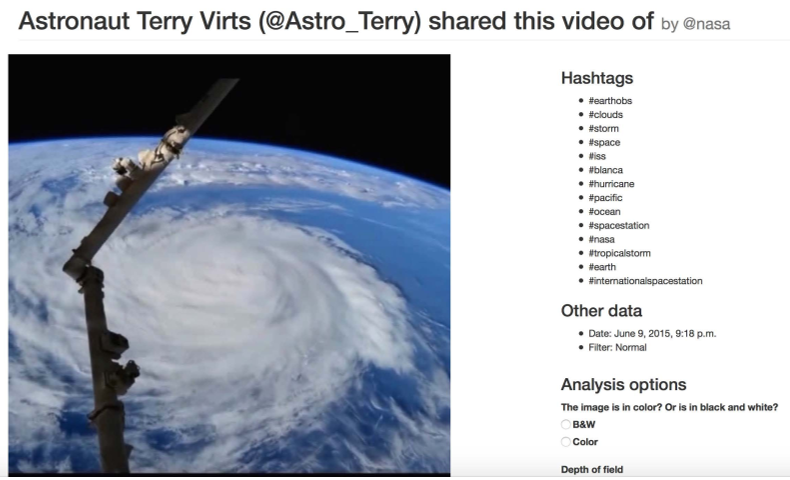 Figure: The beta interface showing photo selection and the manual analysis parameters available to researchers.
Experiments & Core Insights
The beta version of the system provides several key breakthroughs even at this early stage:
- Overcoming Data Constraints: Instagram famously wipes EXIF data (which contains camera model, aperture, etc.). The authors proposed using hashtag analysis to reconstruct these technical profiles, identifying which devices users are likely using.
- Trendsetter Identification: By tracking imitation behaviors—such as the viral adoption of specific filters—the tool can identify "lead users" who set the visual tone for their communities.
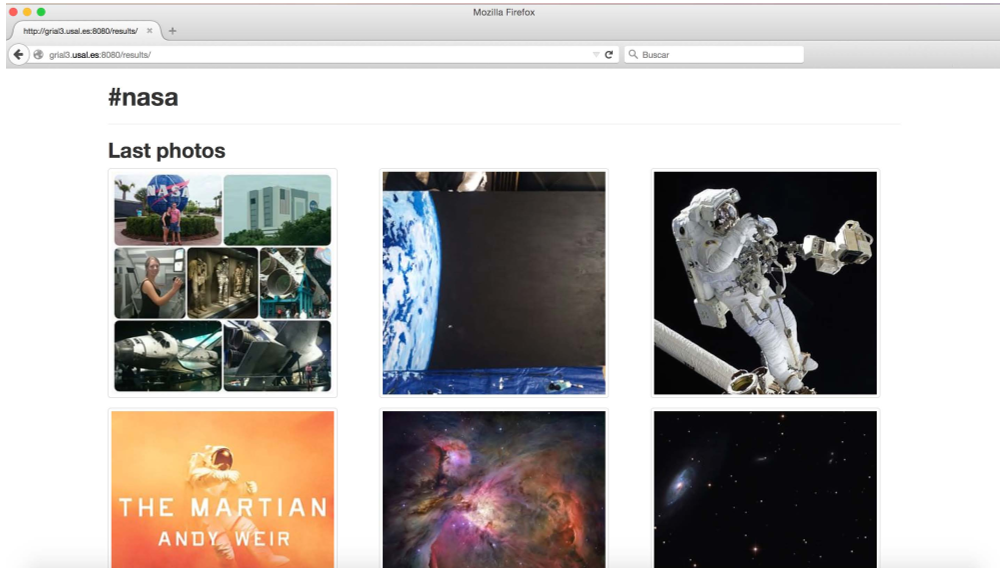 Figure: Real-world search results from the system for the hashtag #nasa, demonstrating the tool's ability to cluster visual content for research.
Critical Analysis & Future Outlook
While the current tool is highly effective for gathering and manually tagging data, its ultimate success will depend on its scalability. The authors' roadmap includes a vital transition to Machine Learning (ML). By training models on the manual tags provided by researchers, the system could eventually automate the detection of "visual dialects" across millions of photos.
Takeaway: This work underscores that in digital social science, the photo is not just an image—it is a node in a conversational network. Future research must stop looking at what is in the picture and start looking at how the picture is being used to "speak."
Limitations: The reliance on manual tagging in the beta stage remains a bottleneck for true "Big Data" analysis, and the ever-changing API policies of platforms like Instagram present a constant hurdle for tool maintenance.