
CDeepCubeA: Transforming "Black-Box" AI into a Learning Partner for Children
Designing Children’s New Learning Partner: Collaborative Artificial Intelligence for Learning to Solve the Rubik’s Cube
The paper introduces CDeepCubeA, a collaborative artificial intelligence framework designed to help children develop problem-solving and algorithmic thinking skills by learning to solve the Rubik's Cube. It extends the DeepCubeA reinforcement learning model by incorporating Knowledge Graphs and Decision Trees to transform a "black-box" solver into an interpretable, human-in-the-loop learning partner.
TL;DR
Researchers at the University of South Carolina have developed CDeepCubeA, a collaborative AI designed to teach children how to solve the Rubik’s Cube. Unlike previous "expert" AIs that simply solve the puzzle using uninterpretable deep learning, this new system uses Knowledge Graphs and Decision Trees to explain why it makes certain moves, allowing students to co-create personalized solving strategies with the AI.
From Optimizer to Educator
While AI has mastered the Rubik’s Cube (DeepCubeA can solve it in a fraction of a second), these models are typically "black boxes." They provide a list of moves but no conceptual understanding. For a child trying to learn, a list of 20 random face rotations is useless.
The researchers identified that to foster algorithmic thinking—the ability to develop effective procedures for solving problems—the AI must speak the human language of subgoals and patterns. The motivation behind CDeepCubeA is to bridge the gap between high-level human intuition (e.g., "let's solve the first layer first") and low-level machine optimization.
Methodology: The Interpretable Core
CDeepCubeA transitions from the original DeepCubeA architecture to a collaborative framework through three key innovations:
1. Plan and Subgoal Decomposition
Instead of viewing the Rubik's Cube as one massive problem, the system breaks it down into a Plan (a series of partial configurations or subgoals) and Algorithms (sequences of actions to reach those subgoals).
2. Knowledge Graph (KG) Integration
The AI uses a Knowledge Graph to translate the 3D grid of colors into human concepts. Instead of seeing "Face R, Row 1, Col 2 is Red," the KG allows the AI to ask and answer queries like:
- "Is the first layer complete?"
- "Are there three edge pieces out of place?"
3. Decision Trees for Strategy
While the original model used a Deep Neural Network (DNN) to map configurations to actions, CDeepCubeA uses a Decision Tree. This allows the model to explain its logic: "If the first layer is complete AND the second layer is incomplete, THEN use the 'Middle-Layer Algorithm'."
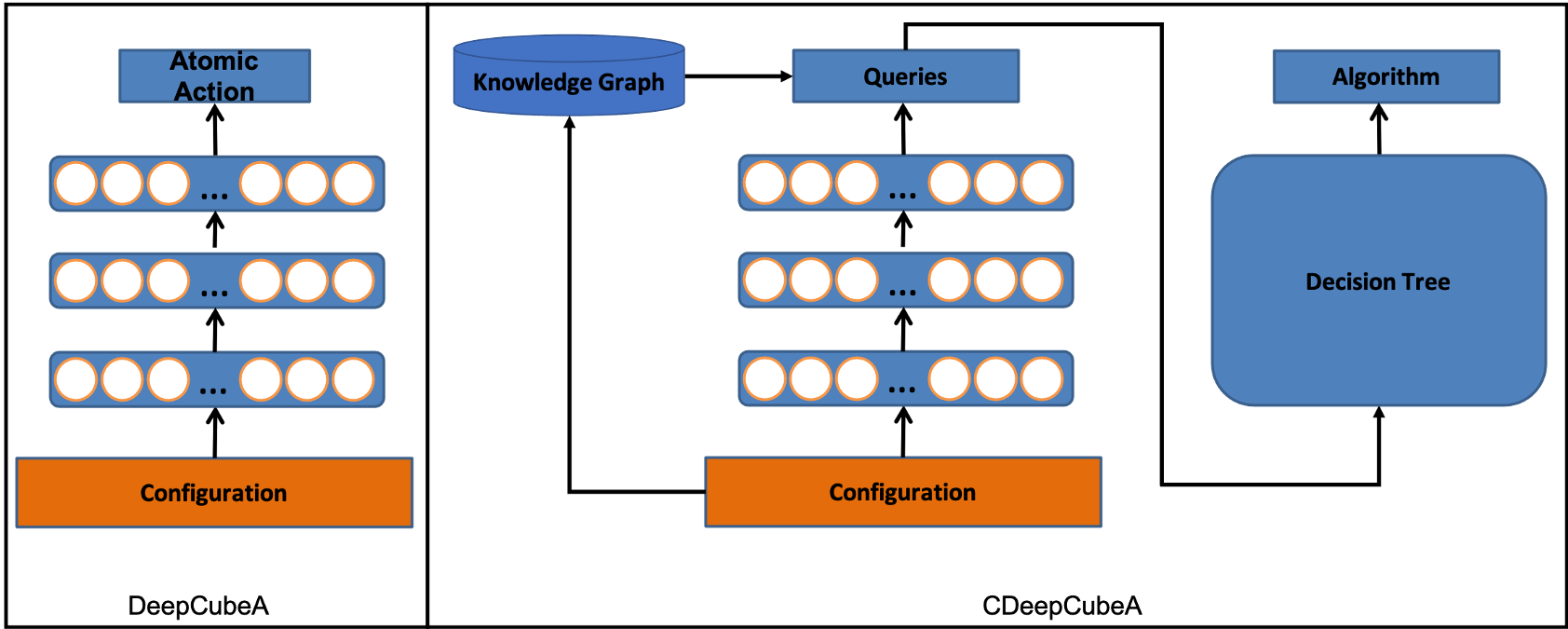 Figure 1: Comparison between the uninterpretable DeepCubeA (left) and the explainable, query-based CDeepCubeA (right).
Human-AI Interaction & UI Design
The system isn't just a solver; it's a conversation. Through a web-based interface and a chatbot, children can:
- Suggest Plans: A child can say, "Let's solve the corners first," and the AI assesses if that plan is feasible.
- Receive Feedback: If a plan is too difficult, the AI suggests intermediate subgoals or alternative algorithms.
- Visual Learning: The UI provides real-time visual cues on the 3D cube to illustrate the "intuition" behind an algorithm (e.g., highlighting how three edge pieces are being swapped).
 Figure 2: A sequence of subgoals in a layer-wise plan, making the complex task manageable for a learner.
Critical Analysis & Conclusion
Takeaway: CDeepCubeA represents a shift in AI design philosophy—moving from AI as a Tool (which provides an answer) to AI as a Partner (which facilitates learning). By leveraging symbolic logic (Knowledge Graphs) alongside neural learning, the researchers have created a blueprint for explainable education technology.
Limitations: Currently, the system supports English-speaking users and focuses specifically on the Rubik's Cube. The scalability of the Knowledge Graph approach to more "open-ended" problems remains a challenge, as the queries must be pre-defined or scraped from expert websites.
Future Work: The team plans to conduct extensive usability testing with students to measure the actual improvement in "algorithmic thinking" skills, potentially expanding the framework to other domains of discrete mathematics and computer science education.