
Beyond Friend Requests: Designing Efficient Implicit Social Networks from Rating Data
Designing and connectivity checking of implicit social networks from the user-item rating data
This paper introduces methodologies for designing and connectivity checking of Implicit Social Networks (ISN) from bibartite user-item rating data. The author proposes a concurrent approach for simultaneous network construction and connected component identification, achieving superior performance on SOTA datasets like Movielens and Epinions.
TL;DR
In the world of E-commerce, you are who you buy. This paper by Suman Banerjee dives into the mechanics of Implicit Social Networks (ISNs)—structures where users are connected not by explicit "friendship," but by shared consumption patterns. The core contribution is a set of high-efficiency algorithms that can build these networks and identify their connected components (clusters of similar users) simultaneously, bypassing the computational bottlenecks of traditional graph projection.
Background: The Power of Implicit Connections
Why care about implicit networks? Explicit networks (like Facebook) are user-defined and often limited by privacy settings. Implicit networks, however, are owned by the platform and map actual behavior. If User A and User B both highly rate an obscure sci-fi novel, they share a "tie." These ties are goldmines for Viral Marketing and Influence Maximization, but there is a catch: generating a network from millions of ratings is computationally "expensive."
The Bottleneck: Why Simple Projection Fails
The standard way to build an ISN is through bipartite projection. However, the author identifies two major hurdles:
- Search Complexity: Exhaustively checking every user pair () for a common item is a nightmare as the user base grows.
- Redundant Traversal: Usually, developers build the graph first and then run BFS (Breadth-First Search) to find clusters. This "Sequential Approach" reads the same data twice.
Methodology: The "Concurrent" Breakthrough
The paper proposes three design algorithms—Exhaustive Search, Clique Addition, and Matrix Multiplication—but the real star is the Concurrent Approach (Algorithm 5).
1. The Clique Intuition
The "Clique Addition" logic recognizes that every item in a rating database acts as a nucleus. Every user who rated that item forms a "clique" (a fully connected sub-graph) in the implicit network.
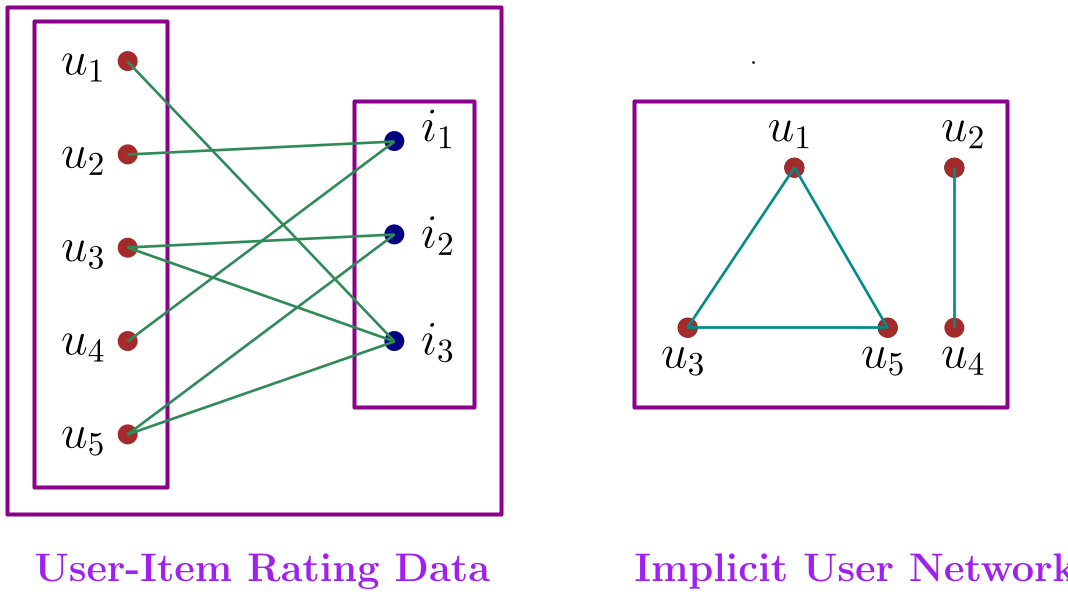
2. Simultaneous Connectivity Checking
Instead of building the whole adjacency matrix and then searching it, Algorithm 5 uses a Status Vector. As it processes a user, it finds all linked items, marks them, and immediately explores all other users connected to those items.
- Why it works: It builds the connected component "on the fly." Once an item's clique is added, it’s never processed again.
- Complexity: It manages to keep space requirements at while speeding up the temporal execution by avoiding the second pass of a standard BFS.
Experiments & Results
The author tested these theories on the Filmtrust, MovieLens, and Epinions datasets.
The Death of Exhaustive Search
On the Filmtrust dataset, the "Exhaustive Search" took over 4000 seconds. In contrast, the "Clique Addition" approach finished in 356 seconds. The difference grows exponentially with dataset size.
Sequential vs. Concurrent
The findings confirm that the Concurrent Approach is consistently faster across all datasets.
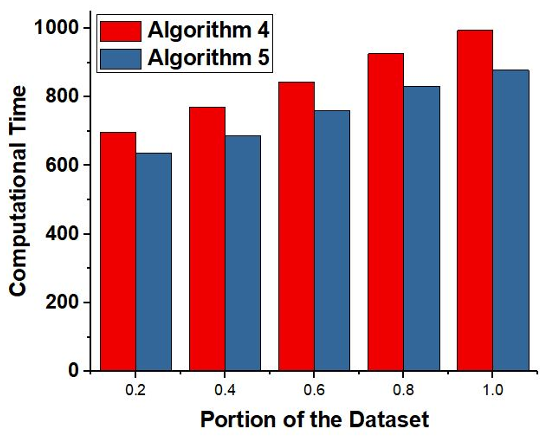
In the figure above (Fig 3a, 3b, 3c), the green line (Concurrent) consistently stays below the blue line (Sequential), proving that "doing two things at once" is mathematically better here.
Critical Insight & Conclusion
Takeaway
The implicit social network is often denser than the sparse rating data it comes from. This "Sparsity-Density Paradox" means that efficient algorithms must focus on processing items (the bridges) rather than users (the nodes).
Limitations
While the algorithms are efficient, they treat all ratings as binary (liked/not liked). Real-world applications might need to consider Weight Adjustment—two users who both gave a movie 1 star are "similar" in their dislikes, but perhaps not in the same way as two users who gave it 5 stars.
Future Outlook
This work lays the plumbing for more advanced Social Recommendation Engines. By knowing the connected components of an implicit network, a marketer can identify "Seed Users" who can trigger information cascades across the entire component, maximizing the ROI of digital advertising.